
The IRS no longer picks audit targets by hand. AI in tax audits scores millions of returns simultaneously, flagging risk patterns no human examiner could catch manually. As of June 2025, the agency runs 126 active AI applications, up from just 10 in 2022, per a March 2026 GAO report. If your return carries digital assets, offshore accounts, partnership income, or large business deductions, an algorithm has already reviewed it.
| Key Takeaways126 active IRS AI applications as of June 2025 (GAO, March 2026)12% enforcement revenue rise in FY2026’s first five months, despite a 25% staff cut$696 billion tax gap in 2022; AI-powered tax enforcement is the IRS’s primary tool to close itLPC AI tax audit selection targeted 76 mega-partnerships in 2024; 3,600+ audits are planned for 2025GAO: algorithmic bias drives 3-5x higher audit rates for Black taxpayersForm 1099-DA (2025) makes crypto underreporting automatically detectable |
The Transition to Tax Administration 3.0: High-Tech IRS Enforcement
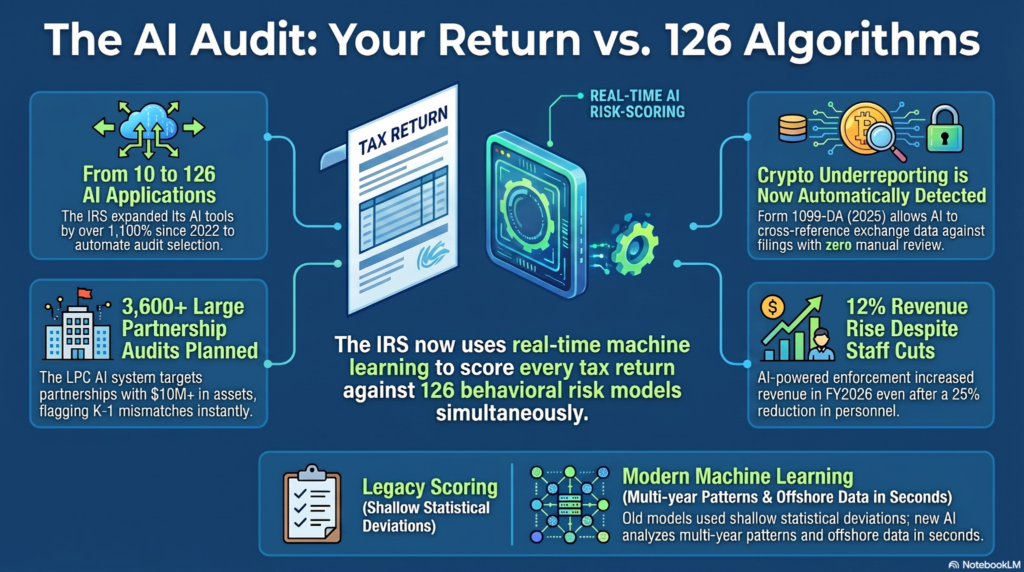
The IRS completed a major technology shift, moving from rule-based scoring to real-time tax compliance technology across 126 behavioral risk models. IRS audit algorithms now do in seconds what used to take examiners weeks. The agency’s IT division and RAAS (Research, Applied Analytics and Statistics) unit spent $58 million on AI in fiscal year 2025, with $32 million more projected for 2026.
How the IRS Shifted from Legacy Scoring to Modern Machine Learning Models
The IRS launched AI-powered tax enforcement in 1986 with the Discriminant Income Function (DIF), a statistical model that ranked returns by income-bracket deviations. DIF worked but ran shallow, and by 2022, the agency still had only 10 active AI applications.
Newer systems simultaneously analyze income, deductions, industry codes, entity structures, third-party data, and multi-year filing patterns. IRS CEO Frank Bisignano credited this tax compliance technology shift for a 12% enforcement revenue increase in the first five months of FY2026, despite cutting staff from 103,000 to 77,000 employees.
Understanding the Processing Scale of Over 125 Active AI Risk Profiles
AI tax audit selection runs simultaneous risk scoring across every return filed. Of the 126 AI applications GAO catalogued, 27 focus specifically on enforcement and automated audit selection. Data inputs include W-2s, 1099s, K-1s, Form 8938, Schedule C, crypto exchange reports, and foreign financial institution records under FATCA.
How AI Tax Audit Selection Operates
AI in tax audits targets four high-risk categories: large corporations, complex partnerships, high-wealth individuals, and digital asset users. Automated audit selection no longer relies on random sampling or basic income scoring.
The Large Partnership Compliance (LPC) System: Automated High-Value Tracking
The Large Partnership Compliance (LPC) system is an AI in a tax audit program that identifies audit targets among partnerships with $10 million or more in assets. In late 2024, LPC selected 76 of the largest U.S. partnerships for examination, with plans to expand to 3,600+ audits in 2025, per IRS LB&I division guidance.
LPC flags K-1 allocation mismatches, basis inconsistencies, disguised sales, and unreported income in related-party structures. A single K-1 discrepancy can trigger AI-powered tax enforcement action on the full partnership.
Line Anomaly Recommenders: Uncovering Hidden Corporate Discrepancies
Line anomaly recommenders are AI tools that compare line-item entries against industry-specific baselines. If a corporation’s meal deductions run 4x the industry average, or depreciation claims don’t match asset values, the model flags it. In our practice, IRS audits fire most often when business deductions appear inflated relative to gross income.
Digital Asset Data Mining: Automated Audits for Cryptocurrency and Form 1099-DA
Reporting for cryptocurrency is now mandatory via Form 1099-DA, which the IRS introduced in 2025. AI-powered tax enforcement cross-references crypto exchange data directly against Schedule D filings. If gains are underreported, data sharing triggers IRS audits automatically through the IRS Digital Asset Compliance program, with zero manual review at the detection stage.
What Triggers an Automated Audit Selection Query?
IRS audit algorithms and modern tax compliance technology flag returns based on deviation from expected statistical patterns. Seven categories generate the most AI tax audit selection queries: income-to-deduction outliers, unreported third-party income, multi-year inconsistencies, offshore account gaps, digital asset underreporting, inflated business losses, and foreign income omissions.
Identifying Multi-Year Trend Inconsistencies and Anomalous Variance Metrics
The IRS compares three to five years of filed returns. A sharp income drop with no business event, or a sudden spike in charitable deductions without prior history, both register as anomalies. AI in tax audits escalates returns above a risk threshold for human review. One inconsistent year can pull prior returns into scope, which is why clean multi-year filing history now functions as active audit protection.
Third-Party Mismatches: Cross-Referencing K-1 Data and Corporate Streams
When a W-2, 1099, or K-1 doesn’t match reported figures, IRS audit algorithms flag it instantly. The IRS collects data from employers, banks, brokers, crypto exchanges, and foreign institutions under FATCA. This data sharing triggers IRS audits before most taxpayers realize there’s a mismatch. IRS audits for foreign income increased sharply once FATCA reached full capacity, because tax compliance technology now surfaces Form 8938 mismatches automatically.
Algorithmic Deficiencies: The Risk of Error and Bias in Automated Audits
IRS audit algorithms are not perfect, and neither is automated audit selection. The March 2026 GAO report confirmed 61% of 126 AI applications were still in development, and it identified unintentional bias as a documented risk. Black taxpayers face audit rates 3 to 5 times higher than comparable filers, driven by patterns in historical training data.
Why Historical Data Biases Can Trigger Unwarranted Flags for Taxpayers
AI tax audit selection trained on biased historical outcomes reproduces those biases automatically. A taxpayer who legitimately claims the Earned Income Tax Credit may still score high-risk because AI in tax audits associates that credit line with historical noncompliance. A May 2025 TIGTA report confirmed AI-powered tax enforcement case selections often lack adequate human oversight.
The Critical Importance of Human Legal Oversight When Algorithms Fail
When an algorithm flags your return incorrectly, standard tax software gives you nothing. Tax compliance technology should support human judgment, not replace it. Legal representation that knows how the flag was generated and how to challenge it through IRS Appeals or Tax Court is the only effective response.
Proactive Defense Layouts: Adapting to Modern Tax Compliance Technology
The best defense against AI in tax audits is building a file that preemptively answers every question AI-powered tax enforcement models might raise. Documentation built before filing protects you; documentation assembled after a notice arrives rarely does. Automated audit selection moves fast, and your defense needs to be ready before the notice arrives.
Building Contemporaneous Documentation Proof to Neutralize Risk Flags
Contemporaneous documentation means records created at the time of each transaction. Business receipts, agreements, valuation appraisals, and income statements should stay organized. Clean paper trail evidence reduces scrutiny when a human reviewer steps in after an AI tax audit selection flag.
How Pre-Filing Risk Scoring Minimizes Exposure to IRS Audit Algorithms
Pre-filing risk review means having a tax attorney analyze your return before submission, using the same AI tax audit selection scoring logic. This catches deduction combinations that flag, income formats that trigger mismatch queries, and Form 8938 filing mistakes that create IRS audit triggers immediately. We typically recommend this for clients with foreign accounts, crypto holdings, partnership income, or losses above $100,000.
Defend Your Position: Strategic Tax Counsel in an Era of AI Enforcement
AI-powered tax enforcement operates faster than most taxpayers can react. The window between filing and audit selection has compressed. IRS agents expand audits quickly once AI in tax audits flags a return, pulling prior years and related entities.
How Advanced Legal Privilege from Verni Tax Law Beats Standard Tax Preparation Software
Verni Tax Law gives you something no software can: attorney-client privilege. Anthony N. Verni is a Tax Attorney, CPA, and MBA with 25+ years of IRS experience, serving clients across New Jersey, New York City, and South Florida.
Standard tax software flags obvious errors. AI-powered tax enforcement, however, scores your return against 126 behavioral risk models simultaneously. Software cannot replicate that analysis, nor does it identify FBAR reporting gaps or help you avoid FATCA penalties before they attach. Anthony N. Verni does all three. His dual credentials, attorney and CPA, let him review your tax position at both the legal and financial levels.
His offshore compliance experience means he knows exactly where automated audit selection models look first: IRS audits for foreign income, missed FBAR filings, and Form 8938 filing mistakes. If you need to file late FBARs, resolve offshore exposure, or correct prior Form 8938 filing mistakes, talk to Anthony N. Verni now.
Your Financial Future Is Under Algorithmic Scrutiny
The IRS runs 126 AI applications that score every filed return against risk models built on billions of data points. IRS agents expand audits quickly once a flag fires, often pulling three to five prior years into scope. The tax gap hit $696 billion in 2022, and AI-powered tax enforcement is the answer. Returns with digital assets, offshore accounts, partnership income, or large deductions face algorithmic scrutiny before any human examiner looks.
Anthony N. Verni brings IRS litigation experience, CPA-level analysis, and deep FATCA, FBAR, and tax compliance technology fluency to defend taxpayers under algorithmic scrutiny. We help you avoid FATCA penalties, resolve FBAR exposure, and get ahead of audit flags before they escalate. Contact Verni Tax Law today to protect your position before an algorithm decides it for you.
FAQs
How does the IRS implement AI tax audit selection for high-net-worth filings?
AI tax audit selection scores high-wealth returns across income patterns, deduction ratios, offshore data, and multi-year trends; returns above the risk threshold are routed to a human examiner.
What are the primary triggers detected by modern IRS audit algorithms?
Third-party data mismatches, unreported digital asset gains, K-1 discrepancies, inflated business losses, and foreign income omissions are the top five IRS audit triggers as of 2026.
Can a taxpayer appeal an automated audit selection determination?
Yes. Taxpayers challenge automated audit selection through IRS Appeals, Tax Court, or by presenting documentation that contradicts the flagged risk factors.
How is business tax compliance technology changing to counter machine-learning audits?
Tax attorneys run pre-filing analysis using tax compliance technology that mirrors AI in tax audits scoring logic, catching deduction patterns and mismatches before the return reaches the IRS.
Does utilizing cryptocurrency increase exposure to AI-powered tax enforcement tracking?
Yes. Form 1099-DA launched in 2025, and reporting for cryptocurrency is cross-referenced automatically against every Schedule D; unreported gains surface without any manual review.
What should I do if a structural anomaly triggers an automated AI in a tax audit notice?
Preserve all records immediately and contact a tax attorney before responding. IRS audit algorithms can flag returns incorrectly, and early legal counsel determines whether the flag is accurate.