

A civil fraud finding costs you 75% of the underpayment. A criminal conviction costs your freedom. The same unreported crypto trade can lead to either outcome, and the split usually comes down to one thing: whether the IRS can prove you acted willfully.
In this blog, we will explain the key signs, common IRS triggers, and how crypto tax evasion cases move from audits to criminal exposure.
Key Takeaways
Civil fraud under IRC 6663 adds a 75% penalty, proven by clear and convincing evidence.Criminal tax evasion under 26 U.S.C. § 7201 needs proof beyond a reasonable doubt, up to 5 years in prison, and fines up to $250,000 for individuals.IRS-CI opened 2,667 criminal investigations in fiscal year 2024 with a 90% conviction rate.The DOJ dissolved its Tax Division on December 9, 2025; criminal tax cases now go through the Criminal Division’s Tax Section.Pure crypto on a foreign exchange isn’t currently FBAR-reportable under FinCEN Notice 2020-2, but hybrid accounts holding crypto plus fiat are, once combined value tops $10,000.
Why Crypto Tax Cases Are Receiving Greater IRS and DOJ Scrutiny
Crypto tax evasion cases are drawing federal attention because the IRS finally has the data to match wallets to real names. Operation Hidden Treasure pairs civil examiners with IRS-CI agents to find unreported digital asset income, using blockchain forensics to trace pseudonymous wallets back to exchange KYC records.
- John Doe summonses have forced major exchanges to hand over data for accounts trading as little as $20,000 over several years.
- Starting with 2025 activity, digital asset brokers must report gross proceeds, closing the old reporting gap.
- The 2024 Frank Ahlgren III conviction was IRS-CI’s first “pure tax” win, evasion as the only charge filed.
Understanding Willfulness in Crypto Tax Cases
Willfulness decides whether your case stays civil or turns criminal. The IRS defines it as “the voluntary, intentional violation of a known legal duty.” In Cheek v. United States, the Supreme Court ruled that a genuine, good-faith misunderstanding of tax law defeats willfulness. Proving the right willfulness standards matters more than the size of an unreported gain.
Recklessness vs Intentional Conduct
Recklessness rarely meets the willfulness standards criminal cases require; prosecutors need a deliberate choice to break a known duty. A misunderstood 1099-DA form usually draws a 20% negligence penalty under IRC 6662, not fraud. Deliberately hiding an exchange looks very different.
Common Evidence Used to Prove Intent
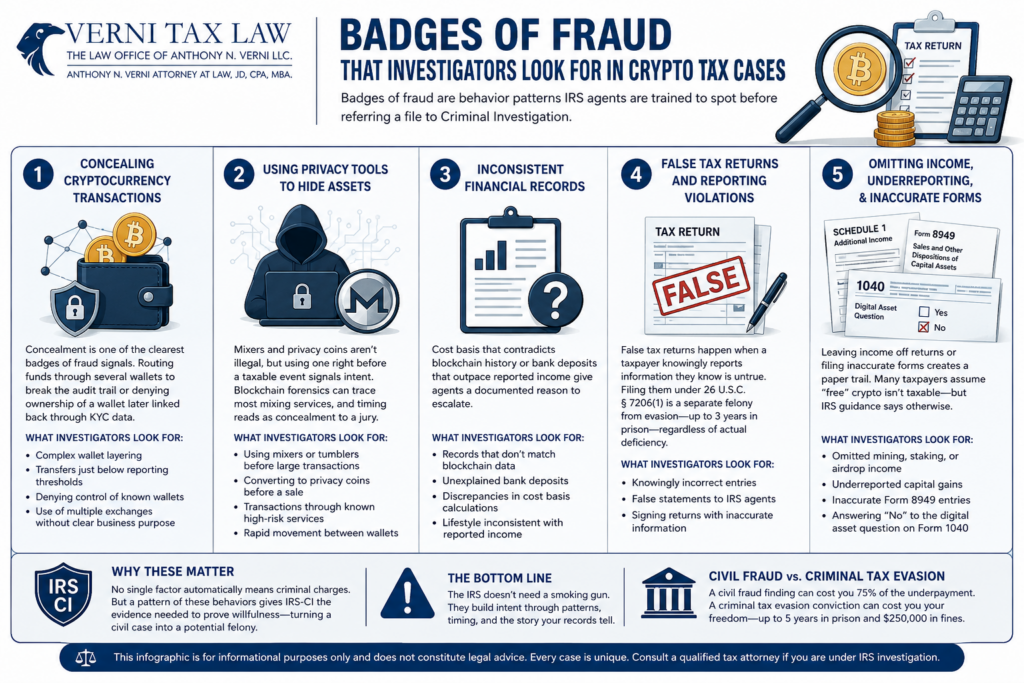
Investigators rarely find a confession, so intent gets built from circumstantial evidence:
- Underreporting crypto gains across multiple tax years
- Contradictory statements made during an audit
- Mixer use timed right before a taxable sale
Badges of Fraud That Investigators Look For
Badges of fraud are behavior patterns IRS agents are trained to spot before referring a file to Criminal Investigation.
Concealing Cryptocurrency Transactions
Concealment is one of the clearest badges of fraud signals, routing funds through several wallets to break the audit trail or denying ownership of a wallet later linked back through KYC data.
Using Privacy Tools to Hide Assets
Mixers and privacy coins aren’t illegal, but using one right before a taxable event signals intent. Blockchain forensics can trace most mixing services, and timing reads as concealment to a jury.
Inconsistent Financial Records
Cost basis that contradicts blockchain history or bank deposits that outpace reported income give agents a documented reason to escalate.
False Tax Returns and Reporting Violations
False tax returns happen when a taxpayer knowingly reports information they know is untrue. Filing them under 26 U.S.C. § 7206(1) is a separate felony from evasion, up to 3 years in prison, regardless of whether the government proves an actual deficiency.
Omitting Crypto Income
Leaving mining rewards, staking income, or airdrops off Schedule 1 is common, since many taxpayers assume “free” crypto isn’t taxable. IRS guidance treats these as ordinary income at fair market value when received.
Underreporting Capital Gains
This usually happens through selective reporting, listing losing trades while omitting profitable exits, or using a method like HIFO without records to support it. Broker-issued 1099-DA forms are closing this gap fast.
Filing Inaccurate Tax Forms
Errors on Form 8949 or the digital asset question on Form 1040 build a paper trail. Answering “no” to that question while holding an active exchange account can turn a routine audit into a fraud referral fast.
When Civil Audits Become Criminal Investigations
A civil audit turns criminal the moment an agent finds a firm fraud indicator, which by policy requires suspending the civil case and referring it to IRS-CI. This is one of the parallel investigations the IRS coordinates between its civil and criminal sides, and once accepted, the audit usually goes quiet.
- The auditor stops requesting documents for weeks at a time
- A summons goes to a bank or exchange without explanation
Triggers That Escalate a Case
The clearest triggers are lying to an agent, a second set of records, mixer use timed to a sale, and noncompliance spanning several years. One innocent mistake rarely escalates a case; a documented pattern almost always does.
Common Scenarios That Increase Criminal Exposure
Holding crypto abroad raises offshore tax evasion exposure once the IRS shows the account hid income. FinCEN Notice 2020-2 confirms pure virtual currency accounts aren’t currently FBAR-reportable, but hybrid accounts with crypto plus fiat are, once the combined value passes $10,000, central to FBAR reporting for cryptocurrency.
Use of Mixers and Privacy Coins
Layering funds through a mixer already flagged by IRS-CI, like the platform behind the 2025 Samourai Wallet prosecution, reads as concealment, not a privacy choice.
Repeated Noncompliance Across Tax Years
Skipping crypto reporting once looks like an error. Skipping it for three or four straight years, especially after an IRS letter like a 6173 or 6174, becomes one of the crypto tax evasion case patterns prosecutors treat as willful by default.
Civil Penalties vs Criminal Penalties
The table below compares the civil and criminal tracks. The table shows why civil fraud is costly but survivable, while a conviction adds prison time and a felony record to the same tax evasion penalties.
| Factor | Civil Fraud | Criminal Tax Evasion |
| Burden of proof | Clear and convincing evidence | Beyond a reasonable doubt |
| Governing law | IRC 6663 | 26 U.S.C. § 7201 |
| Penalty | 75% of the underpayment | Up to 5 years, fine up to $250,000 |
| Prosecuted by | IRS Office of Fraud Enforcement | DOJ Criminal Division, Tax Section |
| Statute of limitations | None, for fraud | 6 years |
Civil Fraud Penalties
The civil fraud penalty adds 75% of the underpayment tied to fraud, plus interest from the original due date. Once the IRS proves fraud on any part, the whole balance is presumed fraudulent unless the taxpayer proves otherwise.
Criminal Tax Evasion Consequences
A Section 7201 conviction is a felony with no federal expungement option. It typically triggers restitution and a parallel civil fraud assessment for the same conduct.
Potential Prison Sentences and Fines
Sentences scale with tax loss under federal guidelines; once loss crosses $550,000, probation becomes unavailable. Ahlgren received two years for roughly $4 million in unreported Bitcoin gains and over $1 million in restitution.
How Taxpayers Can Reduce Legal Risk
Coming forward before the IRS opens an audit is the single most effective move, since voluntary disclosure made before contact sharply lowers prosecution risk.
- Amend prior returns to fix omitted crypto income before any IRS notice arrives
- Avoid a quiet disclosure; the risks of quiet disclosure include the IRS reading a silent fix as proof of willfulness once discovered
- Contact a criminal tax defense attorney before responding to any IRS letter mentioning crypto
How Verni Tax Law Helps in Crypto Tax Defense
Anthony N. Verni will help you build a defense the moment a crypto audit shows signs of turning criminal, drawing on more than 25 years in crypto tax evasion cases as both an attorney and a CPA. He has represented clients through civil fraud exams, criminal referrals, and offshore disclosure since 2009, reviewing your transaction history before the IRS finishes its own analysis so weak spots get fixed first.
Delay is the one variable you still control. Book a confidential consultation with Anthony N. Verni before your next IRS letter arrives.
Audit and Investigation Representation
He represents you directly in civil exams and IRS-CI interviews, closing off the offhand statement agents later use as a badge of fraud.
He engages IRS-CI and DOJ prosecutors before an indictment, the strongest window to keep parallel investigations from turning fully criminal. His civil tax litigation background lets him pursue a civil resolution instead of letting a case drift toward prosecution.
Guidance for High-Net-Worth Crypto Investors
He advises high-net-worth crypto holders on FBAR reporting for cryptocurrency, FATCA thresholds, and offshore voluntary disclosure before a foreign account becomes a liability.
Understanding the Line Between Civil and Criminal Liability
Willfulness, not the size of an unreported gain, decides whether a crypto tax problem stays civil or becomes a federal prosecution. Badges of fraud and false tax returns are proof points for intent, not technicalities to explain away later.
Anthony N. Verni from Verni Tax Law turns that evidence into a defense, reviewing your transaction history with the same scrutiny IRS-CI applies, before the government finishes its file. A criminal tax defense attorney engaged early is often the difference between a costly civil case and a federal indictment. Contact Verni Tax Law today for a confidential review of your crypto tax exposure.
FAQs
What is willfulness in a crypto tax investigation?
Willfulness means the voluntary, intentional violation of a known legal duty. A genuine misunderstanding of crypto tax rules defeats it under Cheek v. United States.
What are badges of fraud in IRS investigations?
They’re behavior patterns, like concealed wallets, false statements, and structured transfers, that agents treat as circumstantial evidence of intent.
Can filing a false crypto tax return lead to criminal charges?
Yes. Filing false tax returns under 26 U.S.C. § 7206(1) is a felony carrying up to 3 years in prison, separate from evasion charges.
What is the difference between civil fraud and criminal tax evasion?
Civil fraud needs clear and convincing evidence and adds a 75% penalty. Criminal evasion needs proof beyond a reasonable doubt and risks prison.
What are parallel investigations by the IRS and DOJ?
Parallel investigations run simultaneous civil and criminal review of one taxpayer, coordinated so civil discovery doesn’t compromise the criminal case.
Can unreported cryptocurrency income result in prosecution?
Yes. Frank Ahlgren III received two years in prison in 2024 for hiding roughly $4 million in Bitcoin gains, with no other charges attached.
How does the IRS prove intent in crypto tax cases?
Through circumstantial evidence: contradictory statements, mixer use timed to sales, structured transfers, and multi-year underreporting patterns.
Can amended tax returns reduce criminal exposure?
Yes, if filed voluntarily before the IRS opens an audit or investigation. Amending after IRS-CI contact carries far less protective value.
When should I hire a criminal tax defense attorney?
Hire one the moment a civil audit goes silent, a summons is issued, or an agent starts asking about intent instead of numbers.
How can Verni Tax Law help defend crypto tax investigations?
Anthony N. Verni represents clients directly in IRS civil and criminal crypto proceedings, structuring privileged defense strategy before charges are filed.