
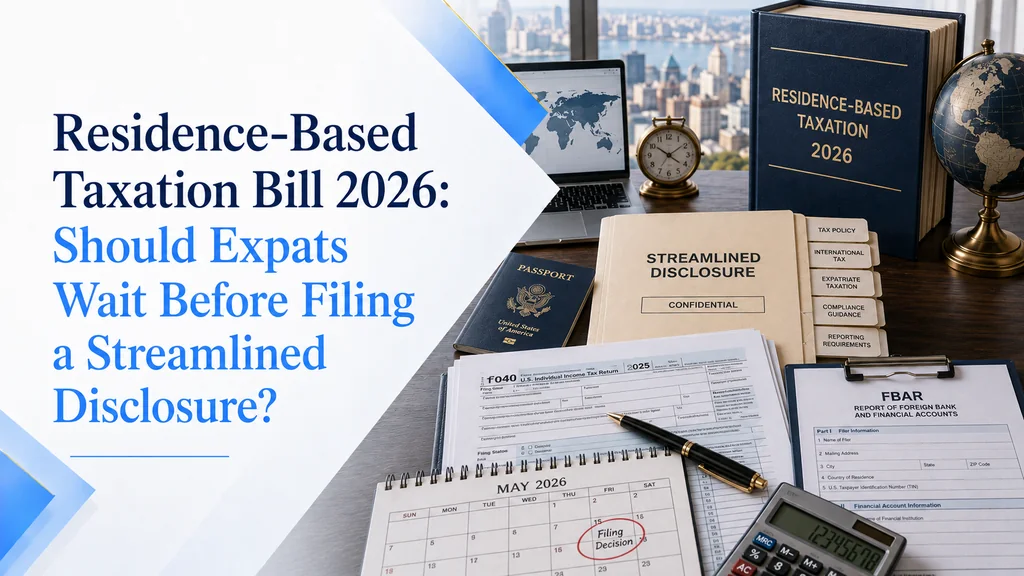
Waiting for the residence-based taxation bill before filing a streamlined disclosure is not the right move for most expats. The Residence-Based Taxation for Americans Abroad Act, first introduced as H.R. 10468, expired when the 118th Congress ended in January 2025 and has not been reintroduced. Meanwhile, the IRS Streamlined Filing Compliance rules for non-willful taxpayers are active right now, and every year you delay adds another year of exposure to FBAR and FATCA penalties under current law.
This article separates what Congress has proposed from what the IRS already allows you to do. We also walk through who qualifies for Streamlined Filing Compliance, what the 330-day nonresidency test actually requires, and why a residence-based taxation attorney expats trust will almost always tell you to fix your filing history before any bill becomes law.
Key Takeaways
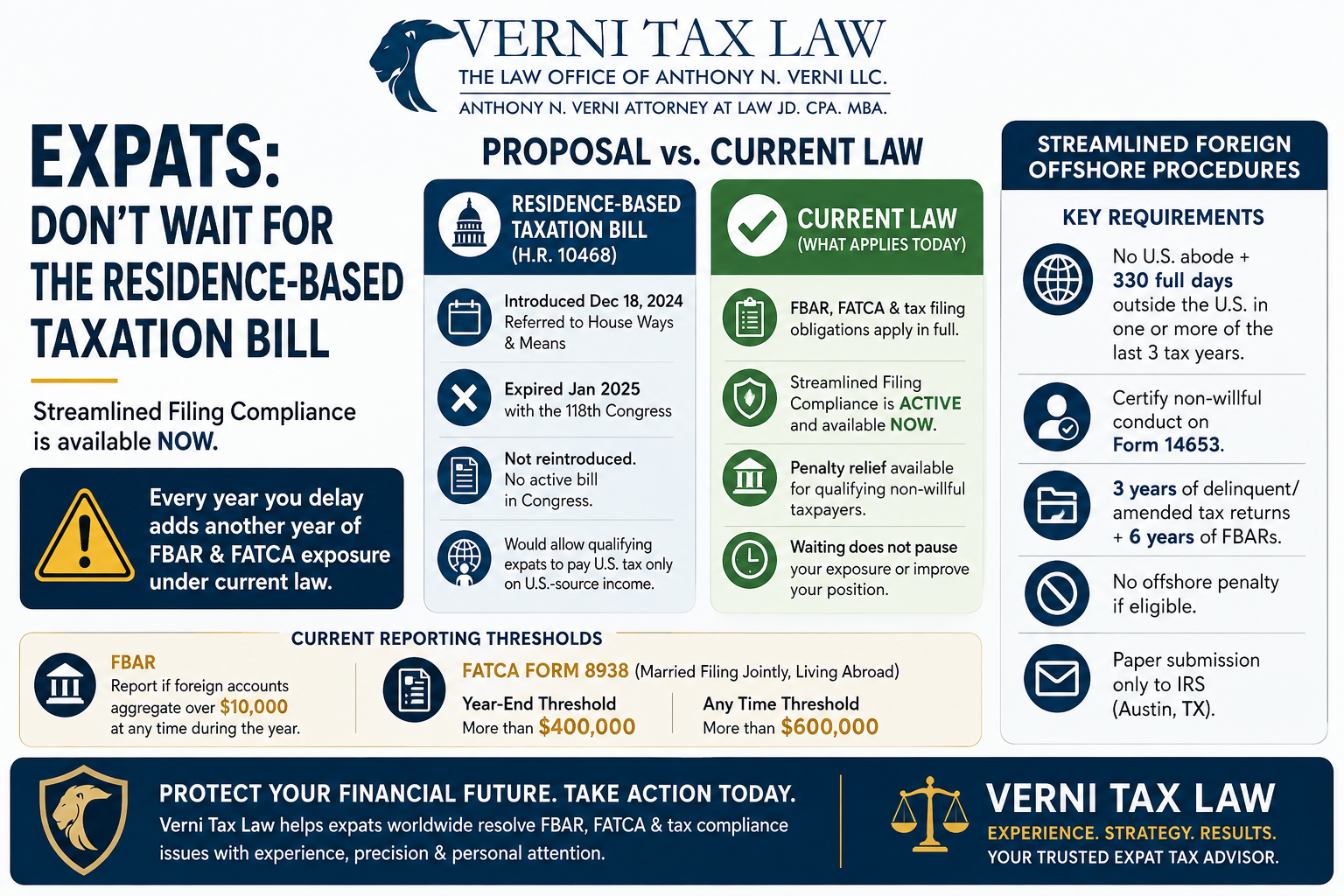
- H.R. 10468 (the LaHood bill) was introduced December 18, 2024, referred to House Ways and Means, and expired with the 118th Congress in January 2025.
- As of this writing, no updated bill has been reintroduced; sponsors are still waiting on a Joint Committee on Taxation revenue score.
- The Streamlined Foreign Offshore Procedures currently waive FBAR, failure-to-file, and accuracy-related penalties for qualifying non-willful taxpayers.
- The 330-day physical presence test for Streamlined is not the same test used for the Foreign Earned Income Exclusion under IRC Section 911.
- FBAR covers accounts over $10,000 aggregate; Form 8938 thresholds for married expats filing jointly are $400,000 (year-end) or $600,000 (any time).
- Nothing in current law suspends your filing obligations while Congress debates reform.
Is the Residence-Based Taxation Bill Actually Law in 2026, or Are Expats Waiting for a Proposal?
The Residence-Based Taxation for Americans Abroad Act is a proposal, not current law, and it does not currently even have active bill status in Congress. Rep. Darin LaHood (R-IL) introduced it as H.R. 10468 on December 18, 2024, and it was referred to the House Committee on Ways and Means that same day. Because it was introduced so late in the 118th Congress, it never advanced past that referral, and the bill expired automatically when that Congress adjourned in January 2025.
A bill, an introduced bill, enacted legislation, IRS guidance, and an available filing procedure are five different things. A bill is a text a member of Congress files. An introduced bill has a number and a committee referral, nothing more. Enacted legislation has passed both chambers and been signed into law. IRS guidance interprets law that already exists. An available filing procedure, like Streamlined, is something you can use today. H.R. 10468 never got past the second stage, and the version now being discussed for reintroduction does not exist as a filed bill yet.
Citizenship-Based vs Residence-Based Taxation
Citizenship-based taxation, the system the United States uses today, taxes citizens on worldwide income regardless of where they live. Residence-based taxation would tax people based on where they actually reside, similar to how nearly every other country structures its tax code.
The LaHood proposal would let qualifying Americans abroad elect nonresident status and pay U.S. tax only on U.S.-source income, such as dividends from American stocks or rental income from U.S. property. Citizenship-based taxation reform 2026 discussions have gained traction in Congress, but the current system remains fully in force for every U.S. citizen and green card holder living overseas.
Current Status of the LaHood Bill
Sponsors LaHood and Senator Todd Young (R-IN) have said publicly that a revised version, addressing trust and Byrd Rule concerns flagged during technical review, is being prepared for the 119th Congress. Advocacy groups tracking the bill report that reintroduction has been anticipated multiple times since early 2025 without a formal filing. Residence-based taxation was also not included in the One Big Beautiful Bill Act. Until a new bill number appears on Congress.gov, there is no pending residence-based taxation legislation to wait for.
How the Proposed Bill Could Affect Americans Living Abroad
If enacted as drafted, the bill would let qualifying nonresident citizens exclude foreign-source income from U.S. tax while keeping U.S.-source income taxable. It would also modify certain FBAR and FATCA obligations for taxpayers who make the election, according to the bill's original text and analysis published by expat advocacy organizations.
Reduced Worldwide Tax Obligations
The bill's core mechanism is an election, not an automatic exemption. A taxpayer would need to affirmatively choose nonresident status and meet residency requirements before foreign-source income would fall outside U.S. taxation. U.S.-source income, including Social Security benefits sourced from U.S. work history, would remain taxable regardless of the election.
Changes to FBAR and FATCA Reporting
Early drafts and advocacy summaries describe lahood bill FBAR and FATCA relief provisions that would ease reporting for electing taxpayers on certain foreign accounts. That relief does not exist under current law. FBAR and Form 8938 obligations apply in full to every U.S. person today, regardless of where the bill stands.
Potential Eligibility Requirements
Reported eligibility concepts include a bona fide foreign tax residency test and a departure-style transition mechanism for long-term expats. These concepts remain unsettled because the bill has not been reintroduced, and any final eligibility language could change again before a vote.
Should Expats Wait Before Filing a Streamlined Disclosure?
No. Waiting for the bill does not pause your existing FBAR or FATCA exposure, and it does not improve your position if the bill stalls again, as it already has once. Non-willful noncompliance carries an increasing risk the longer it remains unresolved, while Streamlined relief is available right now.
Risks of Delaying Your Filing
Every additional year of non-filing extends your FBAR lookback exposure and increases the chance that an unrelated event, a bank inquiry, an inheritance, or a visa application triggers IRS attention before you've acted. Delinquent FBAR penalties can reach into the tens of thousands of dollars per violation for non-willful conduct, and willful penalties run far higher. Once the IRS opens a civil examination on any year, Streamlined eligibility disappears entirely.
Situations Where Filing Now Is the Better Choice
Filing now makes sense if you have unreported foreign accounts, missed FBARs, or unfiled information returns and no IRS contact yet. It also makes sense if your foreign tax residency is already stable and unlikely to change, since a future RBT election would not undo past-due obligations anyway. Delinquent tax return help for expats through Streamlined resolves prior-year exposure independent of whatever Congress eventually decides.
How Streamlined Filing Compliance Procedures Work in 2026
The Streamlined Filing Compliance Procedures let taxpayers whose noncompliance was non-willful catch up on delinquent or amended returns and FBARs without failure-to-file, failure-to-pay, accuracy-related, information return, or FBAR penalties, according to the IRS. Streamlined Filing Compliance has two tracks: the Foreign Offshore Procedures for taxpayers who meet a nonresidency test, and the Domestic Offshore Procedures for U.S. residents, which carries a miscellaneous offshore penalty the foreign track does not.
Eligibility Requirements
You must certify non-willful conduct, have no open IRS civil examination or criminal investigation for the relevant years, and hold a valid Social Security Number or apply for an ITIN with your submission. For the foreign track specifically, U.S. citizens and green card holders must show no U.S. abode and physical presence outside the United States for at least 330 full days in one or more of the three most recent tax years.
Non-Willful Certification
Non-willful conduct is conduct due to negligence, inadvertence, mistake, or a good-faith misunderstanding of the law, per IRS guidance. You certify this on Form 14653, and the statement must be signed and attached to every return and information return submitted under the procedure.
Required Forms and Documentation
The below table summarizes what a foreign-track submission requires. Use it to confirm you have every piece before mailing anything to the IRS.
| Requirement | Foreign Offshore Procedures |
| Delinquent or amended returns | 3 most recent years |
| Delinquent FBARs | 6 most recent years |
| Certification | Form 14653, original signature |
| Offshore penalty | None, if eligible |
| Submission method | Paper only, mailed to Austin, TX |
What Makes a U.S. Expat Eligible for the Streamlined Foreign Offshore Procedures Today?
Eligibility hinges on whether you meet the nonresidency test, and whether your conduct is non-willful. Both must be true, and meeting one does not automatically satisfy the other.
The Nonresidency Test Is More Specific Than Simply Living Outside The United States
For citizens and green card holders, the IRS requires no U.S. abode plus physical presence outside the United States for at least 330 full days in one or more of the applicable three years. "Abode" is not the same as citizenship, voter registration, or where you keep a driver's license. It refers to where your economic, family, and personal ties actually sit.
The 330-Day Test Should Not Be Confused With Foreign Tax Residency Under the Proposed RBT Bill
Streamlined uses its own nonresidency definition, and the proposed RBT bill contemplates a different concept: foreign-country tax residency. The IRS states directly in its FAQs that the reference to IRC Section 911 in the Streamlined rules applies only to the definition of "abode," not to the full nonresidency standard, and that being nonresident under Section 911 does not automatically make you nonresident for Streamlined purposes.
Non-Willfulness Is A Separate Eligibility Question From Physical Presence
You can pass the 330-day test cleanly and still be ineligible if the underlying failure to report was willful. Willfulness turns on intent and awareness, not geography. Hiring a Streamlined FBAR attorney conversation early on typically centers on this exact judgment call, since getting it wrong risks disqualifying an otherwise-eligible submission.
What Happens If the RBT Bill Becomes Law After You File?
Filing correctly today under current rules does not put you at a disadvantage if legislation eventually passes. Compliance obligations are assessed against the law in effect for the year in question, and no version of the RBT proposal reviewed so far claims retroactive effect on already-filed, compliant returns.
Can Previously Filed Returns Be Affected?
There is no provision in the introduced bill text suggesting retroactive reopening of properly filed returns. Congress would need to write that language explicitly, and nothing currently proposed does so.
Possible Future IRS Guidance
If a residence-based taxation law passes, the IRS would need to issue implementing regulations and transition guidance before taxpayers could elect nonresident status. That process alone typically takes a year or more after enactment based on how the agency has handled comparable structural changes.
Will Penalties Be Refunded?
Nothing proposed suggests refunding penalties already assessed under current citizenship-based rules. Waiting in hopes of a retroactive penalty refund is not supported by any language in the bill as introduced.
FBAR and FATCA Reporting Under Current Law
FBAR filing requirements and FATCA obligations apply in full today, with no exception for taxpayers anticipating future legislation.
FBAR Filing Requirements
You must file FinCEN Form 114 if the aggregate value of your foreign financial accounts exceeded $10,000 at any point during the calendar year. The form is due April 15, with an automatic extension to October 15 requiring no separate request. FBAR penalties for non-willful violations run into the tens of thousands of dollars per violation; willful violations carry penalties of the greater of a much higher flat amount or 50% of the account balance, plus potential criminal referral.
FATCA Form 8938 Rules
FATCA compliance and foreign asset reporting requirements apply through Form 8938, attached to your Form 1040. For married expats filing jointly and living abroad, the threshold is more than $400,000 in specified foreign financial assets on the last day of the year, or more than $600,000 at any point during the year, according to the IRS. Single filers abroad face a $200,000 year-end or $300,000 any-time threshold. Failure to file carries a $10,000 penalty that can escalate significantly after IRS notification.
Alternatives to Streamlined Filing
Streamlined is not the only path back into compliance, and it is the wrong path if your conduct was willful.
Voluntary Disclosure Practice
Taxpayers concerned their conduct was willful should consider the IRS Criminal Investigation Voluntary Disclosure Practice instead, which addresses criminal exposure directly but carries a different penalty structure than Streamlined.
Delinquent FBAR Submission Procedures
If you have no unreported income and simply missed FBARs, delinquent FBAR filing procedures outside Streamlined may apply, generally resulting in no penalty when reasonable cause is properly documented.
Delinquent International Information Return Submission Procedures
For missed forms like 3520, 3520-A, or 5471 where all income was properly reported and taxed, this procedure allows late filing with a reasonable cause statement attached to each form, though the IRS notes penalties may still be assessed during initial processing regardless of that statement.
How Verni Tax Law Helps Expats Evaluate Their Options
Verni Tax Law is led directly by Anthony N. Verni, an attorney licensed in New Jersey, the U.S. Tax Court, and U.S. District Courts, who is also a CPA and holds an MBA. He has represented taxpayers through offshore compliance matters since 2009, including through every phase of the former Offshore Voluntary Disclosure Program, and now guides expat clients through Streamlined submissions, delinquent FBAR filings, and FATCA compliance.
Reviews your filing history against the actual 330-day and non-willfulness standards, not assumptions
Determines whether Streamlined FBAR filing, DIIRSP, or Voluntary Disclosure fits your specific facts
Prepares and files FBARs, Form 8938, and delinquent returns directly with the IRS and FinCEN
Represents clients under exam or audit selection after a Streamlined submission
Advises on international tax planning ahead of any future residence-based taxation election
He personally handles every case, and he works with clients worldwide by phone and secure video conference. Book a confidential consultation for more on how a submission is built end-to-end.
Conclusion
Residence-based taxation reform remains a proposal without a bill number in the current Congress, while Streamlined Filing Compliance is an active IRS procedure available today to non-willful taxpayers who meet the 330-day nonresidency test. Waiting for legislative reform does not pause FBAR or FATCA exposure, and no version of the bill reviewed so far promises retroactive relief for penalties assessed under current law. The decision to file now should rest on your actual compliance exposure and eligibility
Anthony N. Verni brings 25 years of combined legal and accounting experience to exactly this kind of eligibility analysis, evaluating each client's filing history against the current IRS rules rather than against a bill that hasn't been reintroduced. His direct, personally handled approach means the person reviewing your FBAR and Form 8938 history is the same person who will represent you if the IRS ever asks questions about it.
If you have unreported foreign accounts or missed international filings, reach out to Anthony N. Verni for a confidential review of where you stand today.
FAQs
What is the Residence-Based Taxation Bill?
It is H.R. 10468, introduced by Rep. Darin LaHood in December 2024, which would let qualifying Americans abroad elect nonresident tax status. It expired in January 2025 and has not been reintroduced.
What is the LaHood Residence-Based Taxation proposal?
It is the working name for the bill that would shift qualifying expats from citizenship-based to residence-based taxation on foreign-source income only. It remains unenacted.
Should I wait to file my taxes if the bill is still pending?
No. The bill is not currently pending in Congress at all, and current FBAR and FATCA obligations apply regardless of its status.
Will the proposed law eliminate FBAR and FATCA reporting?
Not entirely. Drafts describe reporting relief for taxpayers who make the election, but core FBAR and FATCA rules would likely continue for other filers.
Can I still use the Streamlined Filing Compliance Procedures in 2026?
Yes. The IRS confirms these procedures remain active for taxpayers certifying non-willful conduct and meeting the nonresidency requirements.
What happens if I delay filing while waiting for tax reform?
Your FBAR and information-return exposure keeps accumulating, and Streamlined eligibility ends immediately if the IRS opens an examination first.
What's the difference between citizenship-based and residence-based taxation?
Citizenship-based taxation taxes worldwide income regardless of residence; residence-based taxation would tax based on where you actually live, similar to most other countries.
If the bill passes later, will it affect returns I've already filed?
No language in the introduced bill claims retroactive effect on properly filed, compliant returns.
Do I still have to file FBARs under current law?
Yes. Any U.S. person with foreign accounts aggregating over $10,000 at any point in the year must file FinCEN Form 114.
Should I hire an expat tax attorney before making a disclosure?
Generally yes, since non-willfulness determinations carry real consequences, and hiring a streamlined FBAR attorney to review before filing catches issues a DIY submission often misses.