
Form 3520 and Form 3520-A are information returns, not tax returns. They report what happened with a foreign trust or a foreign gift.
You do not have to owe extra U.S. income tax for a penalty to hit. The IRS penalizes the missing paperwork itself.
You should check your filing history if you transferred money or property to a foreign trust, received a distribution, benefit, or use of assets from a foreign trust, or were treated as the U.S. owner of a foreign trust under IRS ownership rules.
| Key TakeawaysForm 3520 penalties start at the greater of $10,000 or 35% of the transferred or distributed amount for trust transactions.Form 3520-A owner-level penalties start at the greater of $10,000 or 5% of trust assets you’re treated as owning.Missed foreign gift reporting (Part IV) costs 5% of the gift per month, capped at 25%.Penalties keep adding $10,000 for every 30 days you stay noncompliant after an IRS notice.The IRS’s own National Taxpayer Advocate reported an average foreign gift penalty above $235,000 between 2018 and 2021.Reasonable cause can remove the penalty, but a foreign trustee’s silence does not count as reasonable cause on its own. |
What Are Forms 3520 and 3520-A?
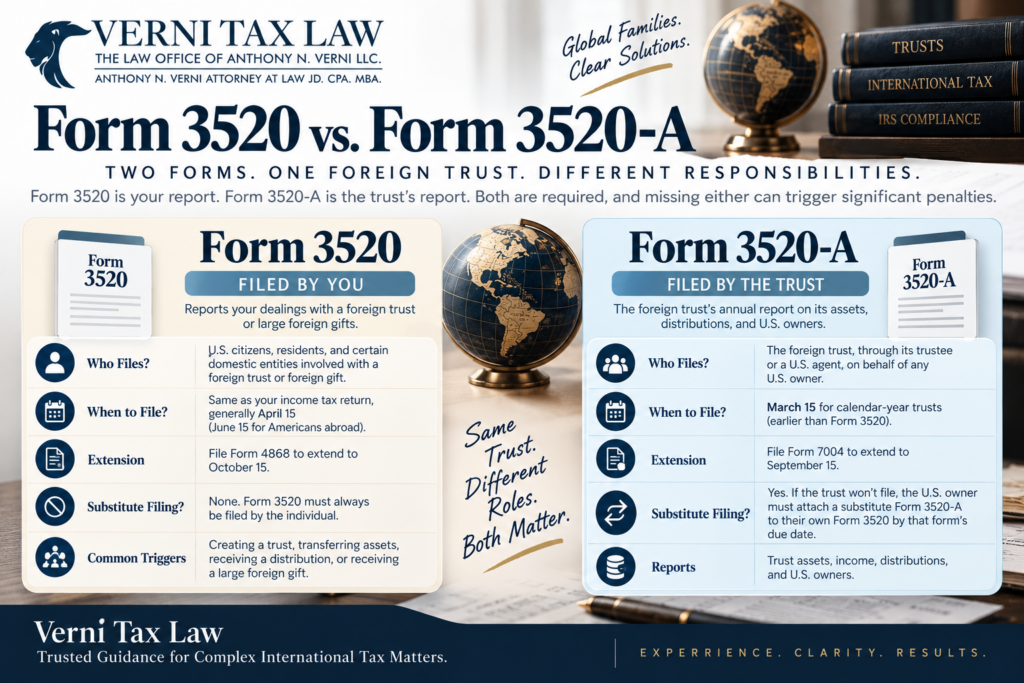
Form 3520 and Form 3520-A report two different sides of the same foreign trust relationship. Form 3520 is filed by the person; Form 3520-A is filed by the trust.
What Form 3520 Reports
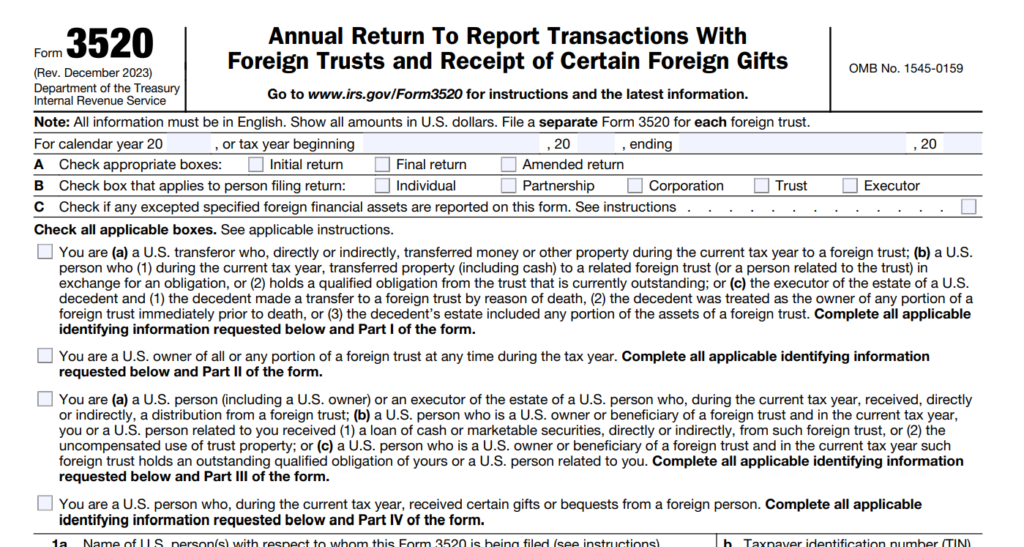
Form 3520 is the return a U.S. person files to report their own dealings with a foreign trust or a large foreign gift. You file it if you created a foreign trust, invested money into one, received money from one, or got a gift over the reporting threshold from a foreign person.
- Who files: U.S. citizens, residents, and certain domestic entities involved with a foreign trust or foreign gift.
- Deadline: The same day as your income tax return, generally April 15 (June 15 automatically for Americans abroad).
- Extension: Filing Form 4868 for your income tax return also extends Form 3520 to October 15.
- Substitute filing: None applies to Form 3520 itself; it’s always filed by the individual.
What Form 3520-A Reports
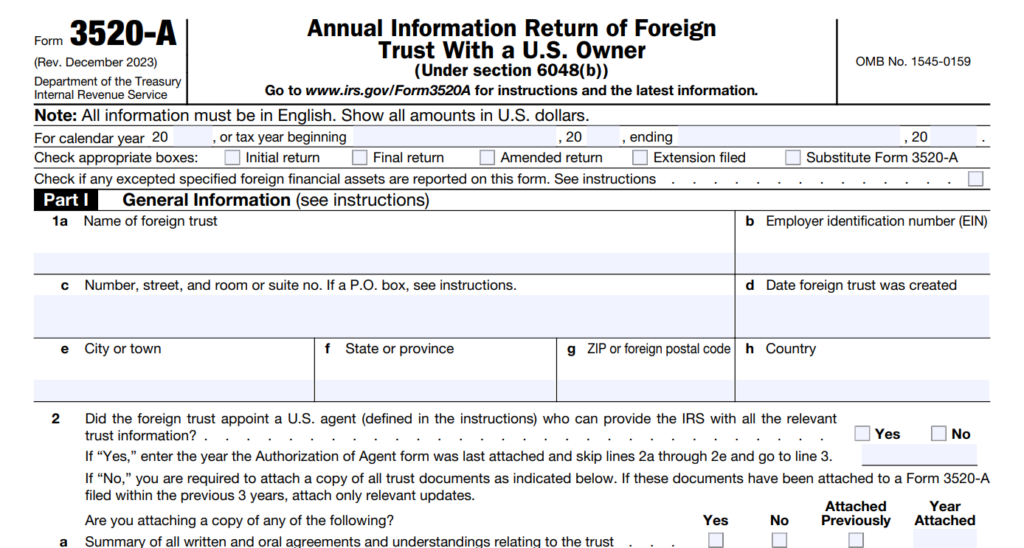
Form 3520-A is the trust’s own annual report to the IRS about its assets, distributions, and owners. A foreign trust IRS enforcement action often starts here, because this form is easy to overlook when a foreign trustee handles the paperwork.
- Who files: The foreign trust, through its trustee or a U.S. agent, on behalf of any U.S. owner.
- Deadline: March 15 for calendar-year trusts, earlier than Form 3520.
- Extension: Form 7004 extends it to September 15.
- Substitute filing: If the trust won’t file, the U.S. owner must attach a substitute Form 3520-A to their own Form 3520 by that form’s due date.
How Form 3520 Differs From Form 3520-A
Form 3520 is your report. Form 3520-A is the trust’s report. The trust and the owner each carry their own filing duty, and missing either one triggers its own penalty.
Why Form 3520 and Form 3520-A Can Create a Penalty Even When You Owe No Additional Tax
A late or missing form can trigger a penalty even if the underlying transaction created zero taxable income.
The penalty is tied to the value of what moved, not to any unpaid tax bill:
- A $500,000 transfer to a foreign trust that produces no taxable gain can still trigger a $175,000 penalty (35% of the transfer).
- A U.S. owner with $2 million in trust assets faces a $100,000 penalty (5%) for a missed Form 3520-A, even with a $0 tax liability.
Based on my experience at Verni Tax Law with these cases, clients frequently express surprise that “no tax owed” does not equate to “no risk of penalties.” The reporting duty and the tax duty are separate questions entirely.
What Are the Penalties for Form 3520 and 3520-A?
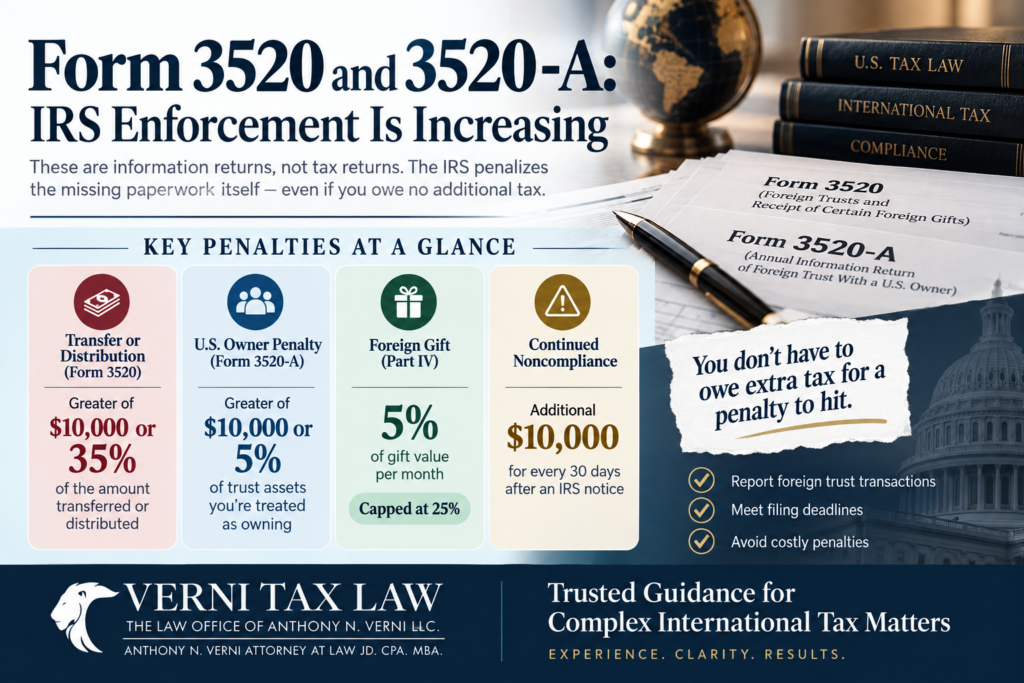
Penalties vary by which part of the form you missed. Here’s the breakdown by category, and each one can apply on its own.
Form 3520 Transfer and Distribution Penalties
Failing to report a transfer to a foreign trust or a distribution you received carries a 3520 late filing penalty equal to the greater of $10,000 or 35% of the amount involved.
Form 3520-A U.S. Owner Penalty
If you’re the U.S. owner of a foreign trust and Form 3520-A never gets filed, you personally face the greater of $10,000 or 5% of the trust assets treated as yours. Filing a substitute Form 3520-A on time with your own Form 3520 avoids this.
Continuing Penalties After IRS Notice
The IRS doesn’t stop at one penalty. Once it mails a notice, an added $10,000 applies for every 30-day period the noncompliance continues. However, total penalties generally can’t exceed the gross value of the reportable amount.
The table below summarizes how the four main foreign trust reporting penalty categories break down.
| Violation | Penalty Formula | Minimum |
| Transfer to a foreign trust | Greater of $10,000 or 35% of value transferred | $10,000 |
| U.S. ownership (Form 3520-A) | Greater of $10,000 or 5% of trust assets owned | $10,000 |
| Distribution received from trust | Greater of $10,000 or 35% of distribution value | $10,000 |
| Foreign gift or bequest (Part IV) | 5% of gift value per month, capped at 25% | None |
How Much Can a Foreign Trust Reporting Penalty Cost?
Every category above carries a $10,000 floor except foreign gifts. Even a small, sloppy trust transaction can cost $10,000 the moment the form is late or incomplete.
Penalties Based on Trust Assets or Distributions
Once the transaction is large, the percentage takes over. A $1 million distribution missed on Form 3520 produces a $350,000 penalty, which explains why foreign reporting penalties in this area rank among the harshest in U.S. tax law.
Additional Penalties for Continued Noncompliance
Ignoring an IRS notice doesn’t buy time. It adds $10,000 every 30 days on top of the original penalty. The National Taxpayer Advocate’s 2023 report to Congress called these international penalties “draconian and inefficient” and noted the average foreign gift penalty from 2018 through 2021 topped $235,000.
What Is the IRS Doing About Foreign Trust Reporting?
The IRS treats international information returns, including Form 3520 and Form 3520-A, as a persistent compliance gap. Even after retiring its dedicated foreign trust audit campaign in 2022, the agency kept the underlying 3520 late filing penalty rules fully intact and continues assessing them.
Information Matching and Cross-Border Reporting
FBAR and FATCA reporting from foreign banks now flows straight to the IRS. A foreign account, a foreign gift, and a foreign trust distribution rarely stay hidden once multiple data sources point in the same direction.
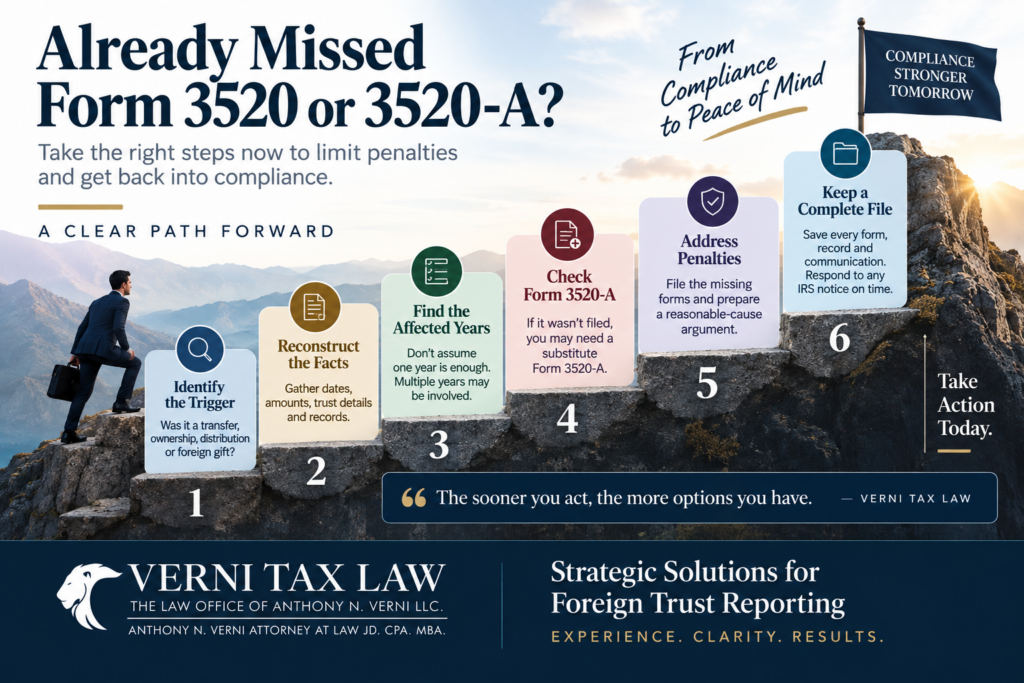
What Should You Do If You Already Missed Form 3520 or Form 3520-A?
- Step 1: Identify exactly what triggered the filing requirement. Was it a transfer, an ownership interest, a distribution, a foreign gift, or several of these at once? Each category has its own rule set.
- Step 2: Reconstruct the transaction and relevant values. Pull together the transaction date, dollar amount, trust identity, ownership details, distribution records, and trustee statements.
- Step 3: Determine which forms and years are affected. Don’t assume fixing one year clears every year. Foreign trust issues frequently span several tax years at once.
- Step 4: Check whether Form 3520-A was ever filed. If it wasn’t, you may need to prepare a substitute Form 3520-A yourself.
- Step 5: Address the penalty issue separately. Filing the missing form and building a reasonable-cause argument are two different tasks, even though they’re related.
- Step 6: Preserve a complete correction file. Keep every filed form, delivery record, trustee email, calculation, and reasonable-cause document. Never avoid an IRS notice while you gather this information; respond within its stated deadline even if your reconstruction isn’t finished.
What If the Foreign Trust or Trustee Refuses to Give You the Information Needed for Form 3520-A?
A foreign trustee’s silence does not erase your reporting duty. The IRS explicitly rejects the argument that a fiduciary’s refusal, or a trust clause blocking disclosure, counts as reasonable cause on its own.
The practical response looks like this:
- Request the required trust information in writing.
- Keep copies of every request you send.
- Note precisely what information is still missing.
- Determine whether you need to file a substitute Form 3520-A.
- Get professional advice before filing with incomplete numbers.
What to Do If You Are Already Facing a Form 3520 Penalty
- Read the notice closely and confirm the exact part of the form and the tax year involved. Different parts carry different rules for relief.
- Build a written reasonable-cause statement with a timeline and supporting records rather than a general explanation
- Respond before the stated deadline. A late response forfeits arguments you might have otherwise made.
- If the penalty was already assessed, an appeal or abatement request is still possible; the door doesn’t close after the first notice.
- A Form 3520 attorney, like Anthony N. Verni, can identify which specific facts support relief in your case, since generic explanations rarely move the IRS.
How Verni Tax Law’s Form 3520 or Form 3520-A Attorney Can Help
Anthony N. Verni brings over 25 years of experience as an attorney, CPA, and MBA to foreign trust and foreign gift reporting cases. He personally handles every matter from Princeton, New Jersey, and Fort Lauderdale, Florida, working with clients across the U.S. and abroad.
- He builds the reasonable-cause record needed to fight a foreign trust reporting penalty before or after the IRS assesses it.
- He prepares substitute Form 3520-A filings when a foreign trustee won’t cooperate.
- He walks clients through offshore voluntary disclosure options when multiple years of foreign trust or gift reporting were missed.
- As an international tax attorney with direct OVDP experience dating back to 2009, he anticipates how the IRS approaches these cases before it becomes a problem.
If you’re facing a Form 3520 penalty or think you may have missed a filing, book a confidential consultation with Anthony N. Verni today.
Conclusion
Form 3520 and Form 3520-A penalties attach to the paperwork. A transaction that owes zero additional tax can still generate a six-figure penalty because the calculation runs off the value transferred, distributed, or owned. Anyone with a foreign trust connection or a large foreign gift needs to treat these filings as a standalone compliance duty.
Anthony N. Verni resolves exactly these cases. His dual credentials as an attorney and CPA let him build both the legal reasonable-cause argument and the financial reconstruction the IRS expects to see, and he manages both without handing your file to a rotating team. Contact Verni Tax Law today to review your foreign trust or foreign gift reporting before the IRS reviews it for you.
FAQs
What is Form 3520 used for?
Form 3520 reports a U.S. person’s transfers to, distributions from, or ownership of a foreign trust, plus large foreign gifts. It’s an information return, not a tax calculation.
What is Form 3520-A used for?
Form 3520-A is the foreign trust’s own annual report on its assets, income, and U.S. owners. The trustee files it, not the individual owner.
Who needs to file Form 3520?
Any U.S. person who created, funded, received a distribution from, or is deemed owner of a foreign trust must file. Large foreign gift recipients file it too.
Who is responsible for filing Form 3520-A?
The foreign trust’s trustee files it. If the trustee won’t, the U.S. owner must attach a substitute version to their own Form 3520.
What is the penalty for filing Form 3520 late?
The penalty is the greater of $10,000 or 35% of the transfer or distribution amount, plus $10,000 for each 30-day period after an IRS notice.
How much is the Form 3520-A penalty?
The U.S. owner faces the greater of $10,000 or 5% of the trust assets treated as theirs at year-end.
Can Form 3520 penalties be waived for reasonable cause?
Yes. The IRS waives penalties when the taxpayer proves the failure was due to reasonable cause and not willful neglect, backed by documentation.
What happens if I never filed Form 3520?
The penalty clock keeps running, and the statute of limitations for that tax year stays open indefinitely until you file.
Can I file Form 3520 late without a penalty?
Only if you qualify for reasonable cause or use a delinquent filing procedure before the IRS contacts you first.
Does receiving money from a foreign trust require Form 3520?
Yes. Any distribution, including loans or free use of trust property, must be reported in Part III of Form 3520.
Do foreign gifts or inheritances have to be reported on Form 3520?
Yes, once they exceed the annual reporting threshold from a foreign individual, estate, corporation, or partnership.
Can a Form 3520 attorney help remove an IRS penalty?
Yes. An attorney builds the reasonable-cause record, handles IRS correspondence, and can pursue abatement even after a penalty is assessed.