

You need an FBAR lawyer when you have missed foreign account reporting deadlines, received an IRS notice, or face possible penalties for failing to report overseas accounts. Legal help also matters when you need to correct past filings and cannot confidently determine whether your mistake was non-willful.
This guide explains FBAR filing requirements, when to hire an attorney, how penalty risks arise, and how Verni Tax Law can help you address your situation.
Key Takeaways
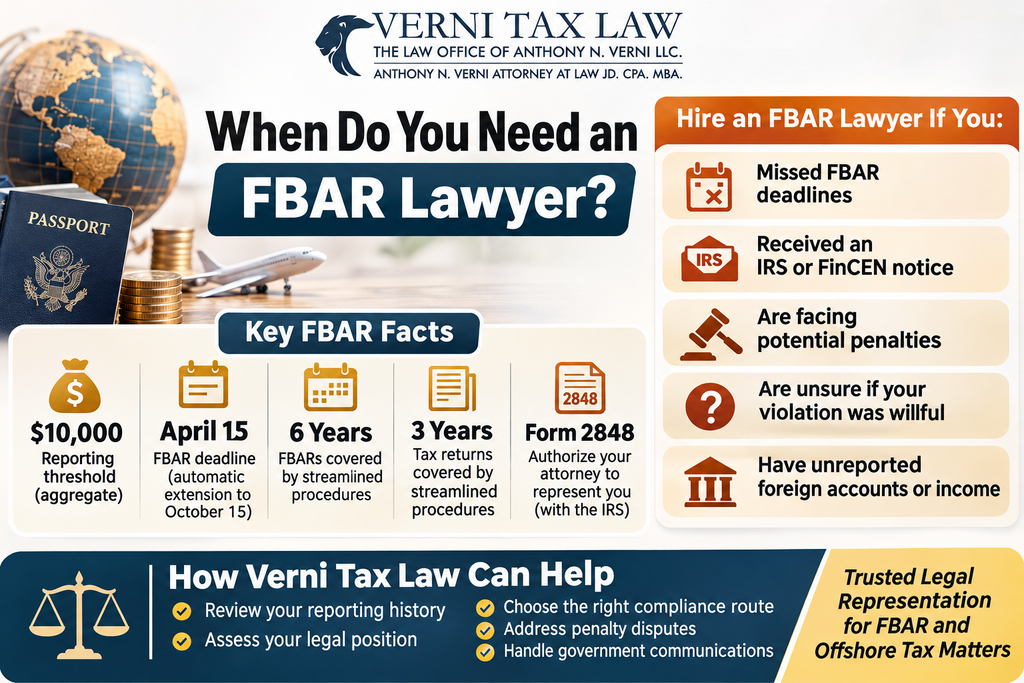
- $10,000: The aggregate maximum value threshold that generally triggers FBAR reporting.
- April 15: The annual FBAR deadline, with an automatic extension to October 15.
- Six years: The reporting period generally covered by the streamlined procedures for delinquent FBARs.
- Three years: The tax return period generally covered by streamlined compliance procedures.
- Form 2848: The IRS power of attorney form used to authorize eligible representatives.
What Is an FBAR and Who Needs to File One?
An FBAR is the Report of Foreign Bank and Financial Accounts, filed electronically with the Financial Crimes Enforcement Network (FinCEN) using FinCEN Form 114.
U.S. persons generally must file when the combined maximum value of their foreign financial accounts exceeds $10,000 at any time during a calendar year.
Who Must Report Foreign Financial Accounts?
You generally must file if you are a U.S. person who:
- Owns or holds a financial interest in foreign financial accounts.
- Has signature authority or other authority over qualifying foreign accounts.
- Holds multiple foreign accounts whose combined maximum values exceed $10,000.
- Has qualifying reporting responsibilities for certain accounts held through businesses or other entities.
Which Foreign Accounts Must Be Reported?
Foreign bank account reporting covers qualifying financial accounts located outside the United States, including:
- Foreign checking and savings accounts.
- Foreign securities and brokerage accounts.
- Certain foreign investment accounts.
- Other foreign financial accounts covered by FBAR rules.
The reporting threshold applies to the combined maximum values, not each account separately. For example, two accounts reaching maximum values of $6,000 each can trigger filing even when neither account individually exceeds $10,000.
The FBAR deadline is April 15 of the following year. FinCEN automatically extends it to October 15 without requiring a separate extension request.
When Do You Need an FBAR Lawyer?
An FBAR lawyer is particularly useful when correcting a reporting error requires legal judgment. The right time to seek advice depends on your filing history, the government’s involvement, and the facts behind the omission.
You Have Missed FBAR Filing Deadlines
If you missed an FBAR deadline, first determine whether you qualify for ordinary delinquent filing or need another compliance procedure.
The IRS advises taxpayers who have not been contacted and are not under civil or criminal investigation to file delinquent FBARs promptly, following the applicable instructions.
However, late FBAR filing becomes more complicated when you also failed to report foreign income or omitted other international tax forms.
An attorney can assess whether a straightforward late submission fits your circumstances. Do not assume that filing a late form automatically resolves every reporting problem.
You Have Received an IRS or FinCEN Notice
Contact an attorney promptly if the IRS or FinCEN questions your foreign accounts or requests records about your reporting history.
An IRS FBAR investigation requires careful attention to the notice, requested documents, response deadline, and issues under review.
Your response should address the actual questions raised by the government. An incomplete explanation or unsupported account balance can complicate the case.
You Are Facing Potential FBAR Penalties
Hire an attorney when the government proposes a penalty or examines whether you failed to report foreign accounts.
The penalties for not filing an FBAR depend on the facts, applicable law, and whether the violation was willful. Penalty amounts also change under annual inflation adjustments.
A lawyer can review the proposed assessment, identify factual or legal errors, and determine whether you have grounds to challenge it.
You Are Unsure Whether Your Violation Was Willful
Seek legal advice if you do not know whether your failure was accidental or involved conduct the government could view as intentional.
A willful FBAR violation involves a failure to meet reporting duties with the required level of knowledge or intent. The government evaluates the evidence and surrounding circumstances.
Relevant facts include prior professional advice, account disclosures, tax return answers, and actions taken after you learned about your obligations.
Do not label your conduct non-willful simply because you did not intend to commit tax fraud. A lawyer should assess the complete record before recommending a filing strategy.
You Have Unreported Foreign Accounts or Income
Consult an attorney if you failed to report foreign accounts, investment income, or other overseas financial activity.
Foreign bank account reporting and U.S. income tax reporting are separate obligations. Filing an FBAR does not replace the need to report taxable income or submit other required international information returns.
The correct response depends on what you omitted, how many years are involved, and whether the failure was non-willful or potentially willful.
What Does an FBAR Tax Attorney Actually Do?
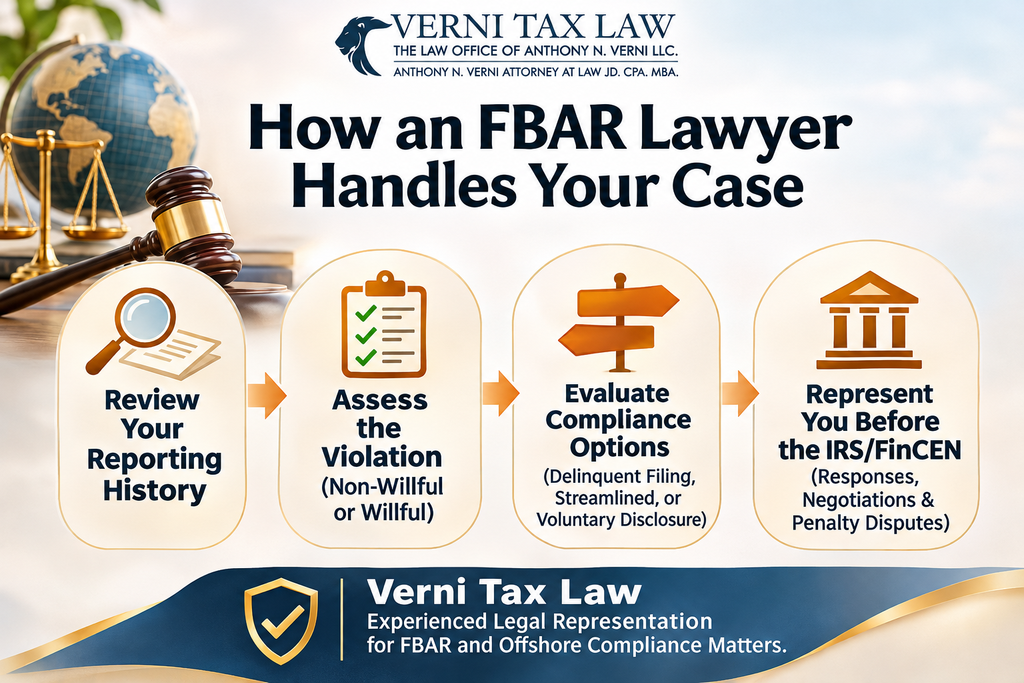
An FBAR tax attorney reviews your reporting history, evaluates legal risks, selects an appropriate compliance strategy, and represents you within the agreed scope of the engagement.
Your attorney must understand how the facts, account records, and previous tax filings fit together. The process generally involves four responsibilities.
1. Reconstruct Your Reporting History
Your attorney identifies foreign accounts, account owners, signature authority, relevant calendar years, and maximum balances. He reviews available bank statements and identifies missing records that need further investigation.
2. Assess The Nature Of The Violation
Your attorney examines why you missed the reporting requirement and whether the available evidence supports a non-willful position. He also considers facts that could raise willfulness concerns.
3. Evaluate Compliance Options
The attorney compares delinquent filing, streamlined procedures, and the IRS Criminal Investigation Voluntary Disclosure Practice where relevant. Each option has different eligibility rules and consequences.
4. Represent You Before The Government
Your attorney helps prepare submissions, handles communications within the representation agreement, and responds to proposed penalties or examination findings.
The IRS permits authorized representation for FBAR matters through an appropriately completed Form 2848. The form should identify FBAR matters, FinCEN Form 114, and the relevant calendar years.
DIY filing software serves different purposes. Software can help prepare routine filings, but it cannot replace legal advice when your facts raise questions about penalties, willfulness, or criminal exposure.
An attorney cannot guarantee penalty elimination or immunity from prosecution. He assesses the facts, explains the available procedures, and advocates for your legal position.
What Happens If You Fail to File an FBAR?
Failing to file a required FBAR can lead to civil penalties and, in serious cases, criminal consequences. The outcome depends on the violation and the evidence supporting the government’s position.
Non-Willful vs. Willful FBAR Violations
A non-willful violation generally involves negligence, inadvertence, or a good-faith misunderstanding of reporting duties. Willful conduct involves intentional or knowing noncompliance, although the legal analysis depends on the facts. Willful FBAR penalties can be substantially more severe than penalties for non-willful violations.
For eligible taxpayers, FBAR streamlined filing procedures provide a route to correct certain non-willful offshore reporting failures. These procedures generally cover the most recent three tax return years and six FBAR years.
U.S. residents using the domestic streamlined procedures generally owe a miscellaneous offshore penalty. Eligible taxpayers using the foreign streamlined procedures generally receive different penalty treatment.
Civil Penalties and Potential Criminal Consequences
Civil penalties are financial penalties for violations of reporting rules. Criminal consequences arise when the government pursues alleged criminal conduct under applicable law.
The IRS evaluates FBAR violations under its examination and penalty procedures. Criminal exposure depends on the conduct and evidence, not merely the existence of an unfiled report.
The IRS Criminal Investigation Voluntary Disclosure Practice addresses qualifying cases involving willful tax noncompliance. A timely, truthful, and complete disclosure does not guarantee immunity from prosecution.
How Can an FBAR Lawyer Help Reduce Penalty Risks?
An attorney can identify reporting errors, assess available relief, and challenge unsupported penalties. FBAR penalty mitigation options depend on your facts and the procedures available for your case.
An FBAR attorney can help by:
- Reviewing account records to establish accurate maximum balances.
- Checking foreign currency conversions against FinCEN guidance.
- Identifying errors in proposed penalty calculations.
- Evaluating eligibility for delinquent FBAR submission procedures.
- Assessing whether streamlined compliance fits the facts.
- Preparing evidence that supports your explanation for the omission.
- Reviewing grounds for challenging an assessed FBAR penalty.
- Developing a response strategy for an IRS examination.
FinCEN generally requires account values to reflect a reasonable approximation of each account’s maximum value during the calendar year. Foreign currency values must be converted using the applicable Treasury exchange rate for the last day of that year, or another verifiable rate when the Treasury rate is unavailable.
How Are FBAR Cases Handled?
An FBAR case typically begins with a review of your circumstances and proceeds to evidence collection, legal strategy, and any required government response.
Initial Case Review and Risk Assessment
Your attorney reviews notices, prior filings, account ownership, and the number of affected years. He identifies urgent deadlines and determines whether the government has already begun an examination or investigation.
Evidence Collection and Legal Strategy
The attorney gathers bank statements, tax returns, account opening records, and relevant communications. He uses these records to evaluate reporting errors and compare available compliance options.
IRS Negotiations, Appeals, or Litigation
Your attorney responds to examination findings and challenges proposed penalties when the facts and law support a dispute. Depending on the case, further review or litigation may become necessary.
How to Choose the Right FBAR Lawyer
Choose a lawyer with direct experience in international tax compliance, FBAR disputes, and cases involving potential penalties.
- Look for an attorney who understands FinCEN reporting rules and the relationship between FBAR filings and U.S. tax returns.
- Ask whether the attorney handles non-willful compliance cases, willfulness assessments, offshore disclosures, and disputes over proposed penalties.
Questions to Ask Before Hiring an Attorney
Ask these questions during your consultation:
- Have you handled cases involving missed FBAR filings?
- How will you assess whether my conduct was non-willful?
- Which compliance options fit my circumstances?
- What records will you need before recommending a strategy?
- Who will represent me in communications with the government?
- How do you charge for the initial review and ongoing representation?
Discussing offshore voluntary disclosure options with an experienced lawyer can help you avoid choosing a procedure that does not fit your circumstances.
What Should You Bring to an FBAR Lawyer Consultation?
Bring the records that help your attorney understand what happened and which reporting years require attention.
Useful documents include:
- Previous FBARs and U.S. tax returns.
- Foreign bank and brokerage statements.
- Account ownership and signature authority records.
- Records showing maximum annual account balances.
- IRS or FinCEN notices and response deadlines.
- Communications with accountants or previous tax advisers.
- Records of foreign income, interest, dividends, and investments.
- Any previous voluntary disclosure or compliance submissions.
If you lack certain documents, explain what is missing and what steps you have taken to obtain it. Do not guess at account balances or submit an explanation you cannot support.
How Verni Tax Law’s FBAR Tax Attorney Can Help With Your FBAR Situation
Verni Tax Law provides legal representation for taxpayers facing foreign account reporting problems, FBAR penalties, and offshore tax compliance issues. Anthony N. Verni is an attorney, Certified Public Accountant, and MBA with more than 20 years of experience practicing before the IRS, according to his published professional biography.
His legal and accounting background helps him assess reporting errors alongside the underlying tax records. His practice includes FBAR matters, FATCA compliance, offshore voluntary disclosure, and civil tax disputes.
Verni Tax Law can help you:
- Review your reporting history: Identify missing filings, account ownership issues, and years that need correction.
- Assess your legal position: Examine whether the available evidence supports a non-willful position or raises willfulness concerns.
- Select a compliance route: Evaluate delinquent filing, streamlined procedures, or voluntary disclosure where appropriate.
- Address penalty disputes: Review proposed assessments and develop arguments supported by the facts and applicable law.
- Manage government communications: Prepare responses and represent you within the agreed scope of legal services.
Anthony N. Verni will help you understand your reporting obligations and assess the legal options available for your FBAR situation. He focuses on building a case strategy around the facts, applicable law, and your compliance history rather than promising a particular outcome.
Schedule a consultation to discuss your foreign account reporting concerns and determine the next appropriate step.
Conclusion
An FBAR problem requires more than correcting a missed filing. Your reporting history, the reasons for the omission, and your response to government inquiries can affect your legal position and available compliance options.
An experienced attorney can assess these facts, determine which procedures fit your circumstances, and challenge penalties when the evidence supports a dispute. Acting before a government inquiry begins can preserve options that might otherwise become unavailable.
Verni Tax Law offers legal representation for foreign account reporting issues, offshore compliance, and FBAR penalty disputes. Anthony N. Verni can review your situation and explain a practical course of action. Contact Verni Tax Law to discuss your case.
FAQs
Do I need an FBAR lawyer if I only missed one filing?
Yes, if the missed filing involves unreported income, uncertain willfulness, or possible penalties. A straightforward late filing may not require legal representation.
Should I contact an FBAR lawyer before contacting the IRS?
Yes, if your case involves possible willfulness, an investigation, or significant penalties. An attorney can assess your facts before you make formal statements or submissions.
Does hiring an FBAR lawyer make my foreign bank accounts confidential?
No. Hiring an attorney does not make foreign accounts or required reports confidential. Attorney-client privilege can protect qualifying confidential legal communications, subject to legal exceptions.
Can a CPA handle an FBAR problem instead of a lawyer?
Yes, a CPA can help prepare accurate filings and tax records. A lawyer is better suited to legal disputes involving willfulness, penalty defense, or potential criminal exposure.
How much does an FBAR lawyer cost?
Fees depend on the case’s complexity, number of years involved, and scope of representation. Ask for the fee structure and expected costs during your initial consultation.