
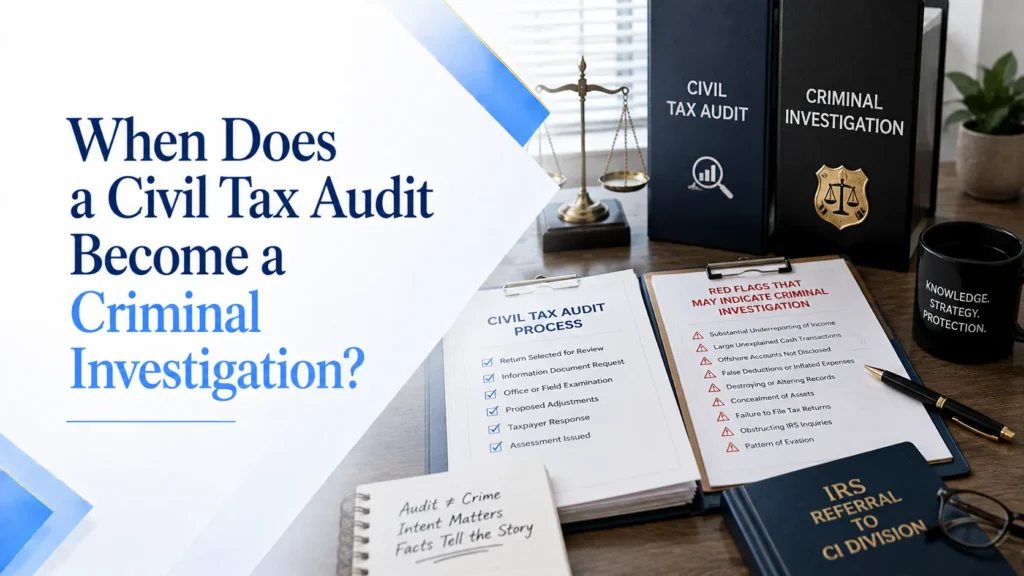
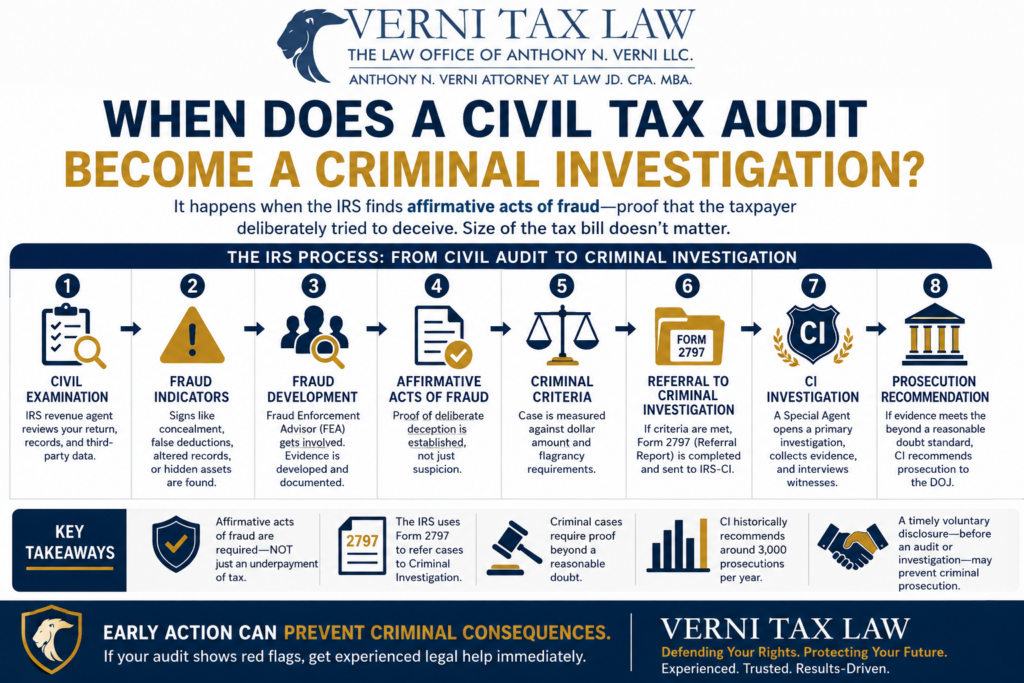
A civil tax audit turns into a criminal investigation when the IRS finds affirmative acts of fraud, proof that the taxpayer deliberately tried to deceive. This difference between civil and criminal tax fraud has nothing to do with how large the tax bill turns out to be.
The criminal investigation sequence involves civil examination, fraud indicators, fraud development, affirmative acts of fraud, criminal criteria, referral to Criminal Investigation, a CI investigation, and then a possible prosecution recommendation to the Department of Justice. IRS guidance confirms that a criminal fraud referral can come directly out of a civil exam once affirmative acts and criminal criteria are documented.
Key Takeaways
- A civil audit criminal investigation referral requires proof of affirmative acts of fraud, not just an underpayment of tax.
- The IRS moves a case to Criminal Investigation using Form 2797, the Referral Report of Potential Criminal Fraud Cases.
- Criminal cases require proof beyond a reasonable doubt; civil fraud cases require the lower standard of clear and convincing evidence.
- CI historically recommends around 3,000 prosecutions a year, a small share of all audits and investigations combined.
- A timely voluntary disclosure, made before an audit or investigation starts, may keep a willful violation from becoming a criminal case.
- Special Agent contact or requests for original records during an audit are strong signs fraud development is already underway.
Civil Tax Audits vs Criminal Tax Investigations: Understanding the Difference
A civil audit corrects the tax owed and may add a financial penalty; a criminal investigation builds a case to prosecute a crime. The IRS is explicit that civil fraud results in a remedial action such as an assessment and penalty, while criminal fraud results in a punitive outcome, meaning fines or imprisonment.
Purpose of a Civil IRS Audit
A civil IRS audit exists to check whether a return correctly reports income, deductions, and credits. Revenue agents adjust the numbers, assess additional tax, and can apply civil penalties, including the civil fraud penalty under IRC 6663, which equals 75% of the underpayment tied to fraud and must be proven by clear and convincing evidence.
Purpose of a Criminal Tax Investigation
A criminal tax investigation exists to determine whether a taxpayer willfully violated federal law and should face prosecution. Special agents build the case through interviews, subpoenas, and forensic accounting, then recommend prosecution to the DOJ Tax Division or a U.S. Attorney’s office once the evidence meets the beyond a reasonable doubt standard.
How a Civil IRS Audit Begins
Returns get selected through statistical scoring, information mismatches, random sampling, or referrals tied to a related case. Common IRS audit triggers include unreported 1099 or W-2 income, deductions that look large next to reported income, cash-heavy businesses, and a prior audit history involving similar issues.
Role of the IRS Revenue Agent
The revenue agent reviews books, records, and third-party data to confirm accuracy. If the agent spots signs of concealment rather than error, a fraud comment must be documented, and the agent can bring in a Fraud Enforcement Advisor (FEA), a specialist trained to evaluate suspected fraud.
What IRS Audit Findings Can Trigger Fraud Development or a Criminal Referral?
Certain findings, such as concealment, fabrication, and deliberate omission, turn a routine adjustment into fraud development. The IRS separates “indicators of fraud,” which merely suggest something is off, from “affirmative acts,” which prove deliberate deception occurred.
Unreported Income Becomes More Serious When Concealment Is Involved
Unreported income alone is common and often accidental. It becomes an affirmative act once concealment enters the picture, such as routing receipts through a personal account or asking a payer to skip issuing a 1099.
False Deductions Are Different From Disputed Deductions
A false deduction claims an expense that never happened. A disputed deduction is one where the taxpayer and the IRS disagree on how the law applies to a real expense. Only the first shows the intent needed to move a case toward IRS audit criminal investigation review.
Altered Or Fabricated Records Can Change The Character Of An Audit
Altered invoices, backdated documents, and duplicated receipts count as direct evidence of intent. The IRS Fraud Handbook lists documents that appear altered or false as a recognized fraud indicator on its own.
Concealing Assets Or Accounts Can Be More Significant Than Merely Failing To Report Them
Failing to report an account may be a filing error. Actively hiding it, through a nominee owner or an undisclosed offshore account, is an affirmative act because it shows the taxpayer knew about the obligation and worked to defeat it.
Intent Matters More Than Mistakes
Willfulness means a voluntary, intentional violation of a known legal duty. A genuine, good faith belief that a position was legal, even if it turns out wrong, defeats a finding of willfulness and keeps the matter civil.
Common Red Flags That Trigger Criminal Referrals
- Sustained, unexplained increases in net worth
- Personal spending well above what reported income can support
- Bank deposits from unexplained sources that dwarf reported income
- Two sets of books, or figures that do not match between them
- Structuring cash deposits to stay under reporting thresholds
- Payroll tax fraud, meaning employee withholding is collected but never remitted to the IRS
- False or misleading statements made directly to the revenue agent
How Does the IRS Decide Whether to Refer an Audit to Criminal Investigation?
The IRS follows a documented, multi-layer process before any file becomes an IRS fraud referral. It moves through several reviewers before a Special Agent ever gets involved.
The Civil Examiner Develops And Documents Suspected Fraud
- The examiner notices one or more fraud indicators during the audit
- The indicators are documented and discussed with a group manager
- The Fraud Enforcement Advisor is contacted through the Specialist Referral System
- The FEA and examiner work the fraud issue further, sometimes for months
- Affirmative acts, or firm indications, of fraud are weighed against the evidence
- Criminal criteria, including dollar amount and flagrancy, are considered
- If criteria are met, the examiner suspends the civil case and completes Form 2797
The referral must present a detailed set of facts establishing firm indications of fraud.
What Information Goes Into A Criminal Fraud Referral?
The table below shows what a Form 2797 referral must contain before criminal investigation will evaluate the case.
| Required Element | What It Establishes |
| Facts showing firm indications of fraud/willfulness | Concrete evidence, not suspicion |
| Taxpayer’s explanation of the conduct | Whether an innocent explanation exists |
| Estimated criminal tax liability | The dollar scope of the alleged fraud |
| Method used to prove income | How the examiner calculated unreported income |
The table above shows that a referral cannot rest on instinct. Every element needs documentation strong enough to survive review by a Fraud Enforcement Advisor and, later, a Special Agent.
The IRS Fraud Referral Process Explained
A completed IRS fraud referral moves through three distinct approval layers before Criminal Investigation opens a file. Each layer exists to filter out cases that do not actually meet criminal criteria.
Revenue Agent Referral Procedures
The revenue agent completes Form 2797, secures group manager approval, and routes the referral through the FEA and FEA group manager before it reaches the correct CI field office by secure email.
Review by Fraud Enforcement Advisor
The Fraud Enforcement Advisor, formerly called the Fraud Technical Advisor, checks the referral for completeness and can add a narrative describing the fraud development process before forwarding it further.
Referral to IRS Criminal Investigation (IRS-CI)
Once CI receives the referral, a Special Agent is assigned within 10 workdays and opens it as a “primary investigation.” Within 30 workdays, CI holds a disposition conference and decides whether to accept or decline the case.
What Happens After a Criminal Referral?
CI treats an accepted referral as a primary investigation. Two layers of CI management, the front-line supervisor and the special agent in charge, must sign off before it becomes a full “subject criminal investigation.”
Evidence Collection and Interviews
Special agents interview third-party witnesses, execute search warrants, subpoena bank records, and use a forensic laboratory to examine documents. This stage often runs well past a year depending on how complex the case is.
DOJ Review and Criminal Prosecution
If the evidence supports guilt beyond a reasonable doubt, the special agent writes a Special Agent Report recommending prosecution. Several CI officials review it before it reaches the DOJ Tax Division or a U.S. Attorney’s office, either of which can still decline the case. A conviction can mean someone will go to prison for tax evasion, since evasion under IRC 7201 is treated as tax fraud, a felony punishable by fines and imprisonment.
Kovel Agreements: Protecting Sensitive Communications
A Kovel agreement lets a tax attorney hire an accountant to assist on a case, extending attorney-client privilege to certain communications with that accountant that would not otherwise be protected.
When a Kovel Agreement May Help
A Kovel agreement can help when a taxpayer needs an accountant’s technical read on complex records but wants those conversations shielded from compelled disclosure. Because this touches privilege law rather than IRS procedure, it should be structured by an IRS criminal investigation attorney.
Voluntary Disclosure Before an Investigation Begins
A timely voluntary disclosure is one submitted before the IRS opens a civil exam or criminal investigation, receives a tip from a third party, or acts on information tied to a criminal enforcement action. Coming forward early carries real advantages:
- It may result in prosecution not being recommended, though it is not automatic immunity
- It requires full cooperation and payment of the tax, interest, and penalties owed
- It generally requires filing Form 14457 and completing a two-part preclearance and acceptance process
- It applies only to willful noncompliance, not to an honest filing mistake
Taxpayers whose issue was a genuine error, not willful conduct, should file an amended or delinquent return instead of applying under voluntary disclosure.
Warning Signs Your Audit May Be Becoming Criminal
Questions about the source of specific deposits, personal spending patterns, or a second set of books go beyond routine verification and often mean fraud development is already underway.
Special Agent Contact
If an IRS Special Agent makes contact, the case has already moved into Criminal Investigation. Special Agents identify themselves as such and follow specific procedures before questioning a taxpayer.
Requests for Original Records
A shift from copies to original documents, especially bank records or ledgers, often reflects a concern about authenticity, a hallmark of active fraud development inside an IRS audit criminal investigation file.
What to Do If You Suspect Criminal Exposure
Do not alter or destroy records. Altering or destroying records after suspecting an investigation is a separate federal crime on its own, and it can serve as its own affirmative act of fraud.
Avoid Speaking Without Legal Counsel
Statements made to a revenue agent or Special Agent can be used later in a criminal case. Declining to answer, done correctly, is a protected right, not an admission of guilt.
Seek Immediate Representation
Retaining an IRS audit attorney and tax attorney for back taxes quickly preserves privilege, controls what information reaches the IRS, and keeps options like voluntary disclosure available before they close.
How Verni Tax Law Defends Clients Facing Criminal Tax Exposure
Verni Tax Law, led by Anthony N. Verni, represents individuals and businesses across the U.S. and abroad who are facing IRS audit or criminal investigation exposure. Anthony N. Verni holds licenses as an attorney, CPA, and MBA, giving him a combined legal, accounting, and financial view of a case that most single-credential advisors cannot offer.
- He personally handles every matter, from the first review of records through resolution
- He has represented clients through IRS offshore disclosure programs since 2009, giving him direct insight into how the IRS evaluates willfulness
- He builds each defense strategy around the taxpayer’s actual risk profile, not a generic template
- He works with clients internationally, including expatriates, business owners, and trustees, and can meet on flexible schedules across time zones
Where a civil audit criminal investigation referral has already happened, he reviews the Form 2797 basis, challenges weak evidence, and represents clients directly with CI and, where needed, the DOJ.
When willfulness is present, he evaluates whether a voluntary disclosure is timely and appropriate, then manages the preclearance and filing process from start to finish.
Anthony N. Verni offers a confidential case review to assess exactly where an audit stands and what comes next. Book a consultation with Verni Tax Law before an examiner’s questions go any further.
Early Action Can Prevent Criminal Consequences
A civil audit crosses into criminal territory only when the IRS can point to affirmative acts of fraud and meets its own criminal criteria. Recognizing the warning signs early, from Special Agent contact to requests for original records, gives a taxpayer time to act before an IRS fraud referral becomes final. A prompt, well-documented response, or a timely voluntary disclosure where willfulness exists, remains the strongest tool a taxpayer has against an IRS audit criminal investigation outcome.
Anthony N. Verni brings 25+ years of combined legal and accounting experience to exactly this kind of exposure. His direct, hands-on approach means every client speaks with him personally, not a case manager, from the first call through resolution. If an audit shows signs of moving toward CI, waiting rarely improves the outcome.
Contact Verni Tax Law today to schedule a confidential consultation and get a clear plan forward.
FAQs
When does an IRS civil audit become a criminal investigation?
An audit becomes criminal when the examiner documents affirmative acts of fraud and criminal criteria are met, which triggers a Form 2797 referral to IRS-CI.
What are firm indications of fraud according to the IRS?
Firm indications are proven acts of deliberate deception, such as concealed accounts or altered records, not mere suspicion or unusual numbers on a return.
What is an IRS fraud referral?
An IRS fraud referral is Form 2797, submitted by a compliance employee to Criminal Investigation once firm indications of fraud and criminal criteria are documented.
Can a revenue agent refer my case to IRS Criminal Investigation?
Yes. A revenue agent can start a referral, but it must first pass through a Fraud Enforcement Advisor and group manager approval before it ever reaches CI.
What is the difference between a civil audit and a criminal tax investigation?
A civil audit corrects tax and may add a financial penalty; a criminal investigation seeks to prove willful fraud beyond a reasonable doubt for prosecution.
What is a Kovel agreement and when is it used?
A Kovel agreement lets an attorney hire an accountant under privilege protection, used when technical financial analysis is needed without waiving confidentiality.
Can voluntary disclosure prevent criminal prosecution?
A timely, complete voluntary disclosure may result in prosecution not being recommended, though the IRS does not guarantee immunity from criminal charges.
What are the warning signs that an IRS audit is becoming criminal?
Special Agent contact, requests for original records instead of copies, and questions about personal spending or unexplained deposits are the key warning signs.
Should I hire an attorney before speaking with IRS Special Agents?
Yes. Statements made without counsel can be used as evidence later, so speaking with an IRS criminal investigation attorney first protects your rights.
How can a criminal tax defense attorney help after an IRS fraud referral?
A tax crime defense attorney can review the referral, challenge weak evidence, negotiate with CI or DOJ, and pursue voluntary disclosure where the facts support it.