

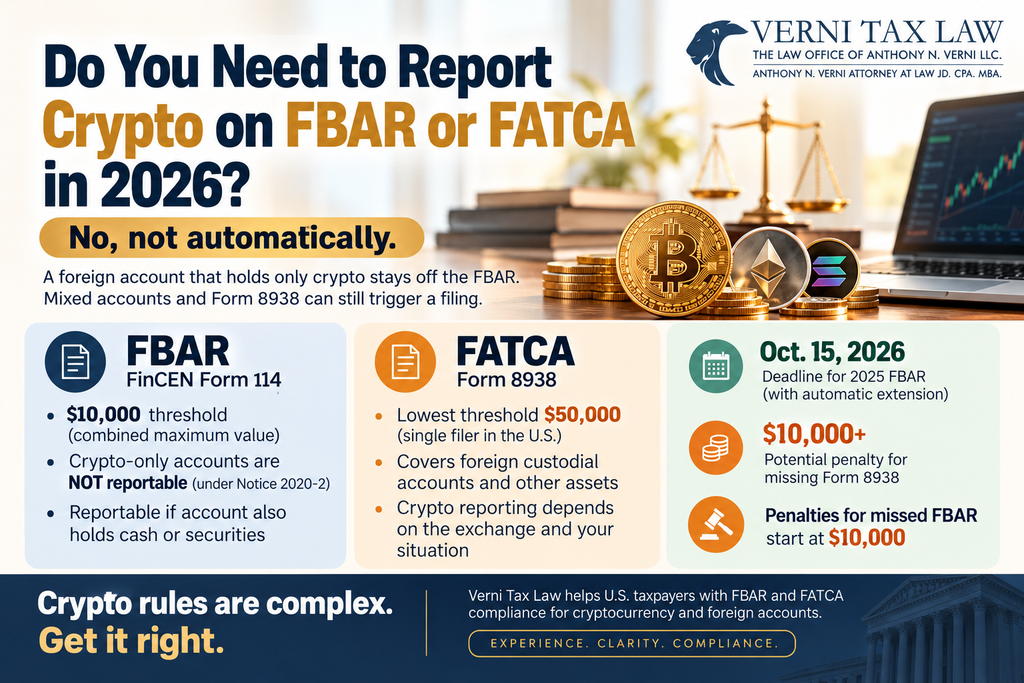
No, not automatically. Under current FinCEN guidance, a foreign account that holds only crypto stays off the FBAR. Mixed accounts and Form 8938 can still trigger a filing, so crypto FBAR reporting in 2026 depends on how your account is built, not on the coin. FinCEN set that position in Notice 2020-2 and promised to change it. Mistakes carry penalties that start at $10,000.
In this guide, we cover the four-question test, FBAR versus FATCA, deadlines, and fixes for missed years. We also lay out the IRS crypto reporting requirements.
| Key Takeaways$10,000: the FBAR trigger when your foreign accounts total more than that at any point in the year.Dec. 31, 2020: FinCEN Notice 2020-2 kept crypto-only foreign accounts off the FBAR.Oct. 15, 2026: the extended deadline for the 2025 FBAR.$50,000: the lowest Form 8938 threshold, for a single filer living in the U.S.$10,000: the base penalty for skipping Form 8938.Both forms: one person can owe the FBAR, Form 8938, or both. |
What Is FBAR Reporting for Cryptocurrency?
FBAR reporting for cryptocurrency means listing foreign accounts that hold digital assets on FinCEN Form 114. FBAR is short for Report of Foreign Bank and Financial Accounts. FinCEN, a Treasury bureau, collects the form. Today it covers accounts, not coins.
Is Crypto Automatically Reportable on FBAR or Form 8938 in 2026?
No. Four questions decide it:
- Are you a U.S. person under the rule? That means citizens, green card holders, residents, and U.S. entities.
- Does a foreign financial account or foreign financial institution hold the crypto?
- Does the rule treat that account as reportable?
- Did you meet the threshold or another filing condition?
An exchange outside the United States does not, by itself, make every crypto balance reportable. That holds for both the FBAR and Form 8938.
The $10,000 Foreign Account Threshold
The FBAR threshold is $10,000 in combined maximum value across all reportable foreign accounts at any point in the year. Add each account’s highest balance, even when the peaks hit on different days. Crypto-only accounts stay out of that total today.
Do You Need to Report Crypto on an FBAR in 2026?
You report crypto on an FBAR only when it sits in a reportable foreign account. Right now, that means an account that also holds cash or securities. FinCEN Notice 2020-2 leaves crypto-only accounts off the list, but FinCEN plans to change that. Keep crypto FBAR reporting records for 2026 in case it does.
When Cryptocurrency May Be Reportable
A mixed account is reportable, and then the whole account counts. Look for these signs:
- A cash balance in dollars or euros next to your coins
- Stocks, bonds, or funds held for you on the same platform
- A final FinCEN rule that adds virtual currency to the FBAR
A common mistake our clients make is checking the coins and ignoring the cash line on the statement.
Foreign Crypto Exchanges and FBAR
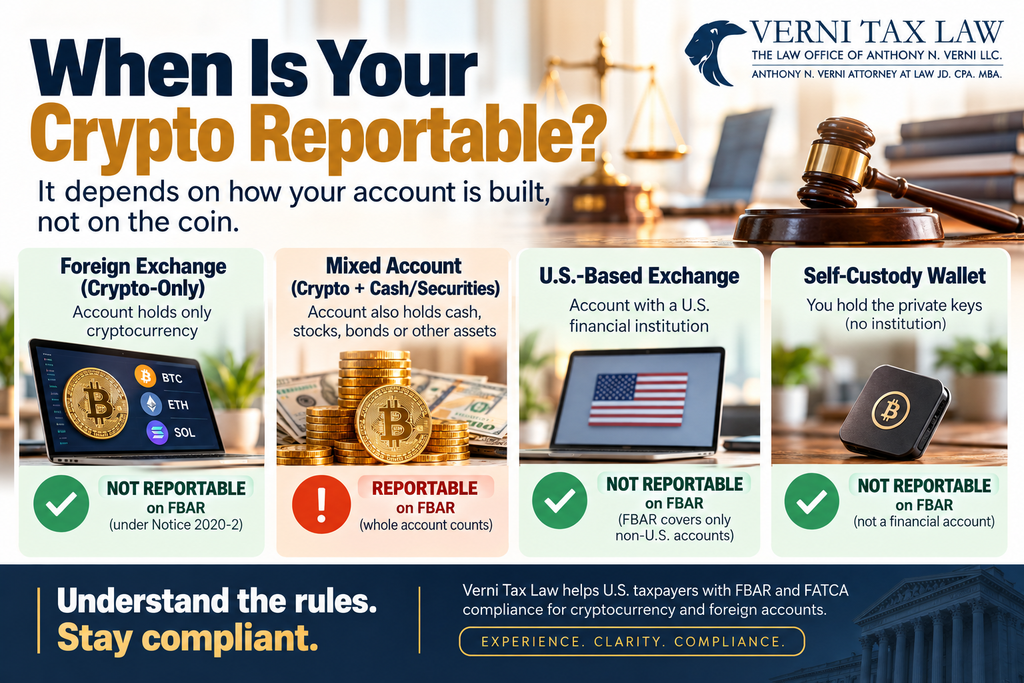
A foreign exchange account is not an FBAR account when it holds only crypto. Many exchanges also offer cash balances and savings products under one login. Check every product tied to the account, not just the trading wallet.
U.S.-Based Exchanges and FBAR
No. The FBAR covers accounts outside the United States, so a U.S.-based exchange account stays off Form 114. Form 8938 also skips accounts that a U.S. financial institution maintains.
Cryptocurrency Wallets and FBAR Reporting
A self-custody wallet is not a foreign financial account. You hold the private keys, and no institution maintains the account. FinCEN has not said how a future rule would treat private keys.
What Counts as a Foreign Crypto Account?
A foreign crypto account is an account that a financial institution outside the United States maintains for you. The institution decides the answer, not the coin. Four setups show up most often, and each gets a different answer. Digital asset foreign account reporting rests on which one you have.
Foreign-Based Cryptocurrency Exchanges
A foreign exchange is a company outside the United States that runs a trading platform. It acts as a foreign institution when it keeps assets in an account for you. Whether it counts as a “financial institution” for FATCA is unsettled.
Custodial Crypto Accounts
A custodial account is one where the platform holds your assets and keys. Form 8938 treats custodial accounts at foreign institutions as reportable. Many tax lawyers apply that to custodial crypto, though the IRS has not confirmed it. The cryptocurrency FATCA rules stay unclear here, so careful filers report.
Decentralized Exchanges and DeFi Platforms
A decentralized exchange is software that trades coins between wallets with no company holding your funds. No institution maintains an account, so no foreign financial account exists under the current FBAR text. Trading gains still count as taxable income.
Crypto Held Through Foreign Entities
A foreign entity is a company, trust, or partnership formed outside the United States. If you own more than 50% of an entity with a reportable foreign account, you report that account on your FBAR. Form 8938 separately covers your interest in the entity itself.
FBAR vs. FATCA for Crypto: Which Form Applies to Which Situation?
FBAR and FATCA are two separate filings. The FBAR goes to FinCEN. FATCA reporting for individuals means Form 8938, which goes to the IRS with your tax return. The table below compares them side by side.
| Question | FBAR | Form 8938 / FATCA |
| Filed with federal income tax return? | No | Yes |
| Filing system | FinCEN | IRS |
| Basic threshold | $10,000 aggregate | $50,000 to $600,000, by status and residence |
| Foreign financial accounts | Central concept | Also relevant |
| Foreign assets outside accounts | More limited | Can be relevant |
| Crypto-only foreign account | Not reportable under Notice 2020-2 | Needs separate analysis |
| Can both apply? | Yes | Yes |
The FATCA Form 8938 filing requirements vary with where you live and whether you file jointly. A single filer in the U.S. starts at $50,000 at year-end, or $75,000 at any time. The FATCA reporting requirements also differ from the Common Reporting Standard.
CRS is the OECD system where more than 100 countries swap account data, and the U.S. relies on FATCA instead. The IRS says Form 8938 does not replace an FBAR.
Do You Have to File Both FBAR and Form 8938 for the Same Crypto Holdings?
Yes, it can happen, but double reporting is not automatic. The FBAR and FATCA filing rules work like this:
- The forms have different purposes. The FBAR targets money laundering, and Form 8938 targets tax evasion.
- They use different thresholds.
- Their definitions and exceptions do not match.
- You can owe one form, the other, or both.
- Reporting an asset on Form 8938 does not satisfy a separate FBAR duty, per the IRS.
Do not pick a form based only on the value of your crypto. Account type and location drive the answer.
How to Calculate the Value of Your Crypto Accounts
Report the highest U.S. dollar value each account reached during the year. Follow these steps:
- Pull a full year of statements and transaction history for each account.
- Find each account’s peak balance, counting coins and cash together.
- Convert the peak to dollars with one documented price source.
- Add the peaks of all reportable foreign accounts, even if they hit on different days.
- Round up to the next whole dollar.
- Save your workpapers with the source of every price.
Apply the same method every year. Digital asset foreign account reporting gets harder to defend when the method changes.
How to File an FBAR for Foreign Crypto Accounts
File the FBAR online through FinCEN’s BSA E-Filing System. It costs nothing, and you do not attach it to your tax return. These FBAR filing instructions take four steps. Anyone who wants FBAR filing assistance can hand the file to an attorney after step one.
Gather Foreign Exchange Information
Collect the details FinCEN Form 114 asks for:
- Name and address of the exchange or bank
- Account number or user ID
- Account type and country
- Highest value during the year
Identify Reportable Accounts
Sort each account into reportable or not reportable. Write down why. A crypto-only account gets a note citing Notice 2020-2. A mixed account goes on the form.
Report Maximum Account Values
Enter each account’s peak value in whole U.S. dollars. Each reportable account gets its own line. The total across all of them drives the $10,000 test. Submit FinCEN Form 114 through BSA E-Filing and save the confirmation.
What Is the FBAR Filing Deadline for 2026?
The 2025 FBAR was due April 15, 2026, and the automatic extension runs to October 15, 2026. That date is days away. Anyone behind should seek FBAR filing assistance now.
Automatic Extension for FBAR Filing
FinCEN extends the deadline to October 15 automatically. You do not file a request or call anyone.
What Happens If You Miss the Deadline?
File as soon as you can. FinCEN accepts late reports, and an early late filing beats a later one. Penalties can apply unless you show reasonable cause.
What Happens If You Fail to Report Crypto on FBAR or FATCA?
Penalties depend on whether the miss was willful.
- Non-willful FBAR penalty: up to $10,000 by statute, adjusted for inflation to more than $16,000 per violation.
- Willful FBAR penalty: the greater of about $165,000 or 50% of the account balance.
- Criminal exposure: up to $250,000 and five years in prison.
- Form 8938 penalty: $10,000, plus up to $50,000 more after 90 days of IRS notice.
- Open audit window: missing Form 8938 keeps that tax year open.
What If You Did Not Report Foreign Crypto Accounts in Prior Years?
Fix it before the IRS or FinCEN contacts you. IRS programs reward voluntary fixes, and many non-willful filers pay no penalty. Three routes exist, and your facts pick the route.
Delinquent FBAR Filing Options
Delinquent FBAR filing means submitting late reports with a short explanation. The IRS procedure fits you if you owe no unpaid tax on the account income and face no exam. The IRS generally skips penalties in that case.
Streamlined Filing Compliance Procedures
The Streamlined Filing Compliance Procedures are an IRS program for people whose failures were non-willful. Taxpayers living abroad pay no penalty. U.S.-based taxpayers pay 5% of the highest foreign asset balance. Both file three years of returns and six years of FBARs.
Reasonable Cause and Penalty Relief
Reasonable cause is a good-faith reason for missing a filing that the IRS accepts to waive a penalty. Serious illness and reliance on a professional with full facts both qualify. Unclear crypto guidance can also support a claim.
Correcting Prior-Year Reporting Errors
Amend the return or file the missing form for each affected year. Fix the FBAR and Form 8938 separately. If you knew about the rules and skipped them, talk to a FBAR tax attorney before you file anything. Our page on the Offshore Voluntary Disclosure Program shows how past programs worked.
A 2026 Decision Tree: Do You Need to Report Your Crypto?
Use these seven steps to decide whether crypto must go on an FBAR, Form 8938, or both.
Step 1: Are you a U.S. person subject to the relevant reporting rule? If no, stop and analyze your applicable status.
Step 2: Does a foreign financial account or institution hold the crypto? If yes, analyze the FBAR and Form 8938 separately.
Step 3: Is the account a virtual-currency-only account? Check the current FinCEN position before concluding that the FBAR applies. Under Notice 2020-2, crypto-only accounts stay off it.
Step 4: Does another foreign account independently qualify for the FBAR? If yes, add up the reportable accounts for the $10,000 test.
Step 5: Do your specified foreign financial assets exceed the Form 8938 threshold for your filing status and residence? If yes, analyze Form 8938.
Step 6: Does an exception apply? Check the exceptions for each form separately.
Step 7: File the form or forms that apply and keep your records. Keep statements, price sources, and filing confirmations.
How Verni Tax Law’s Tax Attorney Can Help With Crypto FBAR Reporting
Verni Tax Law helps U.S. taxpayers at home and abroad sort out foreign account reporting. Anthony N. Verni is an attorney, CPA, and MBA with offices in Princeton, NJ, and Fort Lauderdale, FL. His work centers on FBAR and FATCA compliance. Here is what he does for crypto holders:
- Reviews every exchange, wallet, and entity you use
- Classifies each account as reportable or not under current FinCEN guidance
- Calculates peak values and prepares Form 114 and Form 8938
- Files missed years through delinquent or streamlined procedures
- Defends against penalties with reasonable cause arguments
- Gives FBAR filing assistance that fits the IRS crypto reporting requirements for your case
Crypto rules shift, and his job is to keep your filings ahead of them. Book a consultation with us today.
Conclusion
Digital asset foreign account reporting turns on account type, not on the coin. Under FinCEN Notice 2020-2, a crypto-only foreign account stays off the FBAR, while an account that also holds cash or securities goes on it. Form 8938 follows separate thresholds and still has open questions for exchanges.
FinCEN has said it will widen the FBAR rule, so record each account’s highest value and contents now. File any missed forms quickly and recheck FinCEN guidance every January. Rules this detailed change faster than most filers expect.
Anthony N. Verni will help you get this right, and Verni Tax Law is the best choice for it. He holds a law degree and a CPA license, plus an MBA, and has 25+ years in FBAR and FATCA matters. He has represented clients through offshore voluntary disclosure programs since 2009.
He reviews each crypto account, files the right forms, and repairs missed years before penalties grow. He explains your options and tells you what he recommends. Contact us for a confidential consultation.
FAQs
Does cryptocurrency need to be reported on an FBAR in 2026?
No, if the foreign account holds only crypto under FinCEN Notice 2020-2. Yes, if it also holds cash or securities and your foreign accounts top $10,000.
Do I have to report crypto held on a foreign exchange?
No, not automatically. The FBAR applies only if the account holds more than crypto, and Form 8938 applies if the exchange acts as your custodian and you pass the threshold.
What is the FBAR threshold for cryptocurrency accounts?
The FBAR threshold is $10,000 in combined maximum value across all reportable foreign accounts in the year. Crypto-only accounts do not count toward it today.
Does FATCA require cryptocurrency reporting?
No, FATCA never names crypto. Form 8938 applies to foreign custodial accounts above $50,000, and the IRS has not said whether exchange accounts qualify.
What is the difference between FBAR and FATCA for crypto?
The FBAR goes to FinCEN at $10,000 and excludes crypto-only accounts today. FATCA means Form 8938, filed with the IRS on your return at $50,000 or more.
Do I report cryptocurrency on Form 8938?
Yes, if a foreign exchange holds it for you and your foreign assets pass your threshold. The IRS has not settled this, so many filers report it.
Are U.S.-based crypto exchanges reportable on an FBAR?
No. The FBAR covers only accounts outside the United States, so a U.S.-based exchange account stays off Form 114.
Are foreign crypto wallets subject to FBAR reporting?
No. A self-custody wallet is not an institution account, and Notice 2020-2 excludes crypto-only accounts. A foreign exchange wallet that also holds cash is different.
How do I report a foreign crypto exchange on an FBAR?
Enter the exchange’s name, address, account number, and highest U.S. dollar value on FinCEN Form 114. File online through BSA E-Filing by October 15 with the extension.
What happens if I forgot to report crypto on my FBAR?
File the late FBAR right away. Non-willful penalties can pass $16,000 per violation, but reasonable cause or the delinquent procedure can bring them to zero.
Can I file a delinquent FBAR for cryptocurrency?
Yes. File Form 114 online with a late-filing explanation. The IRS delinquent procedure generally skips penalties when you owe no unpaid tax and face no exam.
What penalties apply for failing to report foreign crypto accounts?
Non-willful FBAR penalties top $16,000 per violation. Willful ones reach the greater of $165,000 or 50% of the balance. Form 8938 starts at $10,000.
Can a tax attorney help with cryptocurrency FBAR reporting?
Yes. A tax attorney sorts your accounts, files late reports, and keeps your talks covered by attorney-client privilege.