
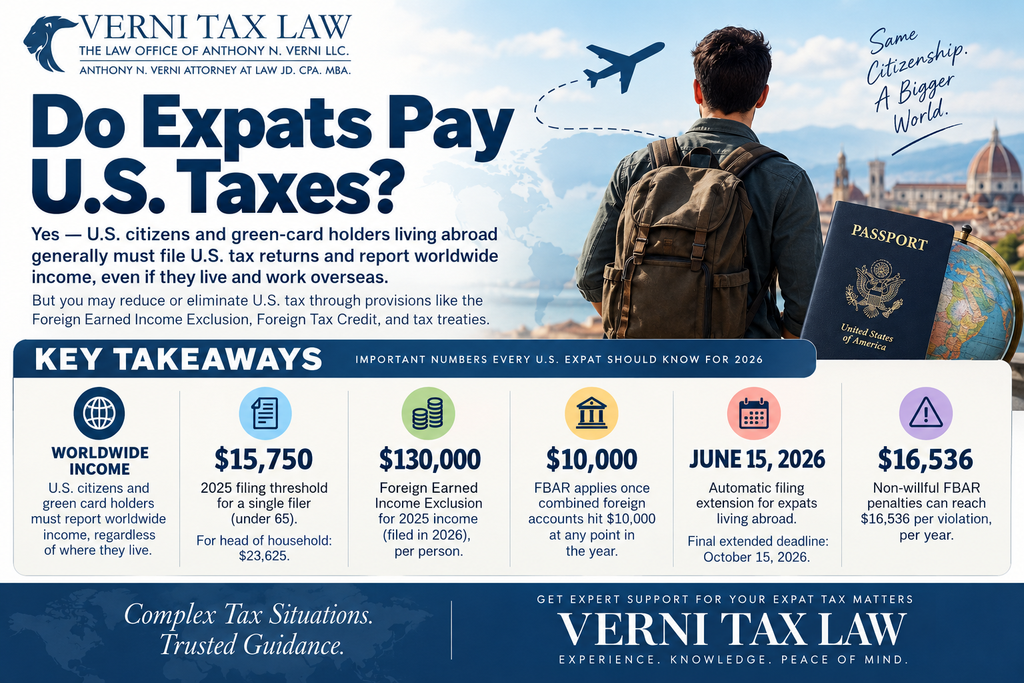
U.S. citizens and green-card holders living abroad generally must file U.S. tax returns and report worldwide income, even if they live and work overseas. However, they may reduce or eliminate U.S. tax through provisions such as the Foreign Earned Income Exclusion, Foreign Tax Credit, and applicable tax treaties.
Non-U.S. citizens who are not U.S. tax residents generally pay U.S. taxes only on certain U.S.-source income.
Key Takeaways
- US citizens and green card holders report worldwide income regardless of residence.
- The 2025 filing threshold for a single filer under 65 is $15,750; for head of household, $23,625.
- The Foreign Earned Income Exclusion for 2025 income (filed in 2026) is $130,000 per person.
- FBAR applies once combined foreign accounts hit $10,000 at any point in the year.
- Expats get an automatic filing extension to June 15, 2026; the final extended deadline is October 15, 2026.
- Non-willful FBAR penalties can reach $16,536 per violation, per year.
Do Expats Pay US Taxes? The Short Answer
Every US citizen and green card holder abroad is taxed on worldwide income, but a return doesn’t always mean a tax bill.
U.S. Citizens Are Taxed on Worldwide Income
US citizens living abroad pay taxes. The US is one of two countries that tax based on citizenship rather than residence (the other is Eritrea). Your salary in Berlin, rental income in Mexico City, and dividends from a Canadian brokerage all land on your Form 1040, right alongside anything earned inside the US.
Filing Doesn’t Always Mean Owing
Most expats who file correctly owe nothing. The Foreign Earned Income Exclusion and the Foreign Tax Credit erase double taxation for the vast majority of earned income, so the return exists mainly to prove the math, not to generate a bill.
What Income Do U.S. Expats Have to Report?
The IRS wants worldwide gross income listed on the return before any exclusion or credit reduces the taxable amount.
- Foreign employment and self-employment income: Wages, bonuses, and freelance earnings all qualify as foreign earned income under FEIE rules, but self-employment tax (15.3%) still applies unless a totalization agreement says otherwise.
- Interest, dividends, and investment income: This is passive income, so FEIE never touches it; only the Foreign Tax Credit or a treaty can offset double taxation here.
- Rental and real estate income: Net rental income from a foreign property is reportable, and depreciation rules differ from US property (30-year straight-line under the Alternative Depreciation System for foreign real estate).
- Retirement and pension income: Most foreign pensions are taxable in the US, though treaty provisions occasionally shift timing or amount.
- Foreign business and partnership income: Ownership in a foreign corporation or partnership can trigger Form 5471 or Form 8865 reporting on top of regular income tax.
Do Expats Have to File a U.S. Tax Return in 2026?
Filing depends on gross income crossing a threshold set by filing status, not on where you live. The 2025 tax year thresholds (filed by the 2026 deadlines) are the ones that matter for this filing season.
| Filing Status | Under 65 | 65 or Older |
| Single | $15,750 | $17,750 |
| Head of Household | $23,625 | $25,625 |
| Married Filing Jointly (both under 65) | $31,500 | $33,100 (one 65+) |
| Married Filing Separately | $5 | $5 |
The table above uses IRS Publication 501 figures for the 2025 tax year. Anyone self-employed abroad must file once net earnings hit $400, regardless of the thresholds above.
U.S. Citizens vs. Green Card Holders Abroad
Green card holders face the exact same worldwide-income rule as citizens. A green card doesn’t need to be “used” to trigger tax obligations; holding it is enough, and abandoning it without filing Form 8854 can leave someone on the hook for years afterward.
When You May Not Have to File
Income below the threshold, with no self-employment earnings and no special triggers (like receiving a foreign gift over $100,000, reportable on Form 3520), generally means no federal return is required. FBAR and FATCA obligations, though, run on completely separate thresholds and can still apply.
What Tax Forms Do Americans Living Abroad Need?
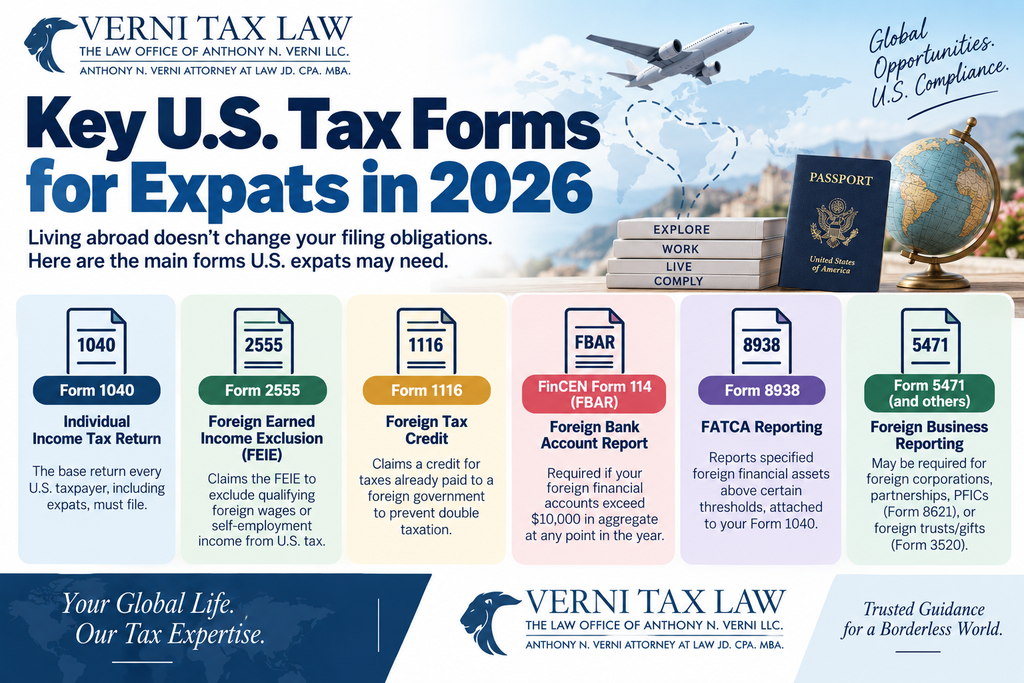
- Form 1040: The base individual return every filer starts with.
- Form 2555: Claims the Foreign Earned Income Exclusion against qualifying wages or self-employment income.
- Form 1116: Claims the Foreign Tax Credit for taxes already paid to a foreign government.
- FinCEN Form 114 (FBAR): Reports foreign financial accounts once the $10,000 aggregate threshold is crossed.
- Form 8938: FATCA reporting for specified foreign financial assets above separate, higher thresholds.
- Form 5471, Form 8621, Form 3520: Cover foreign corporations, passive foreign investment companies (PFICs), and foreign trusts or large foreign gifts.
How the Foreign Earned Income Exclusion Helps Expats
The Foreign Earned Income Exclusion (FEIE) is a provision under IRC §911 that lets qualifying taxpayers exclude a set amount of foreign wages or self-employment income from US tax entirely. For 2025 income filed in 2026, that cap is $130,000 per person; for 2026 income filed in 2027, it rises to $132,900.
Bona Fide Residence Test & Physical Presence Test
- Bona Fide Residence Test: This test asks whether you were a genuine resident of a foreign country for an entire, uninterrupted tax year, not just physically present, but settled there with no clear intent to return to the US permanently.
- Physical Presence Test: 330 full days outside the US within any 12-month period. Short trips home for holidays reduce that count fast, so travel logs matter more than people expect.
How Form 2555 Claims FEIE
Form 2555 attaches to Form 1040 and requires exact travel dates, employer information, and the qualifying test used.
FEIE vs. Foreign Tax Credit: Which Is Better?
- If you are living in a high-tax country like Germany or the UK, the Foreign Tax Credit usually wins, because foreign tax paid there often exceeds what US tax would have been anyway, and unused credit carries forward.
- If you are living somewhere with low or no income tax, like the UAE, FEIE is almost always the better call, since there’s little or no foreign tax to credit against.
- Self-employed expats should run both calculations before deciding, since FEIE doesn’t reduce self-employment tax the way a credit sometimes offsets it.
How Foreign Tax Credits Prevent Double Taxation
The Foreign Tax Credit lets a taxpayer offset US tax dollar-for-dollar against income tax already paid to a foreign government, filed on Form 1116. It exists specifically to stop the same income from being taxed twice.
Can You Claim Both FEIE and Foreign Tax Credits?
Yes, but not on the same dollar of income. Income excluded through FEIE can’t also generate a foreign tax credit; the credit only applies to income and tax that fall outside the excluded amount, which matters for anyone earning above the FEIE cap.
Tax treaties can shift which country taxes specific income first, and they matter most for pensions, Social Security equivalents, and government wages. U.S. expat tax advice on treaty benefits should come from someone who has actually read the specific treaty text, since provisions vary enormously by country.
Do Expats Have to File FBAR in 2026?
Yes, once foreign accounts cross $10,000 in combined value at any single moment during the year, filing FinCEN Form 114 becomes mandatory.
Who Must File
Any US person, citizen, green card holder, or resident alien, with a financial interest in or signature authority over a foreign account, qualifies. Signature authority alone, without ownership, still counts.
What Accounts Count
Bank accounts, brokerage accounts, foreign pensions with cash value, and certain foreign life insurance policies all count toward the aggregate. Documents needed to file an FBAR include account numbers, the maximum balance during the year, and the financial institution’s name and address for each account.
FBAR vs. Form 8938
| FBAR (FinCEN 114) | Form 8938 (FATCA) | |
| Filed with | FinCEN, separately | IRS, attached to Form 1040 |
| Threshold (single, abroad) | $10,000 aggregate | $200,000 year-end / $300,000 any time |
| Threshold (married, abroad) | $10,000 aggregate | $400,000 year-end / $600,000 any time |
| Deadline | April 15, auto-extends to Oct 15 | Same as your tax return |
A missed FBAR deadline triggers automatic exposure to civil penalties, currently up to $16,536 per non-willful violation per year. Willful violations run far higher, the greater of $165,353 or 50% of the account balance. Late FBAR penalties escalate the longer the gap sits unaddressed, so a missed FBAR deadline rarely gets cheaper with time.
What Are the 2026 U.S. Tax Deadlines for Expats?
FBAR follows a separate calendar: April 15, 2026, with an automatic extension to October 15, 2026, regardless of the income tax extension status.
- April 15, 2026: The standard federal deadline for 2025 tax year returns.
- June 15, 2026: An automatic two-month extension for anyone living outside the US on April 15; no form required, though any tax owed still accrues interest from April 15.
- October 15, 2026: The final extended deadline, available by filing Form 4868 before June 15.
Do Expats Still Pay U.S. State Taxes?
Sometimes, and it depends entirely on which state you left. Most states stop taxing someone who establishes clear domicile abroad and severs ties like voter registration and property ownership. States like California, Virginia, New Mexico, and South Carolina are notorious “sticky” states that keep taxing former residents until specific domicile-abandonment steps are documented and proven.
What If You Never Filed U.S. Taxes While Living Abroad?
The IRS built a specific path for this exact situation. Filing multiple years of unfiled tax returns doesn’t have to mean facing maximum penalties if the failure was non-willful.
Streamlined Filing Compliance Procedures
The Streamlined Filing Procedures require three years of tax returns and six years of FBARs, plus a signed non-willfulness certification (Form 14653 for those living abroad). Expats using the foreign track pay tax and interest only, with no additional offshore penalty.
When Streamlined Filing Applies
Eligibility requires that the original failure to report resulted from negligence, a misunderstanding of the rules, or an honest mistake, not a deliberate choice to hide income. Anyone already under IRS examination is disqualified from using this program.
Delinquent FBAR Submission Procedures
If income was reported correctly and only the FBAR was missed, separate delinquent FBAR submission procedures exist to file without amending any tax return, generally without penalty.
What Happens If an Expat Doesn’t File?
- Failure-to-file penalties accrue at 5% of unpaid tax per month, up to 25%.
- Failure-to-pay penalties add another 0.5% per month on top of that.
- FBAR penalties apply separately and can reach $16,536 per unfiled report even without willfulness.
- The IRS can pursue collection indefinitely on an unfiled return since the statute of limitations never starts running.
- Passport renewal or issuance can be denied under Section 7345 for seriously delinquent tax debt over a set threshold.
- Interest compounds daily from the original due date, not from when the IRS discovers the issue.
Special Tax Situations for Americans Living Abroad
Americans Married to Foreign Spouses
A non-citizen spouse isn’t automatically taxed by the US, but filing status choices (married filing separately versus a Section 6013(g) election to treat the spouse as a US resident for tax purposes) carry real tradeoffs in exclusions and credits.
U.S. Expats Who Own Foreign Businesses
Owning 10% or more of a foreign corporation can trigger Form 5471, one of the most penalty-heavy forms in the entire tax code; $10,000 per form, per year, for a late or missing filing.
Foreign Retirement Accounts and Pensions
Employer pensions in some countries qualify for treaty relief; personal retirement accounts abroad often don’t get the same tax-deferred treatment the US gives 401(k)s and IRAs, and some (like Canadian TFSAs) require separate trust reporting on Form 3520-A.
Digital Nomads and Remote Workers Abroad
Working from a laptop in Bali for a US company still counts as US-source income in many cases, not foreign earned income, which means FEIE may not apply at all depending on where the employer and the work are legally sourced.
U.S. Citizens Retired Overseas
Social Security payments stay taxable under the same rules as if living in the US, and required minimum distributions from IRAs and 401(k)s don’t pause just because the account holder relocated.
Common U.S. Expat Tax Mistakes to Avoid in 2026
- Assuming FEIE eliminates self-employment tax (it doesn’t).
- Skipping FBAR because the accounts are jointly held with a foreign spouse.
- Missing the June 15 income tax extension window and paying avoidable interest.
- Forgetting that a foreign pension can trigger Form 3520 or 3520-A reporting.
- Filing FEIE and FTC on the same income and creating a math error the IRS flags.
- Believing that not owing tax means not needing to file at all.
When Should You Hire an Expat Tax Accountant or Advisor?
- Foreign business ownership, trusts, or PFIC holdings are involved.
- Multiple years are unfiled and Streamlined eligibility needs confirming.
- FBAR penalties have already been assessed or threatened.
- Citizenship renunciation (Form 8854) is being considered.
- State residency status is contested by a “sticky” state.
- The FEIE vs. Foreign Tax Credit decision affects a six-figure income swing.
What Should Americans Living Abroad Do Before Filing Their 2026 Taxes?
Step 1: Gather U.S. and Foreign Income Records
Pull W-2s, foreign payslips, self-employment ledgers, and 1099s from every source, US and foreign alike.
Step 2: Review Foreign Bank and Investment Accounts
Check the highest balance in every foreign account across the year to determine FBAR and FATCA exposure before assuming neither applies.
Step 3: Determine FEIE or FTC Eligibility
Run both the bona fide residence and physical presence tests, then compare FEIE against the Foreign Tax Credit using actual numbers, not guesses.
Step 4: Check FBAR and FATCA Requirements
Confirm account totals against both the $10,000 FBAR threshold and the higher, residency-based FATCA thresholds.
Step 5: Confirm Your Filing Deadlines
Mark April 15, June 15, and October 15 for the income tax return, and April 15/October 15 separately for FBAR.
Step 6: Get Professional Help If Your Situation Is Complex
A CPA for expats or an expat tax advisor earns their fee fast once foreign corporations, PFICs, or multiple unfiled years enter the picture.
How Verni Tax Law Helps With Expat Tax Filing
Anthony N. Verni is licensed as an attorney in New Jersey, a Certified Public Accountant, and holds an MBA, with more than 25 years spent resolving federal and international tax matters. Expat cases often blend legal exposure (FBAR penalties, disclosure programs) with pure accounting work (FEIE calculations, foreign tax credit math), and few practitioners are qualified to handle both sides of the same case.
- Reviews global account structures to determine exact FBAR and FATCA exposure before anything gets filed.
- Prepares and files Streamlined Filing submissions for clients with multiple years of unfiled returns.
- Represents clients directly before the IRS on FBAR penalty disputes, using experience built through the Offshore Voluntary Disclosure Program since 2009.
- Handles consultations by phone or secure video conference for clients anywhere in the world, at hours that work across time zones.
Anthony personally reviews every case himself, so the strategy applied to a case matches the judgment his 25 years of experience actually built. Book a confidential consultation with Anthony N. Verni to review your specific expat filing situation before a deadline or penalty becomes unavoidable.
Conclusion
Filing correctly, using FEIE, the Foreign Tax Credit, and FBAR where each applies, keeps most expats from owing anything beyond the paperwork itself. The real risk is with people who assume distance from the US erases the obligation; it doesn’t, and the penalties for guessing wrong compound daily.
Anthony N. Verni at Verni Tax Law built his practice around exactly this kind of cross-border complexity, holding credentials as an attorney, CPA, and MBA that let him handle both the legal exposure and the accounting math in one place. His work with the Offshore Voluntary Disclosure Program since 2009 gives him a working knowledge of how the IRS actually treats disclosure cases.
If unfiled returns, FBAR exposure, or an FEIE-versus-credit decision is on the table, contact Anthony N. Verni directly to talk through the specifics of your case.
FAQs
Do U.S. citizens living abroad have to pay U.S. taxes?
Yes. Citizenship, not residence, determines the obligation, so worldwide income gets reported regardless of where you live.
Do expats pay U.S. income tax on foreign income?
Yes, foreign income is reportable, though FEIE or the Foreign Tax Credit often reduces the actual tax owed to zero.
Can I avoid U.S. taxes by living in another country?
No. Only formal expatriation under Form 8854, or income falling below the filing threshold, changes the obligation.
What is the Foreign Earned Income Exclusion?
It’s a provision letting qualifying expats exclude up to $130,000 (2025 tax year) of foreign earned income from US tax.
How does the Foreign Tax Credit work for expats?
It offsets US tax dollar-for-dollar against foreign income tax already paid, filed on Form 1116.
Do expats need to file Form 2555?
Only if claiming FEIE. It’s optional for those choosing the Foreign Tax Credit instead.
Do U.S. citizens abroad have to file FBAR?
Yes, once combined foreign accounts exceed $10,000 at any point in the year.
What is the U.S. expat tax deadline for 2026?
April 15, 2026, with an automatic extension to June 15, 2026, and a final extension to October 15, 2026.
Do expats have to file U.S. state taxes?
Sometimes. It depends on whether the former state of residence considers domicile fully severed.
What happens if I never filed U.S. taxes while living abroad?
Streamlined Filing Compliance Procedures can resolve this with three years of returns and six years of FBARs, often without penalty.
Can an expat file several years of back taxes?
Yes, through Streamlined Filing if the failure was non-willful, or through voluntary disclosure if it wasn’t.
Do retired Americans living abroad pay U.S. taxes?
Yes. Social Security and retirement account distributions remain taxable under the same rules as in the US.
Do digital nomads have to pay U.S. taxes?
Yes, and FEIE may not apply if the income is US-sourced rather than foreign-earned, depending on the work arrangement.
Should I hire a CPA for expat taxes?
It’s worth it once foreign businesses, trusts, PFICs, or multiple unfiled years are involved, since the penalty exposure is high.