
A civil FBAR violation can be “willful” even when the taxpayer did not knowingly break the law. The Second Circuit’s January 2026 decision in United States v. Reyes confirmed that reckless conduct can satisfy the civil willfulness standard.
An FBAR tax attorney can assess the facts before the IRS turns an honest mistake into a much larger penalty dispute. This guide explains the United States v. Reyes FBAR ruling, the meaning of reckless disregard, current penalty rules, defense options, and how a FBAR willful penalty lawyer can respond.
Key Takeaways
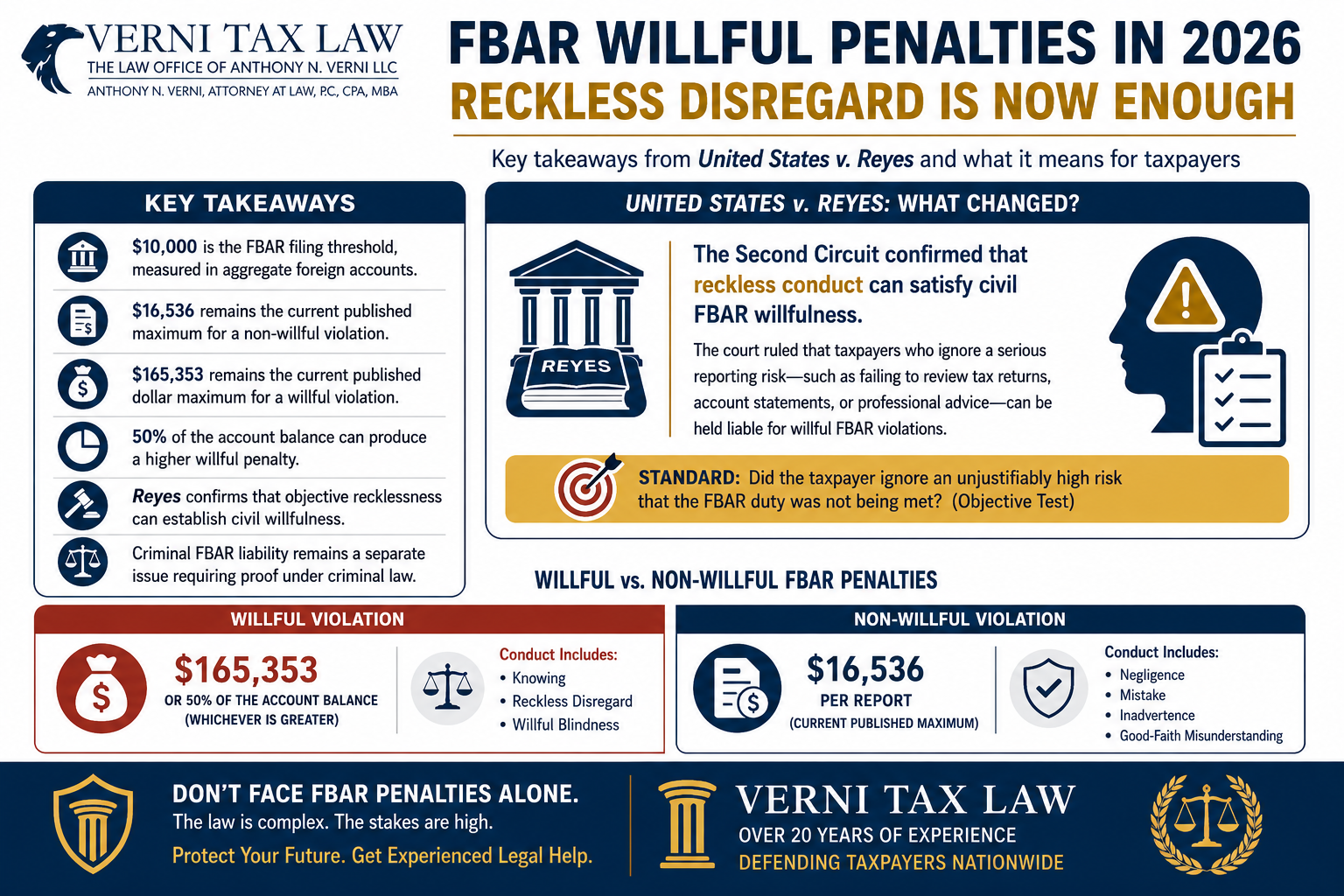
- $10,000 is the FBAR filing threshold, measured in aggregate foreign accounts.
- $16,536 remains the current published maximum for a non-willful violation.
- $165,353 remains the current published dollar maximum for a willful violation.
- 50% of the account balance can produce a higher willful penalty.
- Reyes confirms that objective recklessness can establish civil willfulness.
- Criminal FBAR liability remains a separate issue requiring proof under criminal law.
What Is a Willful FBAR Violation in 2026?
A willful FBAR violation occurs when a taxpayer knowingly, recklessly, or through willful blindness fails to meet the foreign-account reporting duty. The IRS states that civil willfulness includes reckless disregard and uses an objective test.
An FBAR is the Report of Foreign Bank and Financial Accounts filed electronically through FinCEN. A U.S. person generally must file when foreign financial accounts exceed $10,000 in total at any time during the year.
| Factor | Willful Violation | Non-Willful Violation |
| Conduct | Knowing, reckless, or willfully blind | Negligence, mistake, inadvertence, or good-faith misunderstanding |
| Civil exposure | Greater of $165,353 or 50% of account balance | Up to $16,536 per report |
| IRS focus | Conduct, knowledge, documents, returns, account activity | Reasonable cause and correction |
| Defense | Contest willfulness and penalty amount | Show non-willfulness and reasonable cause |
| Bittner impact | Willful rules remain distinct | Non-willful penalty applies per report |
The table shows why a willful vs non-willful FBAR 2026 analysis must happen before choosing a filing or disclosure path. The IRS has discretion over the penalty amount, so the statutory maximum does not automatically become the assessment.
United States v. Reyes: How It Changed the FBAR Willfulness Standard
United States v. Reyes did not create reckless disregard from scratch. It confirmed in the Second Circuit that civil FBAR willfulness under 31 U.S.C. § 5321 includes reckless conduct.
Background of the United States v. Reyes Case
Juan and Catherine Reyes held a Swiss account containing more than $2 million. They did not report the account on FBARs for 2010, 2011, and 2012, despite questions from their accountant and the IRS.
The government sought civil penalties. The district court found their conduct reckless and imposed enhanced penalties. The Second Circuit affirmed and entered judgment for the United States.
The Court's Reckless Disregard Standard
The reckless disregard FBAR penalty standard asks whether the taxpayer ignored an unjustifiably high risk that the reporting duty was not being met. The court applied an objective test.
The Second Circuit relied heavily on Safeco Insurance Co. v. Burr, where the Supreme Court explained that civil “willfulness” can include reckless conduct. The court also noted that multiple federal appellate courts had reached the same conclusion for FBAR penalties. The decision reinforces an appellate consensus that civil FBAR willfulness is broader than intentional wrongdoing.
Impact on Taxpayers With Foreign Accounts
A taxpayer cannot safely assume that “I did not know” ends the analysis. In a serious case, the IRS may ask why the taxpayer failed to review tax returns, Schedule B, bank records, or professional advice.
An FBAR willful penalty lawyer should examine those facts before the taxpayer makes statements that could later support the IRS position.
What Does Reckless Disregard Mean for FBAR Penalties?
Reckless disregard means the taxpayer faced a serious reporting risk that was obvious enough to require attention, yet failed to check or act. The IRS expressly describes civil recklessness as an objective standard.
Ignoring FBAR Filing Obligations
Ignoring repeated reporting duties can support willfulness. Prior FBAR filings, IRS notices, or prior professional advice can become important evidence.
Failing to Review Tax Returns and Forms
Schedule B asks about foreign financial accounts. Failing to review that question can become evidence when other facts show the taxpayer could easily have learned about the FBAR duty.
Signing Returns Without Understanding Reporting Requirements
Signing a return does not automatically prove willfulness. Yet repeated signatures on returns containing foreign-account questions can become evidence when combined with other facts.
Using an Unqualified Tax Preparer
Hiring a preparer does not automatically transfer legal responsibility. IRS guidance states that the taxpayer remains responsible for timely and accurate FBAR filing.
How Much Is the Willful FBAR Penalty in 2026?
The current published maximum for a willful FBAR violation is $165,353 or 50% of the account balance at the time of violation, whichever is greater. OMB canceled the 2026 inflation adjustment, leaving the January 2025 FinCEN amounts in place.
Maximum Civil FBAR Penalty
The statutory $100,000 figure is inflation-adjusted to $165,353 under the currently published FinCEN table. The IRS may assess less because FBAR penalties have no mandatory minimum.
Penalty Based on Account Balance
The 50% test can produce a much larger result. For example, 50% of a $1 million account is $500,000. The IRS mitigation rules can reduce certain assessments. Willful FBAR penalties therefore require both a willfulness analysis and a penalty calculation.
Criminal FBAR Penalties
Civil and criminal FBAR penalties are separate. Criminal liability can involve fines and imprisonment under 31 U.S.C. § 5322, while the civil penalty operates under 31 U.S.C. § 5321. An FBAR tax attorney should treat criminal exposure differently from a civil assessment.
Willful vs Non-Willful FBAR Violations: Key Differences
The biggest difference in willful vs non-willful FBAR 2026 cases is the type of conduct the government must establish. Non-willful conduct can result from negligence, inadvertence, mistake, or a good-faith misunderstanding.
| Difference | Willful | Non-Willful |
| Penalty | Greater of $165,353 or 50% | Up to $16,536 per report |
| IRS investigation approach | Builds facts showing knowledge, recklessness, or blindness | Examines mistake, reasonable cause, and correction |
| Available resolution options | Mitigation, litigation, settlement, voluntary disclosure where appropriate | Reasonable cause, delinquent filing, streamlined procedures where eligible |
| Bittner rule | Not changed | One penalty per annual report, not per account |
After Bittner, the Supreme Court limited non-willful penalties to the report rather than each account. An FBAR penalty defense attorney should therefore separate the Bittner issue from the much more severe willful penalty framework.
How the IRS Determines FBAR Willfulness
The IRS generally builds willfulness from the full factual record rather than one document. Its own manual says the burden of establishing willfulness rests with the IRS.
Prior FBAR filings or prior FBAR warnings.
Schedule B answers on signed tax returns.
Foreign bank statements.
Communications with tax preparers.
Evidence about unreported foreign income.
Account ownership and signature authority.
Attempts to conceal accounts or income.
Responses to IRS information requests.
Offshore bank promotional material.
The taxpayer’s explanation for the missing filing.
The taxpayer’s cooperation during examination.
These facts explain why FBAR attorney guidance matters when the IRS starts asking questions.
What Should You Do If You May Have a Willful FBAR Violation?
Do not rush to file corrected forms or sign a willfulness statement before reviewing the evidence. An FBAR penalty defense attorney can first determine whether the facts actually support a willful classification.
Step 1: Gather Every Relevant Record
Collect tax returns, Schedule B forms, FBARs, bank statements, preparer communications, and IRS notices.
Step 2: Build a Year-by-Year Timeline
Identify each account, maximum balance, ownership interest, filing history, and communication about foreign accounts.
Step 3: Review What You Actually Knew
Separate actual knowledge from assumptions. Then examine whether the facts could support objective recklessness.
Step 4: Choose the Correct Compliance Path
Do not assume that delinquent FBAR filing procedures fit every case. The correct approach depends on whether the conduct was non-willful and whether the IRS has already contacted you.
Step 5: Protect Your Position Before Responding
If the IRS has assessed a penalty, review the assessment, calculation, evidence, and procedural history before seeking FBAR penalty defense after assessment.
Can You Reduce or Avoid Willful FBAR Penalties?
Yes, penalty exposure can sometimes be reduced, but the available remedy depends on the facts, timing, and compliance status. The IRS gives examiners discretion and provides mitigation rules for qualifying cases.
Voluntary Disclosure Practice
Taxpayers concerned that their conduct was willful may consider the IRS Criminal Investigation Voluntary Disclosure Practice. The IRS specifically directs taxpayers concerned about willfulness toward this practice rather than falsely claiming non-willfulness.
Reasonable Cause Arguments
Reasonable cause can protect against a non-willful FBAR penalty when the requirements are met. It is not a simple escape from a proven willful violation.
Non-Willful Certification Options
Eligible taxpayers may use streamlined procedures when their conduct was genuinely non-willful. Domestic streamlined procedures generally cover the most recent 3 tax-return years and 6 FBAR years, with a 5% miscellaneous offshore penalty for qualifying U.S. residents.
A streamlined FBAR attorney should test eligibility before certification. A false certification can create serious consequences. The IRS also provides specific FBAR penalty mitigation options and IRS FBAR mitigation guidelines for examiners assessing civil penalties.
How Verni Tax Law Helps Defend Against FBAR Willful Penalties
Verni Tax Law can help taxpayers analyze FBAR willfulness, challenge reckless-disregard arguments, and address civil or criminal offshore tax issues. Anthony N. Verni is a tax attorney, CPA, and MBA with more than 20 years of experience practicing before the IRS.
He reviews the facts behind the alleged reckless disregard for penalty.
He examines returns, Schedule B answers, bank records, and IRS evidence.
He evaluates mitigation under the IRS FBAR mitigation guidelines.
He can assess FBAR penalty appeal options after an assessment.
He evaluates whether streamlined procedures or voluntary disclosure fit the facts.
He handles offshore civil and criminal tax matters.
His practice includes taxpayers facing IRS examinations and DOJ criminal investigations.
Anthony N. Verni can help determine whether the IRS has enough evidence to support willfulness under United States v. Reyes FBAR. He can also assess whether the government’s penalty calculation matches the governing rules.
If you need an FBAR willful penalty lawyer, contact Verni Tax Law to discuss your FBAR penalty concerns and determine your next step.
Conclusion
A taxpayer does not need to admit that he knowingly broke the FBAR rules before the government can establish civil willfulness. Objective recklessness can be enough when the reporting risk was serious and obvious. The current published willful penalty can reach $165,353 or 50% of the account balance, while non-willful treatment remains far less severe. Taxpayers facing exposure should address the classification first, then evaluate mitigation, correction, or defense options based on the complete record.
Verni Tax Law is a strong choice for taxpayers facing this specific problem. Anthony N. Verni combines tax law and accounting experience with more than 20 years of IRS practice. He represents taxpayers dealing with unfiled FBARs, offshore assets, IRS examinations, voluntary disclosures, and serious civil or criminal tax matters. If you need help with an FBAR willful penalty lawyer, an FBAR tax attorney, or an FBAR penalty defense attorney, contact Verni Tax Law for a consultation. Contact Verni Tax Law
FAQs
What did United States v. Reyes change about FBAR penalties?
Reyes confirmed in the Second Circuit that reckless conduct can satisfy civil FBAR willfulness under 31 U.S.C. § 5321.
What is considered reckless disregard for FBAR violations?
Objective recklessness means ignoring a serious and obvious risk that the FBAR reporting duty was not being met.
What is the difference between willful and non-willful FBAR violations?
Willful includes knowing, reckless, or willfully blind conduct; non-willful conduct involves negligence, mistake, or good-faith misunderstanding.
How much is the penalty for a willful FBAR violation?
$165,353: The current published maximum dollar amount is $165,353, or 50% of the account balance when that amount is greater.
Can the IRS impose FBAR penalties without proving intentional wrongdoing?
Yes. Civil FBAR willfulness can rest on reckless conduct, so intentional wrongdoing is not always required.
What evidence does the IRS use to prove FBAR willfulness?
Tax returns: The IRS may examine Schedule B, bank records, prior FBARs, preparer communications, IRS notices, and account activity.
Can I reduce a willful FBAR penalty?
Yes. IRS mitigation rules and examiner discretion can sometimes reduce an assessment, depending on the facts and applicable criteria.
Should I use voluntary disclosure after a possible FBAR violation?
Only after review: Taxpayers concerned about willfulness should evaluate the IRS Voluntary Disclosure Practice before making a non-willful certification.
Can an FBAR attorney help fight a willful penalty?
Yes. An attorney can review the IRS evidence, challenge willfulness, assess penalty calculations, and evaluate FBAR penalty appeal options.
How can taxpayers correct past FBAR mistakes in 2026?
Determine whether the conduct was non-willful, then evaluate delinquent FBAR filing procedures, reasonable cause, streamlined procedures, or voluntary disclosure.