
Americans living abroad must file a US tax return every year, even if they owe nothing and already pay tax in their host country. Small errors on foreign income, FBAR forms, or FATCA disclosures are what turn a routine filing into an audit or years of back returns. This guide covers exactly what to file, when, and how a US expat tax consultant helps you avoid the mistakes that cost the most money.
Key Takeaways
- US citizens abroad must file once worldwide income exceeds $14,600 (single filers).
- The Foreign Earned Income Exclusion covers up to $130,000 of foreign wages for 2025, rising to $132,900 for 2026.
- FBAR filing kicks in once foreign accounts hit $10,000 combined, at any point in the year.
- Form 8938 applies at $200,000 (single, year-end) for expats, double for joint filers.
- Streamlined Filing lets non-willful late filers catch up with zero penalty.
- An expat tax preparation service catches PFIC and FBAR errors most generalists miss.
Do Americans Living Abroad Still Need to File US Taxes?
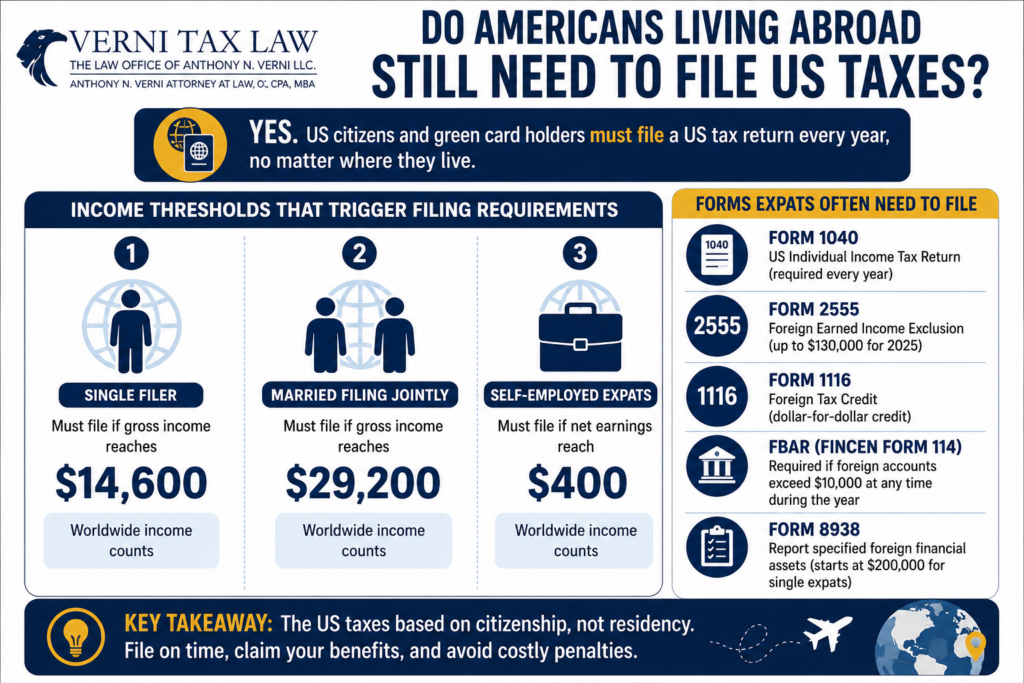
Yes, US citizens and green card holders must file a federal return every year, no matter where they live, because the US taxes based on citizenship, not residency.
Citizenship-Based Taxation Explained
Citizenship-based taxation means the IRS taxes you on worldwide income simply because you hold a US passport or green card. Only the United States and Eritrea tax citizens this way. This is exactly why an expat tax preparation service matters if you have years of unfiled returns.
Income Thresholds That Trigger Filing Requirements
A single filer under 65 must file once gross income reaches $14,600; a married couple filing jointly must file at $29,200. Self-employed expats must file once net earnings hit just $400. These thresholds count worldwide income, including foreign salary, freelance pay, rental income, and pension distributions.
Essential Documents Needed Before Filing
You need proof of foreign earnings, foreign account records, and foreign asset statements before you start.
Foreign Income Records and Employer Documents
Gather pay stubs, contracts, or a foreign equivalent of a W-2. Self-employed expats need profit and loss statements instead. Translate any foreign-language document and keep the original, converting figures to US dollars using the correct exchange rate for each pay period.
Foreign Bank Account Information
Pull year-end and highest-balance statements for every foreign account you own or control. These numbers feed straight into your FBAR filing documents and Form 8938, so accuracy here prevents mismatches later. Include joint accounts and any account where you hold signature authority, even without ownership.
Investment and Foreign Asset Documentation
Collect statements for foreign brokerage accounts, foreign mutual funds, foreign pensions, and any stake in a foreign business. Foreign mutual funds often qualify as Passive Foreign Investment Companies (PFICs), which carry harsh default tax treatment. An expat tax preparation service helps you complete PFIC reviews.
Step-by-Step Process to File US Taxes from Overseas
Filing from overseas follows the same core steps as a domestic return, plus extra forms for foreign income and account disclosures. Residency status and income reporting come first; exclusions and credits get applied afterward.
Determine Your Filing Status and Tax Residency
Confirm your filing status and check whether you meet the Bona Fide Residence Test or the Physical Presence Test under IRS Publication 54. The Physical Presence Test requires 330 full days in a foreign country within any 12-month period. Meeting either test qualifies you for the Foreign Earned Income Exclusion and the automatic extension to June 15.
Report Worldwide Income Correctly
Report every dollar of worldwide income on Form 1040 first, then apply exclusions or credits. A common error is skipping income assumed to be “already taxed” abroad; the IRS still requires it on the return before any exclusion reduces the bill.
Claim Available Exclusions and Credits
File Form 2555 for the Foreign Earned Income Exclusion or Form 1116 for the Foreign Tax Credit, whichever saves more. Expats in high-tax countries like the UK or Germany usually benefit more from the credit, since it has no dollar cap. Expats in low-tax countries usually save more with the exclusion.
Important Expat Tax Benefits That Reduce Tax Liability
Three expat benefits that reduce tax liability are the Foreign Earned Income Exclusion, the Foreign Tax Credit, and the Foreign Housing Exclusion.
Foreign Earned Income Exclusion (FEIE)
The FEIE excludes up to $130,000 of foreign earned income for 2025, and $132,900 for 2026, using Form 2555. It only covers earned income, not passive income like dividends, and it does not reduce self-employment tax, a detail many freelance expats miss.
Foreign Tax Credit (FTC)
The FTC gives a dollar-for-dollar credit on Form 1116 for foreign income tax already paid, with no cap on the credit amount. Unused credits carry forward for up to 10 years, making it stronger than FEIE for high-tax countries.
Foreign Housing Exclusion and Deduction
Employees claim a Foreign Housing Exclusion; self-employed expats claim a Foreign Housing Deduction. Both cover rent and utilities above a base amount, capped at 30% of the FEIE limit, though high-cost cities like Hong Kong may qualify for a higher cap.
FBAR and FATCA Reporting Requirements
FBAR and FATCA are separate rules covering foreign accounts and assets, and most expats with meaningful foreign holdings must file both.
When FBAR Filing Is Required
FBAR filing is required once combined foreign accounts exceed $10,000 at any single point in the year, even for one day. This covers checking, savings, and any account where you hold signature authority. It is filed separately with FinCEN on Form 114, due April 15, with an automatic extension to October 15.
FATCA Form 8938 Reporting Rules
FATCA Form 8938 filing requirements apply once foreign financial assets exceed $200,000 at year-end (or $300,000 at any point) for single expats, and double that for joint filers. Form 8938 attaches to Form 1040 and covers a broader asset range, including foreign stocks held outside a bank account.
Common Mistakes That Cause Delays and IRS Problems
The costliest mistakes are missing the FBAR deadline, skipping PFIC reporting, and assuming foreign tax withholding replaces US filing duty. Each triggers IRS foreign income audits more often than expats expect, since FATCA data sharing gives the IRS direct account visibility.
- Assuming foreign tax paid cancels US filing duty
- Missing the FBAR deadline since it is separate from the tax deadline
- Reporting foreign mutual funds as regular investments instead of PFICs
- Using the wrong currency conversion date
- Filing married filing separately without checking Form 8938 thresholds
One expat in Singapore assumed a 15% local tax rate meant nothing was owed to the IRS, then found three years later that FEIE and FTC needed correct filing to avoid double taxation. A routine filing became a multi-year cleanup.
What If You’re Behind on US Tax Filings Abroad?
If you are behind, the Streamlined Filing Compliance Procedures usually offer the fastest, penalty-free path back for taxpayers whose non-compliance was not willful.
Streamlined Filing Compliance Procedures
The Streamlined Foreign Offshore Procedures require the 3 most recent delinquent returns and 6 years of FBARs, plus a signed non-willful certification on Form 14653. Qualifying expats pay a 0% penalty. This is the most effective delinquent tax return filing help for expats available today.
Catch-Up Filing Options for Expats
Expats can also use Delinquent FBAR Submission Procedures if returns were filed correctly, but FBARs were missed, or Delinquent International Information Return Procedures for missed forms like 8938.
Resolving Prior-Year Non-Compliance
Resolving prior non-compliance starts with a specific, factual explanation of why filings were missed; vague explanations get flagged. This is where late FBAR filing help from someone experienced with these submissions changes the outcome.
Benefits of Working With a US Expat Tax Consultant
A US expat tax consultant brings hands-on experience with FEIE, FTC, FBAR, and FATCA that a general accountant may only see occasionally, cutting the odds of an error that draws an IRS notice.
- Picks correctly between FEIE and FTC based on your foreign tax rate
- Catches PFIC exposure before it becomes a costly surprise
- Coordinates FBAR and Form 8938 so figures match and nothing is double-counted
- Handles Streamlined Filing paperwork for multi-year catch-up cases
- Represents you directly if the IRS opens an inquiry
How Verni Tax Law Helps Americans File Taxes Overseas
Verni Tax Law gives Americans abroad direct access to Anthony N. Verni, an attorney, CPA, and MBA who has personally handled international tax and FBAR cases since 2009. He works with US taxpayers across dozens of countries, from the Philippines to Germany to Japan.
- Personally reviews and manages every case, with no handoff to junior staff
- Combines legal, accounting, and business judgment across FBAR, FATCA, and Streamlined Filing matters
- Represents clients directly before the IRS if a filing turns into an examination
- Offers flexible consultations by phone or video, scheduled around international time zones
Personalized International Tax Planning
He builds a filing strategy around your specific accounts, income sources, and risk profile instead of a generic template, which matters most for taxpayers juggling multiple countries or years of missed filings.
He handles FBAR filings, Form 8938 reporting, Streamlined Filing submissions, and IRS notice responses under one point of contact. Book a confidential consultation with Verni Tax Law before a small gap becomes a bigger problem.
Stay Compliant and Avoid Costly Filing Mistakes Abroad
Filing US taxes from overseas comes down to three steps in order: report worldwide income first, apply FEIE or FTC to reduce what you owe, then complete FBAR and FATCA disclosures for accounts above the thresholds.
Anthony N. Verni has spent over 25 years resolving exactly these situations for Americans across dozens of countries, combining his background as an attorney, CPA, and MBA into one point of contact for the entire filing process. He personally manages FBAR filings, FATCA disclosures, and Streamlined Filing submissions, rather than routing cases through junior staff.
If you are behind on filings or facing an IRS notice about foreign accounts, contact Verni Tax Law today for a confidential consultation.
FAQs
Can I use a file US taxes abroad service if I live overseas permanently?
Yes. Citizenship-based taxation applies regardless of how long you have lived abroad.
What does an expat tax preparation service help with?
It handles worldwide income reporting, FEIE and FTC selection, FBAR filing, and Form 8938 disclosures in one filing.
When should I seek overseas tax filing help USA?
Seek help before your deadline if you have foreign income, accounts over $10,000, or unfiled prior years.
Why should I work with a US expat tax consultant?
A consultant catches FEIE, FTC, PFIC, and FBAR errors that general accountants often miss.
What IRS expat filing assistance options exist for late filers?
Streamlined Filing offers a 0% penalty path for non-willful late filers with 3 years of returns and 6 years of FBARs.
Do I need to file both FBAR and FATCA forms?
Yes, if you meet both thresholds: FBAR starts at $10,000 in accounts; Form 8938 starts at $200,000 in assets for expats.
What happens if I fail to report foreign income?
It can trigger penalties, interest, and IRS foreign income audits, since FATCA gives the IRS direct account data.
Can I catch up on several years of missed tax filings while living abroad?
Yes. Filing multiple years of unfiled tax returns through Streamlined Filing resolves 3 years of returns and 6 years of FBARs at once.