

Taxpayers can often resolve offshore tax evasion legally if they act before the IRS initiates contact. Depending on whether the conduct was willful or non-willful, the IRS provides several disclosure paths, such as streamlined filing, delinquent submission procedures, or the Voluntary Disclosure Practice, to bring accounts into compliance.
Under FATCA, over 110 countries now share financial data directly with the IRS. Once the IRS identifies a mismatch in your reporting, your options for penalty relief disappear. This guide explains how to identify offshore evasion, select the appropriate correction program, and avoid the severe consequences of waiting for an audit.
Key Takeaways
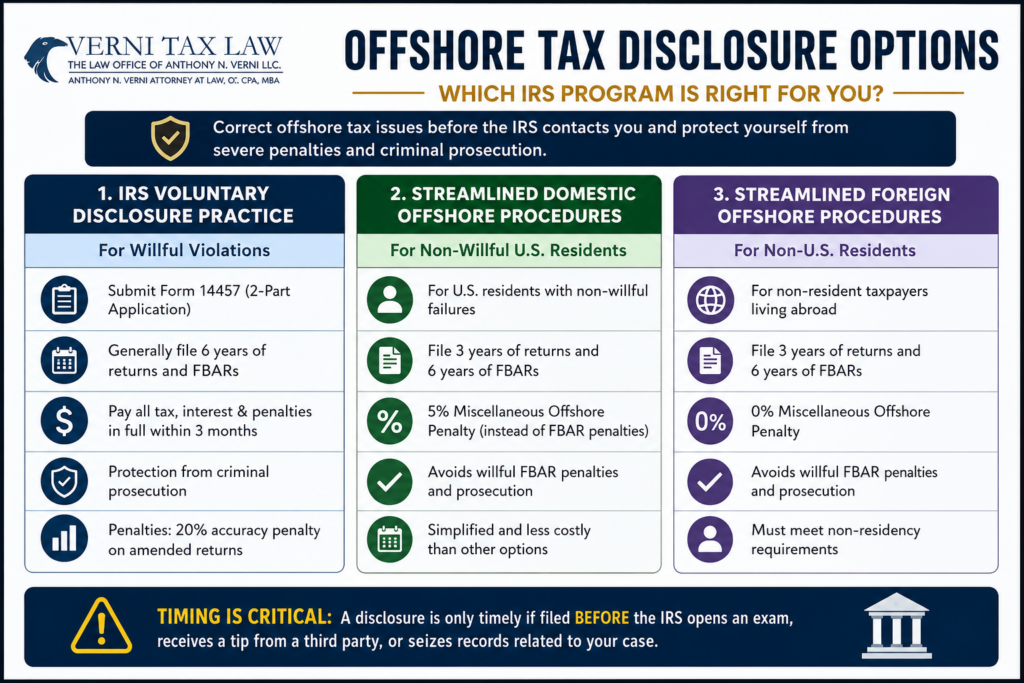
- The IRS Voluntary Disclosure Practice requires taxpayers to submit Form 14457 and generally file six years of returns and reports.
- Non-willful FBAR penalties top out at $16,536 per violation for 2026; willful penalties reach $165,353 or 50% of the account balance, whichever is greater.
- The Streamlined Domestic Offshore Procedures carry a flat 5% miscellaneous offshore penalty instead of stacked FBAR and accuracy penalties.
- The Streamlined Foreign Offshore Procedures charge a 0% penalty for qualifying non-resident taxpayers.
- Form 8938 reporting thresholds start at $50,000 for single filers living in the US and rise to $600,000 for married couples abroad.
- A disclosure is only timely if filed before the IRS opens an exam, gets a tip from a third party, or seizes records tied to your case.
What Constitutes Offshore Tax Evasion?
Offshore tax evasion happens when someone hides foreign income, foreign bank accounts, or foreign assets from the IRS on purpose. It’s different from a simple paperwork slip. The IRS checks if you intentionally ignored your foreign account reporting duty or if you genuinely did not realize it applied to you.
Common examples include:
- Keeping a foreign bank account open without listing it on an FBAR
- Reporting a foreign business but leaving its income off your 1040
- Using a relative’s name or a shell entity abroad to hold assets
- Filing a “quiet” amended return without going through any official disclosure track
An offshore tax compliance attorney looks at your full pattern of conduct before deciding which program actually fits.
How the IRS Detects Undisclosed Foreign Assets
The IRS finds undisclosed foreign accounts mainly through FATCA data matching, where over 110 partner countries and roughly 300,000 foreign financial institutions report US account holder information directly to the IRS each year. Banks also flag large wire transfers, and IRS Criminal Investigation runs data analytics against tax returns to catch mismatches between reported income and known foreign holdings.
A few other detection paths worth knowing:
- Whistleblower tips, which pay informants a share of recovered tax
- John Doe summonses issued to foreign banks and crypto exchanges
- Information shared through the Common Reporting Standard used by non-US tax authorities
- Random and targeted IRS audits of high-net-worth returns
Can You Correct Offshore Tax Issues Before the IRS Finds Them?
You can correct offshore tax issues on your own terms as long as the IRS hasn’t already started a civil exam, opened a criminal case, or received a tip about your specific situation from a third party. Once any of those three things happens first, you lose the ability to fix tax evasion legally through the more favorable disclosure paths and get pushed into whatever the examiner decides.
IRS Voluntary Disclosure Program Help: What You Need to Know
IRS voluntary disclosure program help applies specifically to taxpayers whose failure to report was willful, meaning they knew about the requirement and chose not to comply. The IRS Criminal Investigation division administers this practice for people seeking protection from criminal prosecution in exchange for full, truthful disclosure.
How the IRS Voluntary Disclosure Practice Works
The practice runs on a two-part application. Part I asks for preclearance to confirm you’re eligible. Once IRS Criminal Investigation clears you, you submit Part II, the full Form 14457, within 45 days. A single 45-day extension is available on written request, but only one.
After preliminary acceptance, your case moves to a civil examiner who reviews your amended and delinquent returns. Under the framework the IRS proposed in December 2025 and opened for public comment, taxpayers generally file the most recent six years of returns and FBARs, pay everything in full within three months of clearance, and sign the required certifications.
Eligibility Requirements for Disclosure Programs
To qualify, your disclosure must be timely, meaning the IRS hasn’t already opened an exam on you, received a tip from an informant or another agency, or pulled records tied to your case through a subpoena or search warrant. You also can’t have income from illegal sources; this practice is strictly for otherwise legal income that went unreported.
Potential Penalty Reductions and Protections
A truthful, timely voluntary disclosure doesn’t guarantee immunity, but it gives IRS Criminal Investigation a real reason not to recommend prosecution. Under the proposed penalty structure, accuracy-related penalties apply at a flat 20% to amended returns, delinquent international information returns carry penalties of up to $10,000 per return per year, and FBAR penalties apply annually with inflation adjustments rather than stacking case by case.
Offshore Tax Amnesty Service and Other Disclosure Options
An offshore tax amnesty service is really a set of separate IRS pathways, each built for a different level of willfulness. Streamlined procedures exist for people whose mistakes were non-willful. Delinquent submission procedures exist for people who simply missed filing deadlines with no unreported income involved.
Streamlined Domestic Offshore Procedures (SDOP)
SDOP is for US residents who non-willfully failed to report foreign income or file FBARs. Instead of streamlined FBAR filing triggering separate FBAR and accuracy penalties, SDOP charges one flat 5% miscellaneous offshore penalty on the highest aggregate value of the unreported assets across the covered years. You’ll amend three years of tax returns and file six years of FBARs, writing “Streamlined Domestic Offshore” in red at the top of each form.
Streamlined Foreign Offshore Procedures (SFOP)
SFOP works the same way but applies to non-resident taxpayers, including many dual citizens and expats who spent at least 330 days outside the US in a relevant year. The penalty here drops to 0%, though you still owe back taxes and interest on any unreported income.
Delinquent FBAR and International Information Return Procedures
If you owe no additional tax and simply missed filing FBARs or information returns like Form 8938 or Form 5471, you can use the delinquent submission procedures instead of a full disclosure track. This avoids the quiet disclosure FBAR, where taxpayers file corrected returns quietly outside any official program and risk full penalty exposure if the IRS later notices the pattern. Late FBAR filing through the proper channel, with a reasonable cause statement attached, frequently results in no penalty at all.
Common Offshore Reporting Violations That Require Immediate Attention
FATCA reporting requirements under Form 8938 catch specified foreign financial assets once they cross $50,000 for single filers at home or $400,000 for married couples living abroad. Missing that form alone triggers a $10,000 penalty that rises to $50,000 for continued non-filing.
- Unreported foreign rental income paired with an unfiled FBAR
- A foreign inheritance never disclosed on Form 3520
- Ownership in a foreign corporation missing Form 5471
- Crypto held on foreign exchanges, now squarely inside FATCA’s reach
One pattern we see often in practice: a taxpayer files US returns correctly for domestic income but assumes a foreign account under $10,000 average balance never crossed the threshold, when the rule actually checks the highest balance on any single day of the year. Form 8938 requirements run on a separate, higher threshold than the FBAR’s $10,000 trigger, so a taxpayer can clear one form and still owe the other.
Consequences of Ignoring Offshore Tax Compliance Problems
Ignoring an offshore filing gap doesn’t make it disappear; it lets willful FBAR penalties compound year over year while the statute of limitations for willful violations never expires. Non-willful violations get penalized up to $16,536 per violation for 2026, but willful ones reach the greater of $165,353 or 50% of the account balance, and that number applies per account, per year.
- Interest and failure-to-file penalties keep accruing on top of any FBAR exposure
- A civil exam can expand into other tax years once it starts
- Willful cases can be referred for criminal prosecution, carrying up to five years in prison
- Once the IRS opens contact first, every disclosure program listed above becomes unavailable
A strong foreign account penalty defense almost always starts before that first IRS letter arrives, not after.
How Verni Tax Law Assists With Offshore Tax Compliance and Defense
Anthony N. Verni is an attorney, CPA, and MBA who has represented offshore disclosure clients since 2009, including cases through every phase of the former OVDP before it closed in 2018. As an offshore voluntary disclosure lawyer, he personally handles each case rather than routing it through junior staff, which matters when the difference between a 5% penalty and a 50% penalty often comes down to how the facts get presented.
- Reviews your full foreign account history to identify the correct disclosure path, whether that’s the streamlined procedures, delinquent submission procedures, or the Voluntary Disclosure Program
- Prepares and files Form 14457, FBARs, and amended returns with the certifications the IRS requires
- Represents clients living anywhere in the world through secure video conferencing, without requiring travel to the US
Comprehensive Offshore Disclosure Strategies
He builds each strategy around the client’s actual facts and risk profile, drawing on direct experience with FATCA enforcement patterns and IRS attaché activity abroad. As a tax evasion defense attorney and litigator admitted to the US Tax Court and federal district courts, he represents clients directly before IRS examiners and, when needed, in federal tax litigation.
Book a confidential consultation with Verni Tax Law to review your specific offshore filing history and next steps.
Correct Offshore Tax Problems Before IRS Enforcement Begins
Offshore tax evasion is fixable, but only while the IRS hasn’t opened an exam, received a tip, or pulled your records first. Whether the right path is the streamlined procedures, delinquent FBAR filing, or the Voluntary Disclosure Practice depends entirely on whether your past conduct was willful, and that distinction drives every penalty outcome discussed above.
If you have an unreported foreign account or missed filing sitting unresolved, contact Verni Tax Law to schedule a consultation.
FAQs
When should I contact an offshore voluntary disclosure lawyer?
Contact one as soon as you discover an unreported account, before the IRS opens an exam or receives a third-party tip, since timing determines which programs stay available.
Can I fix tax evasion legally before the IRS starts an investigation?
Yes. Streamlined procedures, delinquent submission procedures, and the Voluntary Disclosure Practice all require you to come forward before IRS contact begins.
What is the IRS voluntary disclosure program help process?
It’s a two-part application: Form 14457 Part I for preclearance, then Part II within 45 days, followed by review from a civil examiner.
Does an offshore tax amnesty service eliminate all penalties?
No. SFOP can reduce the penalty to 0% for qualifying non-residents, but SDOP still charges 5%, and back taxes and interest are always owed.
What happens if I fail to report foreign bank accounts?
Non-willful failures risk up to $16,536 per violation for 2026; willful failures risk $165,353 or 50% of the account balance, plus possible criminal referral.
Can a tax evasion defense attorney help with FBAR and FATCA violations?
Yes. An attorney can evaluate willfulness, select the correct disclosure track, and prepare the FBARs, Form 8938, and amended returns required.
What disclosure options are available for non-willful offshore violations?
Non-willful taxpayers generally use SDOP, SFOP, or the delinquent FBAR and international information return procedures, not the Voluntary Disclosure Practice.
Is it better to disclose offshore accounts before the IRS contacts me?
Yes. Every IRS correction program listed here requires the disclosure to be timely, meaning it must happen before the IRS opens contact on its own.