
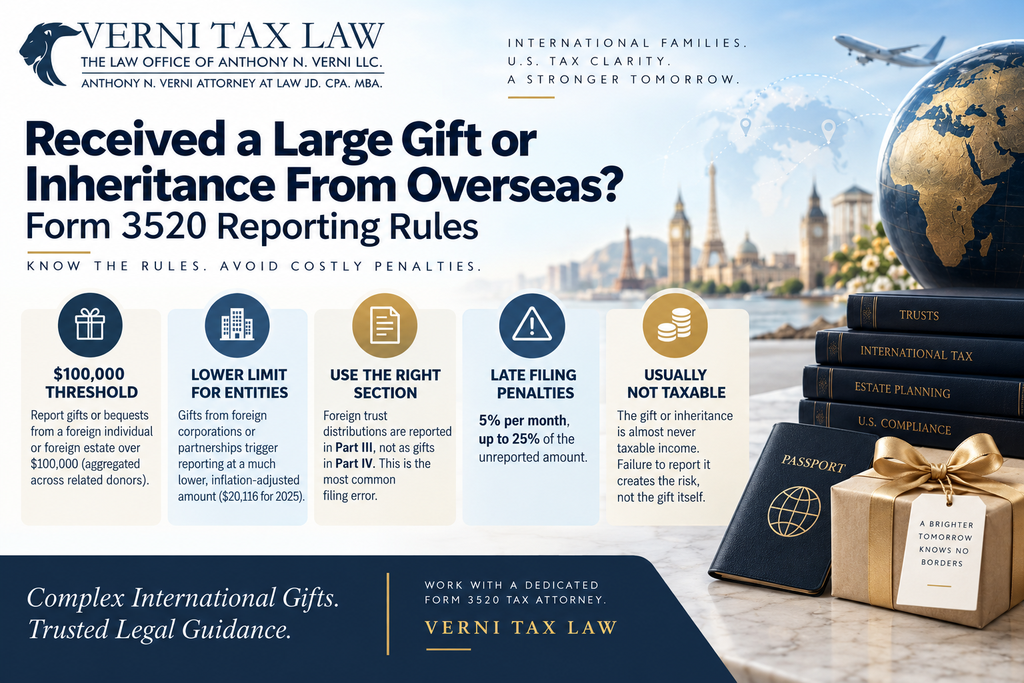
You generally must file Form 3520 tax attorney-reviewed paperwork with the IRS if you received more than $100,000 in gifts or bequests from a foreign individual or foreign estate during the tax year.
The reporting rules depend on who transferred the money or property, whether it was a gift, inheritance, or foreign-trust distribution, the value received, and the tax year involved.
Key Takeaways
- The large foreign gift IRS threshold is $100,000 from a nonresident alien or foreign estate, aggregated across related donors.
- Gifts from foreign corporations or partnerships trigger reporting at a much lower, inflation-adjusted amount ($20,116 for 2025).
- A foreign trust distribution is reported in Part III, not as a gift in Part IV. Mixing these up is the most common filing error.
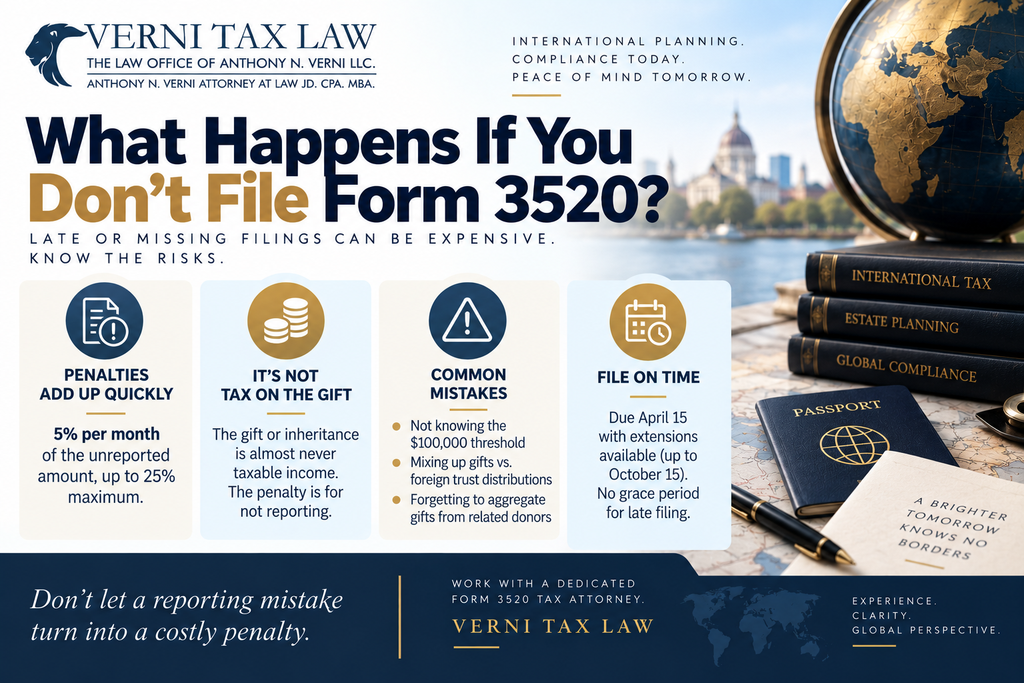
- Late or missing Form 3520 filings can carry a Form 3520 foreign gift penalty of 5% per month, up to 25% of the unreported amount.
- The gift itself is almost never taxable income. The failure to report it is what creates exposure.
Do You Have to Report a Large Foreign Gift or Inheritance?
Yes, if the money or property came from a nonresident alien individual or a foreign estate and the total for the year tops $100,000. Below are the situations that trigger the requirement:
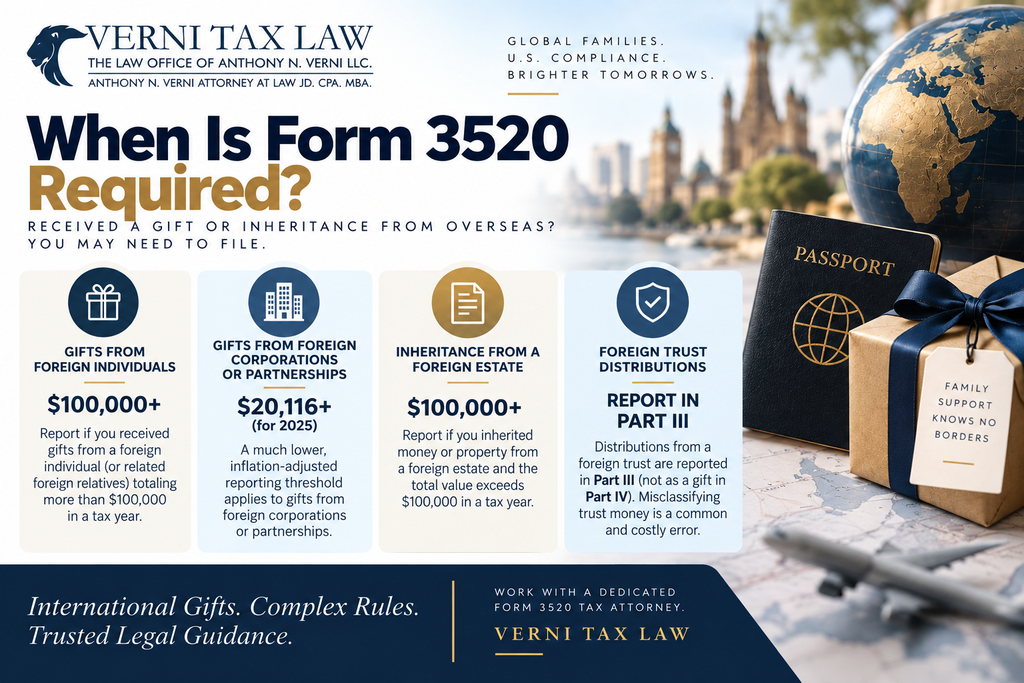
- You received cash, stock, real estate, or other property valued over $100,000 from one foreign relative or a group of related foreign relatives.
- You inherited assets from a foreign estate after a relative’s death and the value crosses $100,000.
- A foreign corporation or foreign partnership gave you a gift exceeding the yearly inflation-adjusted threshold.
- A domestic trust that a foreign person is treated as owning made a distribution to you.
What Is IRS Form 3520?
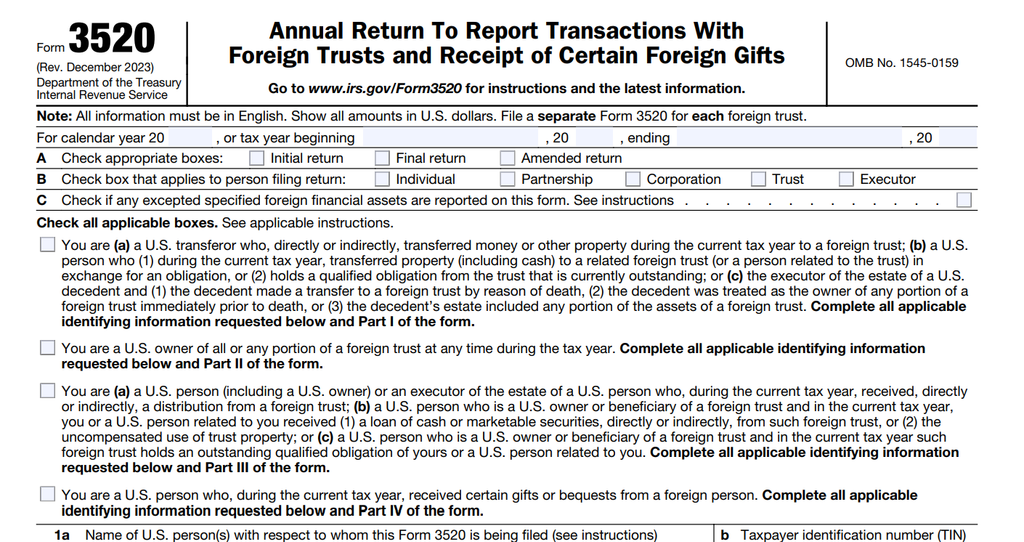
Form 3520 is the annual information return U.S. persons file to report transactions with foreign trusts and the receipt of certain foreign gifts or bequests. It exists purely so the IRS can track large amounts moving into the United States from abroad.
Form 3520 is used to report three separate categories:
- Foreign Gifts and Bequests (Part IV): money or property from a nonresident alien individual or foreign estate above the $100,000 threshold.
- Foreign Trust Transactions (Parts I through III): transfers you made to a foreign trust, ownership of a foreign trust, or distributions you received from one.
- Related-party transfers: contributions and distributions involving foreign trusts connected to your family.
Who may need to file Form 3520? U.S. citizens, green card holders, and resident aliens who received a large gift, an inheritance, or any distribution from a foreign trust, regardless of whether they currently live in the United States.
When Does a Foreign Gift Require Form 3520?
A foreign gift requires Form 3520 once your total from a single foreign individual or foreign estate, plus related persons, exceeds $100,000 in one tax year. Watch for these specific triggers:
- One gift alone exceeds $100,000.
- Several smaller gifts from the same foreign relative add up to more than $100,000 across the year.
- Gifts from a parent and that parent’s sibling combine because the IRS treats related donors as one source.
- The donor is a foreign corporation or partnership and gifts exceed the smaller inflation-adjusted limit.
- You suspect the named donor is actually passing funds along for someone else, which raises the nominee question addressed later in this article.
How Do You Know Whether Your Overseas Payment Is a Gift, Inheritance, or Foreign Trust Distribution?
The legal character of the transfer decides which part of Form 3520 applies, and getting this wrong is where most non-attorneys stumble.
Money received directly from a foreign parent or relative
This is a straightforward gift when a living nonresident alien sends funds voluntarily and receives nothing of value in return. Document the relationship and the fact that no services or goods changed hands.
Money received from a foreign estate after someone’s death
An inheritance from a deceased relative’s foreign estate falls under the same Part IV framework as a lifetime gift once it crosses $100,000. The date of death and the estate’s country of administration matter for your recordkeeping.
Money distributed by a foreign trust
If a foreign trust makes the payment, the source isn’t a person, it’s the trust itself, and the IRS instructions state that this is generally reported as a foreign trust distribution in Part III rather than a gift in Part IV. Treating trust money as a simple family gift is the single most expensive misclassification I see.
What Is the Form 3520 $100,000 Threshold Actually Measuring?
The threshold measures the total value you treated as gifts or bequests from a nonresident alien individual or foreign estate during the year. Several details commonly get overlooked:
- It’s a running total of everything received as a gift.
- Related donors count together. A grandmother and an uncle who are related to each other get combined into one figure.
- Property counts at fair market value, not just cash amounts.
- Multiple smaller gifts from the same person or related group must be added together across the entire tax year.
The current Form 3520 instructions specifically refer to gifts or bequests from a nonresident alien individual or foreign estate, including certain foreign persons related to that donor, which is why aggregation catches people who assumed each gift stood on its own.
What Is the Difference Between a Foreign Gift and a Taxable Gift?
A foreign gift you report on Form 3520 and a taxable gift under U.S. gift tax law are two different concepts, and confusing them causes unnecessary panic.
Filing Form 3520 is an information disclosure. Most people who receive a large foreign gift owe zero U.S. tax on the money itself.
U.S. Gift Tax vs. Foreign Gift Reporting
U.S. gift tax applies to the person giving a gift, not the person receiving one, and it generally only applies to U.S. citizens or residents making the gift. A foreign gift tax attorney can confirm that a nonresident alien giving you money typically isn’t subject to U.S. gift tax rules at all.
Who Is Responsible for Paying Any Tax?
As the recipient, you’re responsible for reporting, not for paying gift tax on funds you receive. Any tax exposure would fall on income the gifted money later generates, such as interest or dividends, which gets reported separately on your regular return.
Common Large Foreign Gift Scenarios That May Require Reporting
Real situations trigger this filing far more often than people expect, and a foreign gift reporting attorney sees the same patterns repeat across nearly every client file.
Parents Sending Money for a Home Purchase
Parents abroad who wire a $150,000 down payment for their child’s house created a reportable gift the moment the funds cleared, even though the money went straight to a title company.
Family Members Sending Large Bank Transfers
Multiple relatives each sending $30,000 can still cross $100,000 in aggregate if the IRS considers them related persons.
Receiving Money for Education or Medical Expenses
Funds sent to cover tuition or medical bills are still gifts for reporting purposes unless paid directly to the school or hospital under a narrow exception, so verify how the payment was routed.
Foreign Family Business or Company Transfers
A distribution or bonus routed through a family-owned foreign company may fall under the lower entity threshold instead of the $100,000 individual threshold.
Gifts Received by U.S. Citizens and Green Card Holders
Citizenship or immigration status doesn’t matter here. Any U.S. person, including a green card holder living overseas, faces the same reporting inheritance from abroad obligation as someone born and raised in the United States.
How to Report a Foreign Gift on Form 3520
Reporting a foreign gift means gathering documentation, correctly identifying the donor, valuing the property, and attaching Form 3520 to your annual return.
Information You Need Before Filing
Assemble these details before you start:
- Date of the gift or bequest
- Description of the property received
- Fair market value at the time of transfer
- Donor’s name and relationship to you
- Whether the donor was a foreign person
- Whether you have reason to believe the named donor acted as a nominee or intermediary
- Bank records or estate documents supporting the transfer
The current Form 3520 instructions specifically address situations where the apparent donor may be acting as a nominee or intermediary and require additional information in that circumstance.
Identifying the Foreign Donor or Transferor
Name the actual person or estate that transferred the funds, not just the bank the wire came from. If a business entity was used to route personal funds, that detail belongs on the form.
Reporting the Value of the Gift or Inheritance
Convert foreign currency to U.S. dollars using the exchange rate on the date received, and value property at fair market value on that same date.
Filing Form 3520 With Your Tax Return
Form 3520 is filed as an attachment sent to a separate IRS service center, not stapled to your Form 1040, though the due dates run together.
When Is Form 3520 Due?
Form 3520 is due on the same date as your individual income tax return, generally April 15 of the year after you received the gift. U.S. persons living abroad get an automatic two-month extension to June 15, and anyone can extend further to October 15 by timely filing Form 4868 for their income tax return.
Penalties begin accruing immediately once the extended due date passes, and there’s no grace period for a first-time miss. Filing a protective extension by the original deadline is the safest move if you’re unsure whether the threshold applies to your situation.
What Happens If You Received a Large Foreign Gift or Inheritance but Never Filed Form 3520?
You have a practical path forward, and panicking rarely helps the outcome. A foreign gift tax attorney typically works through the following sequence:
- Determine exactly who transferred the money or property.
- Establish whether it was a gift, bequest, or foreign trust distribution.
- Calculate the exact amount or value received.
- Identify the specific tax year involved.
- Review whether Form 3520 Part IV applied to that transfer.
- Check whether FBAR, Form 8938, or another information return was separately required.
- Consider whether a late-filing or correction procedure fits the facts.
- Document everything supporting the chosen tax treatment.
Penalties can apply to late, incomplete, or incorrect Form 3520 filings, but reasonable-cause rules may provide relief in qualifying circumstances, which is why an accurate written explanation matters more than rushing to file blindly.
What If the Foreign Gift Also Involves a Foreign Bank Account?
Receiving the gift into a foreign account can create two additional filings on top of Form 3520. FBAR filing requirements apply once your combined foreign accounts exceed $10,000 at any point during the year, filed electronically through FinCEN by April 15 with an automatic extension to October 15.
FATCA Form 8938 filing requirements: A single filer living in the U.S. files at $50,000 year-end or $75,000 at any point during the year, while someone living abroad files at $200,000 or $300,000. Married couples abroad face a $400,000 or $600,000 threshold.
How Verni Tax Law’s Foreign Gift Reporting Attorney Can Help
Foreign gift rules punish honest mistakes just as harshly as intentional ones, which is why working with a dedicated Form 3520 tax attorney matters from the first filing decision.
Anthony N. Verni, Attorney at Law, CPA, and MBA, has spent over 25 years resolving international tax reporting issues for clients living in the United States and abroad.
- He personally reviews every gift, bequest, and trust distribution to correctly classify it before a single form gets filed.
- He identifies whether FBAR, Form 8938, or a delinquent filing procedure applies alongside your Form 3520.
- He builds a documented reasonable-cause position when a past gift or inheritance was never reported.
- He communicates directly with clients across time zones, so living overseas never delays your case.
As a foreign gift tax attorney and CPA, Anthony brings legal and accounting judgment to a single case file instead of splitting your matter across two professionals. Book a consultation with Verni Tax Law before your next filing deadline arrives.
Conclusion
Reporting inheritance from abroad, along with any large gift or foreign trust distribution, comes down to three questions: who sent it, how much it’s worth, and what type of transfer it legally was. The $100,000 threshold, the nominee rules, and the Part III versus Part IV distinction all exist to answer those three questions correctly on paper.
Anthony N. Verni will review your specific transfer, confirm which IRS forms apply, and correct any past gaps before they turn into a Form 3520 foreign gift penalty. His combined background as an attorney and CPA means one professional handles the legal classification and the numbers together. Contact Verni Tax Law today to protect your large foreign gift IRS filing before your next deadline.
FAQs
Do I have to report a large gift from overseas to the IRS?
Yes. Gifts or bequests over $100,000 from a nonresident alien individual or foreign estate must be reported on Form 3520.
When is Form 3520 required for a foreign gift?
It’s required once your total foreign gifts from one donor or related donors exceed $100,000 in a single tax year.
Does receiving an inheritance from abroad require Form 3520?
Yes. A foreign inheritance is treated the same as a lifetime gift once it exceeds the $100,000 reporting threshold.
How much can I receive from a foreign person before filing Form 3520?
Up to $100,000 total per year from a nonresident alien or foreign estate before Part IV reporting applies.
Is a foreign gift taxable income in the United States?
No. A genuine gift or inheritance isn’t taxable income, though income it later generates is.
What is the penalty for failing to report a foreign gift on Form 3520?
5% of the unreported gift value per month, capped at a 25% maximum penalty.
What is the penalty for filing Form 3520 late?
Foreign gift penalties cap at 25%, while unreported foreign trust transactions carry the greater of $10,000 or 35%.
Can Form 3520 penalties be removed for reasonable cause?
Yes, if you can document a legitimate, non-willful reason for the late or missing filing.
How do I report an inheritance from a foreign estate?
Complete Form 3520 Part IV, listing the estate as donor, the date received, and the fair market value.
Does a foreign gift also need to be reported on an FBAR?
Only if the gifted funds sit in a foreign account exceeding $10,000 at any point during the year.
Do I need to file Form 3520 and Form 8938 for the same foreign gift?
Possibly. They’re independent requirements, so meeting one threshold doesn’t excuse the other.
Can a foreign gift reporting attorney help with a missed Form 3520?
Yes. An attorney can classify the transfer correctly and pursue reasonable-cause or delinquent-filing relief.