

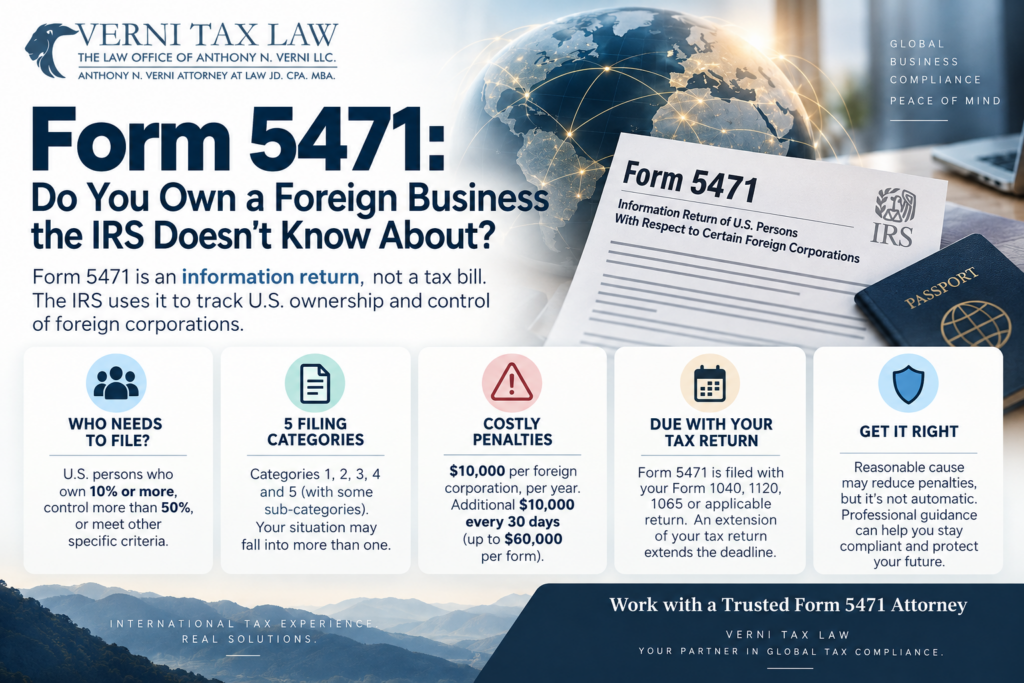
If you own stock in a foreign company, sit on its board, or helped set it up, the IRS may already expect a form from you that has nothing to do with income tax. Form 5471 is an information return, not a tax bill. It exists so the IRS can track which U.S. persons own, control, or recently bought or sold stock in a foreign corporation, and the filing duty can start the moment you cross a stock threshold, not when you owe tax.
Missing it is one of the most expensive paperwork mistakes in foreign business ownership IRS compliance, because the penalty attaches whether or not you owe a dollar of additional tax.
| Key TakeawaysForm 5471 reports ownership in a foreign corporation. It does not calculate tax on its own.Five filing categories exist (1, 2, 3, 4, and 5), and some split into sub-categories such as 1a and 5c.The base penalty for failing to file is $10,000 per foreign corporation, per year.A continuation penalty of $10,000 per 30-day period can push the total to $60,000 per form.Criminal penalties can apply under sections 7203, 7206, and 7207 in willful cases.Reasonable cause may reduce penalties, but the IRS decides this case by case; it is never automatic. |
What Is IRS Form 5471?
Form 5471 is an information return that certain U.S. officers, directors, and shareholders of foreign corporations must file with their federal tax return.
- The form itself reports the corporation’s ownership structure, balance sheet, income, and transactions with related parties.
- It does not, by itself, create a tax bill; the IRS uses it to check that Subpart F, GILTI, and other anti-deferral rules were applied correctly elsewhere on your return.
Who generally has a filing duty:
- A U.S. citizen or resident who owns 10% or more of a foreign corporation’s value or voting stock
- A U.S. person who acquires or disposes of stock that crosses the 10% mark
- A U.S. officer or director connected to certain stock acquisitions
- A U.S. person who controls more than 50% of a foreign corporation
- A U.S. shareholder of a controlled foreign corporation (CFC)
What Is a Controlled Foreign Corporation (CFC)?
A controlled foreign corporation is a foreign company where U.S. shareholders together own more than 50% of the total voting power or value on any day of the tax year. That ownership can be direct, indirect, or constructive, meaning stock owned by a spouse, parent, or a related entity can count toward your total even if your name is nowhere on the stock certificate.
Three ownership types apply:
- Direct ownership. Stock held in your own name.
- Indirect ownership. Stock held through a partnership, trust, or another corporation you control.
- Constructive ownership. Stock attributed to you from family members or related entities under section 958(b).
These same ownership rules also feed into FATCA reporting obligations, since foreign accounts tied to a CFC often need separate disclosure on the FinCEN 114 (FBAR).
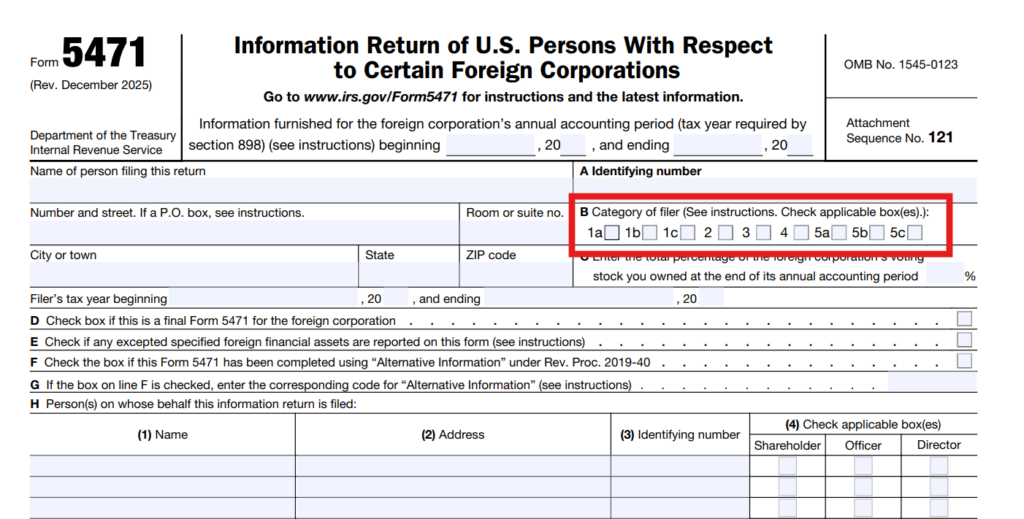
Form 5471 Filing Categories Explained
Five categories determine what schedules you file, and the IRS instructions describe each one with a distinct ownership or control trigger.
| Situation | Potential category |
| Certain U.S. shareholders of section 965 specified foreign corporations | Category 1 |
| U.S. citizen or resident officer or director connected to a reportable acquisition | Category 2 |
| U.S. person acquiring or disposing of stock reaching or crossing 10% | Category 3 |
| U.S. person with more than 50% control | Category 4 |
| U.S. shareholder of a CFC | Category 5 |
The table above maps common situations to their likely category, but categories often overlap. A person who owns 100% of a foreign corporation is both a Category 4 and a Category 5a filer at the same time.
Category 2 Filers
A Category 2 filer is a U.S. citizen or resident officer or director present when a U.S. person acquires 10% or more of the foreign corporation, or adds another 10% on top of existing stock. The officer or director does not need to own any stock personally; the trigger is someone else’s acquisition.
Category 3 Filers
Category 3 catches four separate situations, and the IRS defines the 10% threshold by value or voting power. A U.S. person falls into this category when they:
- acquire stock that reaches the 10% threshold;
- acquire stock that independently meets the 10% threshold;
- become a U.S. person while already meeting the threshold; or
- dispose of enough stock to fall below 10%.
Becoming a U.S. person while already owning the foreign corporation can create a Category 3 filing duty on its own, even without buying or selling a single share that year.
Category 4 Filers
Category 4 applies to a U.S. person with control, meaning ownership of more than 50% of voting power or value at any point during the tax year. Control can also flow through a chain of corporations; if Corporation A owns 51% of B, and B owns 51% of C, and C owns 51% of D, then A controls D under the attribution rule, even without a direct stake in D.
Category 5 Filers
Category 5 covers U.S. shareholders of a CFC, and the chain runs like this: a U.S. shareholder owns 10% or more of a foreign corporation; that corporation qualifies as a CFC because U.S. shareholders together hold more than 50%, and the 10% owner becomes a Category 5 filer. The category splits further into 5a, 5b, and 5c depending on whether the ownership is direct, unrelated, or constructive.
Why You May Fall Into More Than One Category
The instructions specifically address filers who fall into more than one category and require a separate Form 5471 for each applicable foreign corporation, so owning stakes in three foreign companies means three separate forms, not one combined filing.
When Is Form 5471 Due?
Form 5471 is due on the same date as your income tax return, including any extension you claim.
Filing Form 5471 With Your Tax Return
The form attaches to your Form 1040, 1120, 1065, or applicable return type and goes to the IRS with that return in a single package. It is not filed as a standalone document.
Form 5471 Extensions
An extension of your income tax return automatically extends the Form 5471 deadline by the same number of months. Filing Form 4868 or Form 7004, for example, pushes back both deadlines together.
What Happens When You Miss the Deadline?
Missing the deadline exposes you to a $10,000 penalty per foreign corporation immediately, and the IRS does not need to open an audit first to assess it. The clock for continuation penalties starts once the IRS mails a formal notice of the failure.
What Information Is Required on Form 5471?
The form and its schedules require your detailed financial and ownership picture of the foreign corporation.
- Identifying information for the filer and the foreign corporation, including EIN or a reference ID number
- Percentage of voting stock owned, entered in Item C
- Balance sheet and income statement data, converted to U.S. dollars using the specific exchange rate method the instructions require
- Stock ownership details across Schedule B, including U.S. shareholders and their percentages
- Related-party transactions and intercompany debt on Schedule M
- Earnings and profits history on Schedule J, including previously taxed amounts on Schedule P
- Subpart F income and GILTI calculations on Schedule I and Schedule I-1
Some of this overlaps with Form 8938 reporting requirements, but the IRS instructions specifically state that assets already reported on Form 5471 do not need to be duplicated on Form 8938; you simply check the excepted-asset box.
What Happens If You Don’t File Form 5471?
Failing to file does not just risk a penalty notice. It changes your standing with the IRS in ways that outlast the missed form itself.
- A $10,000 penalty applies per foreign corporation, per accounting period
- Your available foreign tax credit can be cut by 10%, with an added 5% reduction every three months; the failure continues past 90 days
- The statute of limitations on your entire tax return can stay open indefinitely for items related to the unreported foreign corporation
- Criminal penalties under sections 7203, 7206, or 7207 can apply in willful cases
- Missed Form 5471s often surface during IRS audits involving foreign income, well after the original due date has passed
How Much Is the Form 5471 Penalty?
The base penalty is set by statute and applies automatically once the IRS identifies the failure.
- $10,000 for failing to furnish required information for each annual accounting period, per foreign corporation
- An additional $10,000 for each 30-day period the failure continues, starting 90 days after IRS notice
- A cap of $50,000 on the additional continuation penalty, for a combined maximum of $60,000 per form
- Separate penalties under section 6679 for failures tied to Schedule O reporting, following the same $10,000-per-30-days structure
Anyone facing a notice at this stage benefits from Form 5471 penalty help before responding, since an incomplete or inconsistent reply can lock in a penalty that a properly supported reasonable-cause statement might have reduced.
Late Form 5471 Filing: What Are Your Options?
Three paths generally apply once a missed form comes to light, and the right one depends on whether the IRS has already contacted you.
Filing Delinquent Forms for Prior Years
The IRS’s Delinquent International Information Return Submission Procedures let taxpayers file missed Form 5471s for prior years and attach a statement asserting reasonable cause.
Correcting Previously Filed Forms
If a Form 5471 was filed but contained errors, the IRS instructions call for a corrected form attached to an amended return, with “Corrected” written at the top and a statement identifying exactly what changed.
Responding to an IRS Penalty Notice
A penalty notice starts a clock. During processing, the IRS can assess the $10,000 penalty before it even reviews an attached reasonable-cause statement, so you may need to respond again after the initial notice to get the penalty reconsidered.
How Can Form 5471 Penalties Be Reduced or Removed?
Reasonable cause is the main avenue for relief, and it works through a specific sequence.
- Identify the exact facts that caused the late or missing filing, such as reliance on a foreign accountant who was unaware of the U.S. requirement.
- Prepare a written statement under penalty of perjury describing those facts, since informal explanations are not accepted.
- Attach the statement to the delinquent or corrected Form 5471, or submit it in response to a penalty notice if one has already arrived.
- Expect an initial assessment regardless. The IRS may assess the penalty first and evaluate reasonable cause afterward.
- Respond to any follow-up correspondence promptly, since the case can require more than one round of communication before it closes.
No filer should assume penalty abatement is guaranteed. Reasonable cause is a basis for requesting relief, not an automatic waiver, and the IRS reviews every statement on its own facts.

What Happens If You Owned the Foreign Business for Years but Never Filed Form 5471?
The IRS has multiple ways to identify foreign ownership that was never reported, including FATCA data shared by foreign banks, FBAR filings that reference the same entity, and information exchanged under tax treaties with other countries. This kind of gap frequently surfaces as part of a broader IRS audit expansion into your foreign accounts once one red flag appears.
Step 1: Reconstruct The Foreign-Company Ownership History
Collect every document that shows who owned what and when:
- incorporation documents
- shareholder registers
- share-transfer records
- ownership percentages by year
- acquisition and disposition dates
- ownership held through other entities
Step 2: Determine the Form 5471 Category for Each Affected Year
Do not assume today’s ownership percentage applied in prior years. Ownership shifts, corporate reorganizations, and even currency conversions can change which category applied in a given year, so each year needs its own analysis.
Step 3: Gather the Foreign Corporation’s U.S. Tax Information
Depending on the category, you may need:
- financial statements
- trial balance or general ledger detail
- foreign income taxes paid
- shareholder transactions and distributions
- earnings and profits history
- full ownership records
Step 4: Determine Whether A Delinquent Filing Procedure Or Other Compliance Option Applies
The IRS’s Delinquent International Information Return Submission Procedure allows a reasonable-cause statement with each late filing. Multi-year gaps often mean filing multiple years of unfiled tax returns alongside the missing Form 5471s.
How Can You File Form 5471 for Previous Years?
Yes, filing for previous years is possible. The process generally starts with confirming which years and categories apply, then preparing each year’s Form 5471 using that year’s exchange rates and ownership data, attaching a reasonable-cause statement where applicable, and submitting the package with an amended return for each affected year.
Because unfiled tax returns and delinquent information returns often need to be corrected together, coordinating the filings in one sequence avoids inconsistencies that can draw further IRS scrutiny.
How Verni Tax Law’s Form 5471 Attorney Can Help
Anthony N. Verni, an attorney, CPA, and MBA with more than 25 years of experience in international tax matters, works directly with clients who are catching up on Form 5471, responding to penalty notices, or facing an IRS audit tied to overseas ownership.
- As a Form 5471 attorney and Form 5471 tax lawyer, he reviews the full ownership history of your foreign corporation, determines the correct filing category for every open year, and prepares reasonable-cause statements built on the specific facts of your case.
- His background as an international tax attorney also means FBAR, FATCA, and Form 8938 issues connected to the same foreign entity get addressed in the same engagement.
Book a confidential consultation with Verni Tax Law to get a clear read on your filing category, your exposure, and your options before the IRS sends the next notice.
Conclusion
Form 5471 identifies which U.S. persons own or control foreign corporations, and when that ownership starts or changes. The five filing categories, the 10% and 50% thresholds, and the $10,000 base penalty all serve that single purpose, and none of it depends on whether the foreign company ever sent money back to the U.S. owner.
Anthony N. Verni built his practice around exactly this kind of cross-border reporting problem. His combined credentials as an attorney, CPA, and MBA let him handle the legal exposure, the accounting reconstruction, and the filing strategy under one roof.
If you suspect a Form 5471 was missed for any year you owned or controlled a foreign business, contact Verni Tax Law before the IRS contacts you first.
FAQs
What is Form 5471 and who needs to file it?
Form 5471 is an IRS information return for U.S. officers, directors, and shareholders of certain foreign corporations. Five filing categories determine who must file, based on ownership percentage, control, or a reportable stock transaction.
Do I need to file Form 5471 if I own a foreign business?
Yes, if you own 10% or more of its value or voting stock, or control more than 50% of it. Ownership below 10% generally does not trigger a filing duty on its own.
What is a Controlled Foreign Corporation?
A CFC is a foreign corporation where U.S. shareholders together own more than 50% of the voting power or value. Ownership can be direct, indirect, or constructive under section 958.
What are the different Form 5471 filing categories?
There are five categories: 1, 2, 3, 4, and 5, with 1 and 5 split into sub-categories a, b, and c. Each has its own ownership or control trigger and its own required schedules.
What happens if I forgot to file Form 5471?
A $10,000 penalty applies per foreign corporation, per year, immediately upon discovery. Continuation penalties can raise that to $60,000 if the failure is not corrected after IRS notice.
How much is the penalty for not filing Form 5471?
The base penalty is $10,000 per form. It can grow by $10,000 for every 30 days of continued failure after IRS notice, up to a $50,000 cap on top of the base amount.
Can Form 5471 penalties be waived for reasonable cause?
Reasonable cause can reduce or remove the penalty, but it is never automatic. The IRS may assess the penalty first and evaluate the reasonable-cause statement afterward.
Can I file Form 5471 for previous years?
Yes, through the Delinquent International Information Return Submission Procedures or by filing corrected forms with amended returns. Each affected year needs its own category analysis.
Can I amend a Form 5471 that was filed incorrectly?
Yes, by filing a corrected Form 5471 with an amended return, writing “Corrected” at the top, and attaching a statement explaining the changes.
Do I need Form 5471 if I also file an FBAR?
Yes, they report different things. The FBAR covers foreign financial accounts, while Form 5471 covers ownership and control of a foreign corporation.
Is Form 5471 required in addition to Form 8938?
Often yes, but assets already reported on Form 5471 do not need to be duplicated on Form 8938; you check the excepted-asset box on Form 8938 instead.
Can a Form 5471 attorney help with late filings and penalties?
Yes, a Form 5471 attorney can determine the correct filing category, prepare a fact-specific reasonable-cause statement, and manage IRS correspondence throughout the process.