Owe the IRS more than you can realistically pay? You are not out of options. Form 656 is the application you use to ask the IRS to settle eligible federal tax debt for less than the full balance, through a program called an Offer in Compromise (OIC).
The catch: many offers are returned or rejected for avoidable reasons, such as a missing tax period, an offer amount that does not match the financial statements, or a skipped payment. This guide walks you through every section of Form 656, lets you estimate your own offer amount, and gives you a sample letter you can adapt.
📖 In This Guide
Key Takeaways
- Form 656 lets eligible taxpayers propose settling federal tax debt for less than the full amount owed.
- Acceptance depends on eligibility, your finances, and evidence. Learn what improves your chances of OIC approval.
- Use Form 656 if you cannot pay. Use Form 656-L if you dispute that you owe the tax.
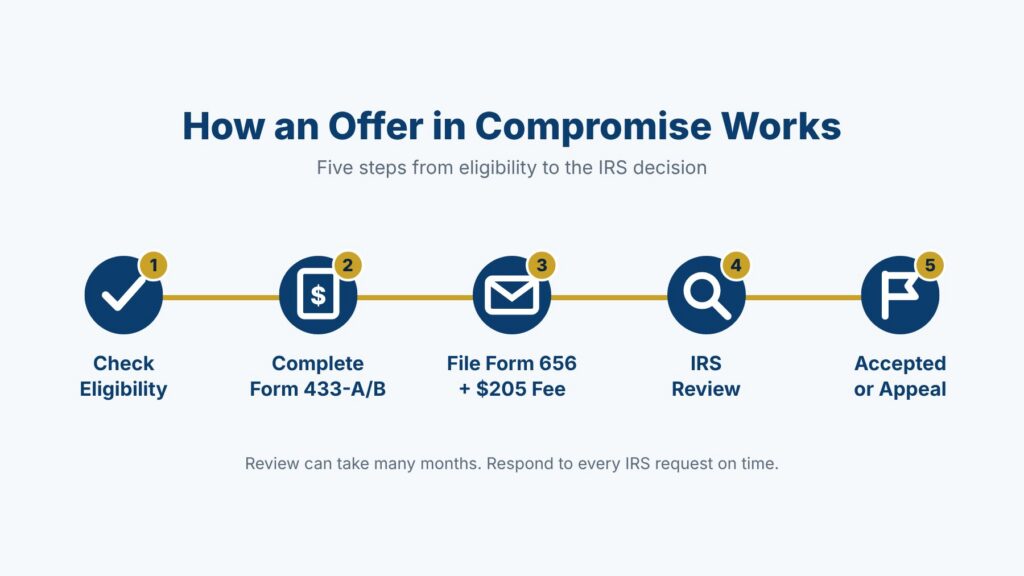
- File all required returns and make current estimated payments or deposits before you apply.
- Your offer must match Form 433-A (OIC) or 433-B (OIC). A lower amount needs a documented reason.
- Always check the current Form 656-B booklet for fees, payment rules, and mailing addresses.
What Is IRS Form 656?
The Form 656, Offer in Compromise application tells the IRS three things: which tax debts you want to settle, how much you are offering, and how you will pay. The IRS then compares your offer with what it believes it could realistically collect from you.
| Form 656 | Form 656-L | |
|---|---|---|
| Use it when | You agree you owe the tax but cannot pay in full, or paying would cause hardship | You believe the tax assessed is legally wrong |
| Grounds | Doubt as to collectibility or effective tax administration | Doubt as to liability |
| Financial statements? | Yes: Form 433-A (OIC) and/or 433-B (OIC) | Generally no |
| Form link | Form 656 (PDF) | Form 656-L (PDF) |
Who Qualifies for an Offer in Compromise?
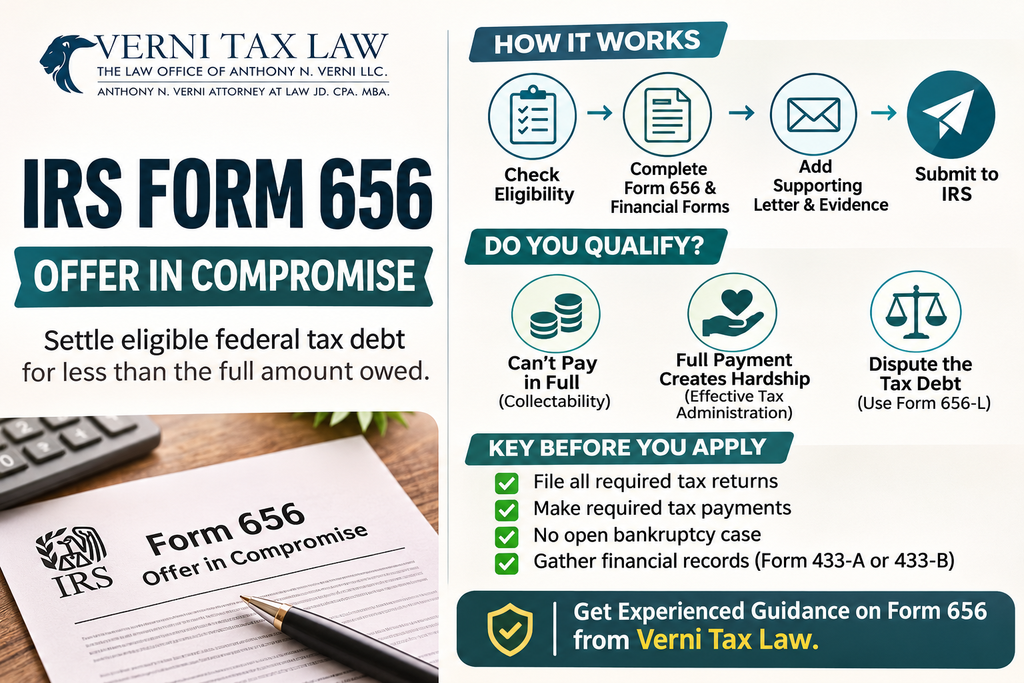
The IRS accepts offers on three grounds. Your reason for applying decides which form you file, so identify it first.
| Ground | What it means | Form |
|---|---|---|
| Doubt as to collectibility | You owe the tax, but your income and assets are not enough to pay it in full. | 656 |
| Effective tax administration | You could technically pay, but doing so would cause economic hardship or be unfair because of exceptional circumstances. | 656 |
| Doubt as to liability | You genuinely dispute that the tax is correct. | 656-L |
Quick Check: Are You Ready to Apply?
Answer five quick questions to see whether you meet the basic IRS requirements.
1. Have you filed all required federal tax returns?
2. Are your current-year estimated payments (or business deposits) up to date?
3. Are you currently in an open bankruptcy case?
4. Do you agree that you owe the tax (you just cannot pay it)?
5. Could you pay the full balance through a monthly payment plan?
This quick check is for general information only and is not legal advice.
When an Offer in Compromise May Not Be the Right Move
- You could pay the debt in full over time. An IRS installment agreement may be simpler.
- You can pay something monthly but not the full balance before the collection deadline. A partial payment installment agreement may fit better.
- You have unfiled returns or unpaid current-year taxes. See how back taxes and unfiled returns affect an offer.
- You dispute the tax itself. A liability challenge is the right path.
Not sure which path fits? Compare all of your IRS tax debt settlement options side by side.
Form 656 Line-by-Line Instructions
Work through the form in order. Each card shows what the section asks, what to enter, what to double-check, and the mistake we see most often.
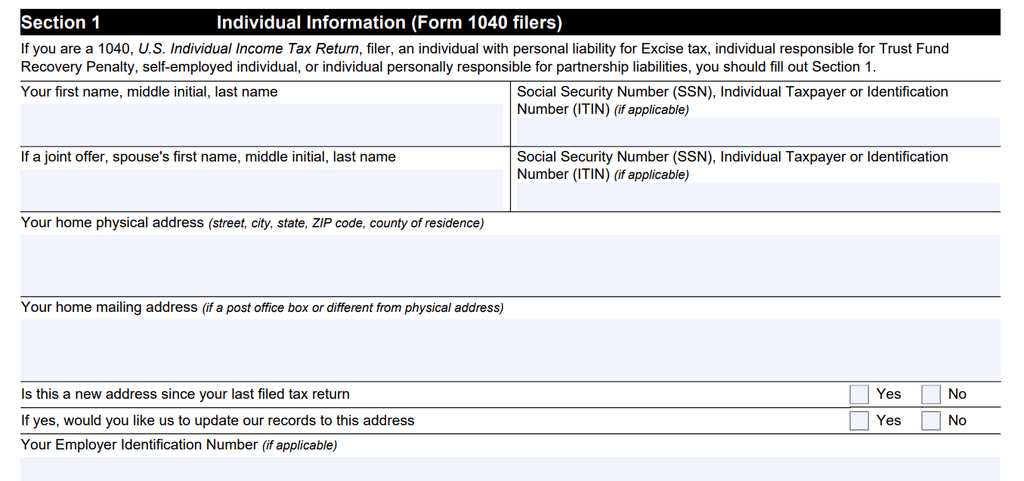
Section 1: Individual Information (Form 1040 Filers)
- What it asks
- Your name, SSN, address, spouse details (if applicable), and the individual tax periods you want settled.
- What to enter
- Your legal name and SSN exactly as on your returns, your current address, and every tax year with a balance.
- Double-check
- Match each year against your IRS notices and account transcripts.
- Common mistake
- A wrong SSN, an old address, or a missing tax year. Any of these can delay processing.
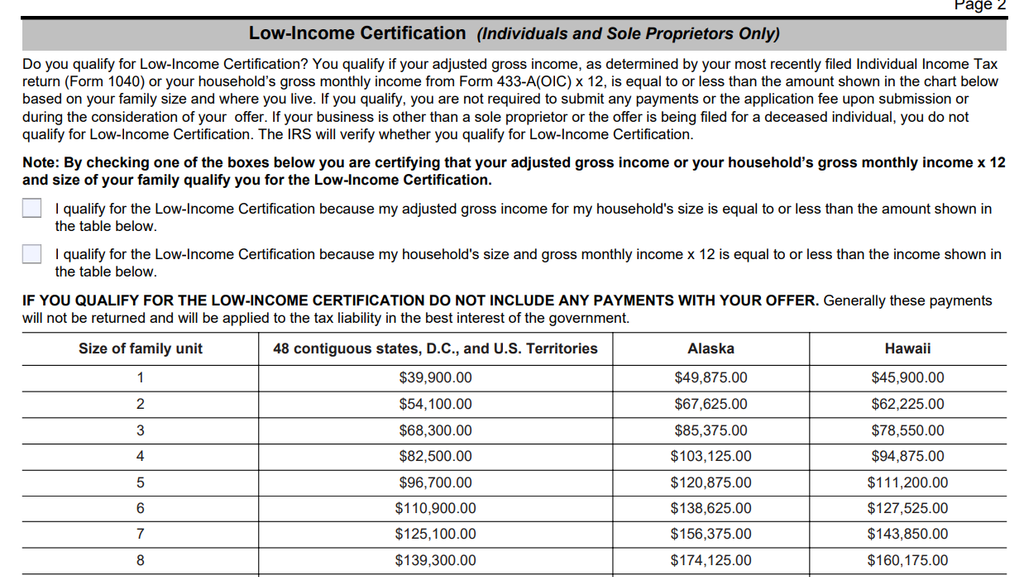
Low-Income Certification (End of Section 1)
If you qualify under the IRS low-income guidelines, you skip the $205 fee and all payments while your offer is being considered.
Section 2: Business Information
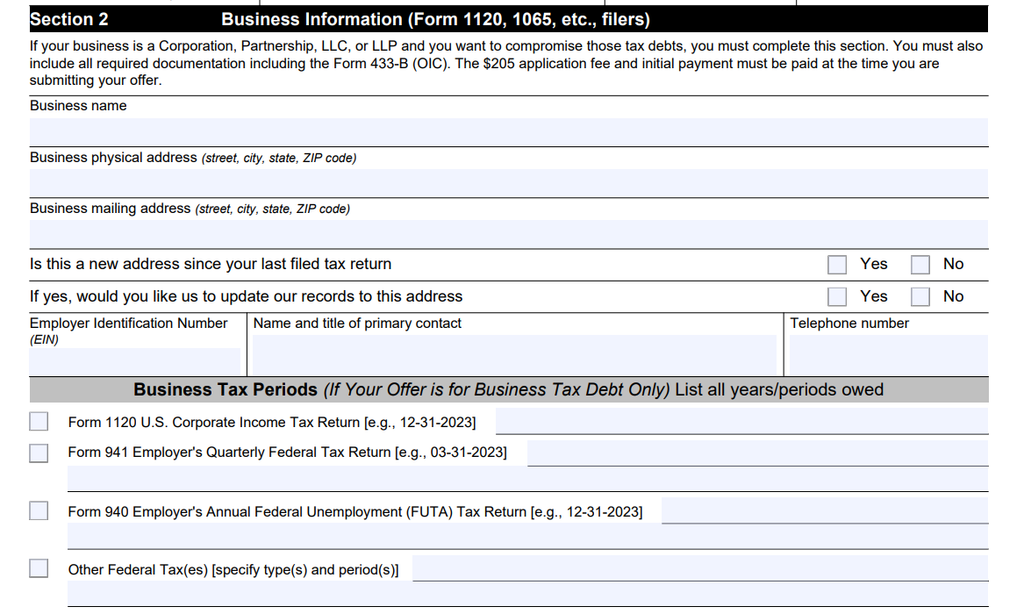
- What it asks
- Business name, EIN, address, and the business tax periods you want settled.
- What to enter
- The tax type (for example, Form 941 employment taxes) and every period with a balance.
- Double-check
- Not every balance qualifies. Unpaid payroll taxes can also create personal liability under the Trust Fund Recovery Penalty.
- Common mistake
- Leaving out a period or including a liability that cannot be compromised.
Section 3: Reason for Offer
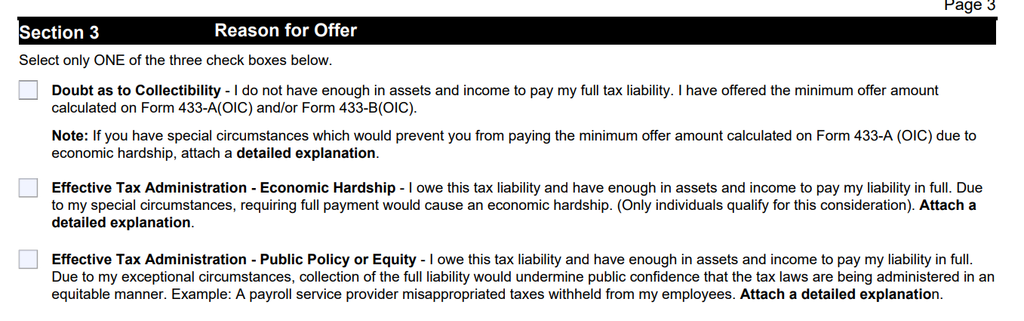
- What it asks
- Which ground applies (doubt as to collectibility or effective tax administration) and why.
- What to enter
- How your income, necessary expenses, assets, or special circumstances (illness, job loss, age) limit your ability to pay.
- Double-check
- Back every claim with pay stubs, medical bills, or proof of reduced income.
- Common mistake
- Claiming hardship without evidence, or mixing up inability to pay with a dispute about the tax.
Section 4: Payment Terms
- What it asks
- Your offer amount and whether you will pay as a lump sum or in periodic payments.
- What to enter
- The total offer and the payment schedule you can actually keep.
- Double-check
- The amount must match your Form 433-A (OIC) or 433-B (OIC) calculation.
- Common mistake
- Offering $5,000 when your statements support $8,000, with no documented reason.
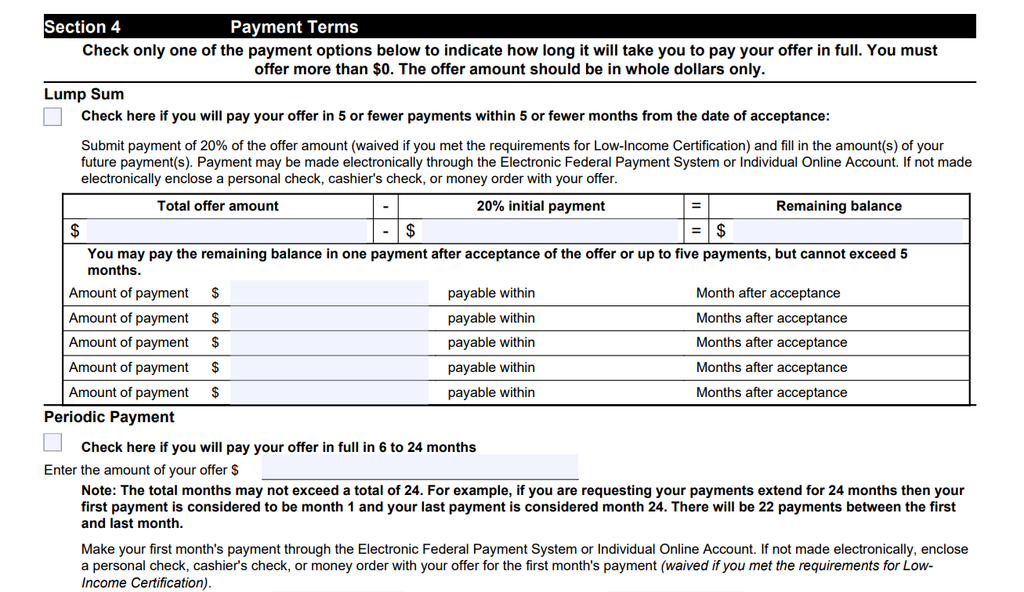
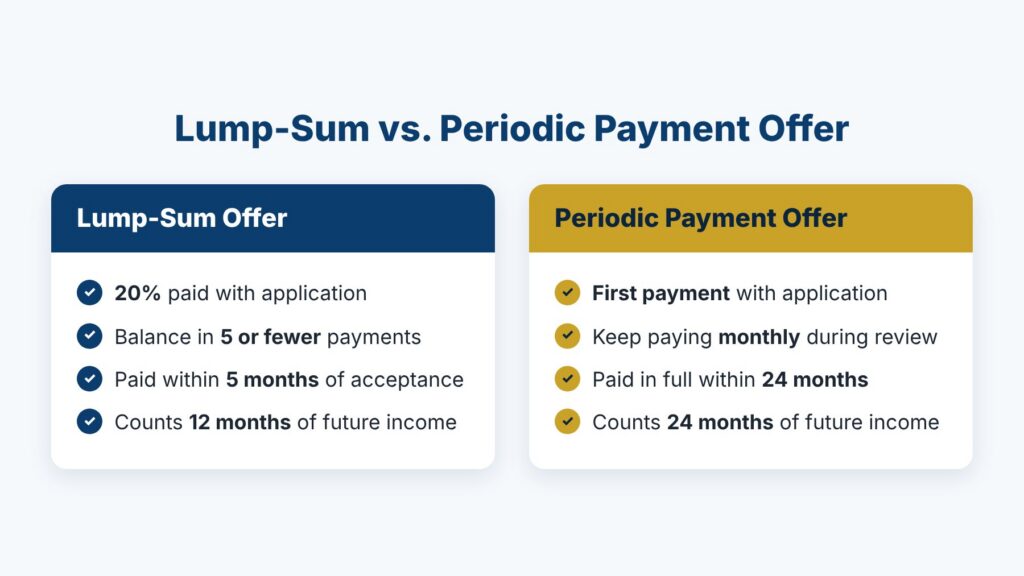
| Lump-Sum Cash Offer | Periodic Payment Offer | |
|---|---|---|
| Paid with application | 20% of the offer | First monthly payment |
| During review | No payments required | Keep paying monthly |
| Balance due | 5 or fewer payments within 5 months of acceptance | Within 6 to 24 months total |
| Future income counted | 12 months | 24 months |
| Best for | Taxpayers who can raise funds quickly | Taxpayers who need time to pay |
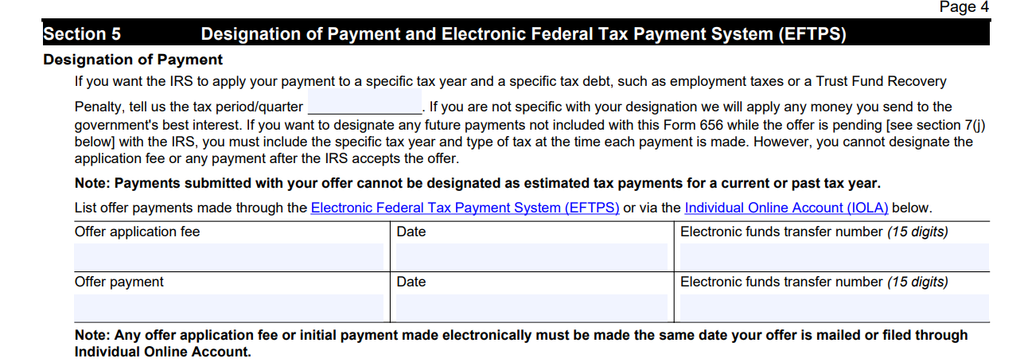
Section 5: Designation of Payment
- What it asks
- Whether you want payments applied to a specific tax year or debt, plus your fee and initial payment details.
- What to enter
- Payment date and electronic funds transfer (EFT) number for the fee and initial payment.
- Double-check
- Pay through EFTPS or your IRS Online Account on the same day you submit Form 656.
- Common mistake
- Recording the wrong EFT number or paying on a different date.
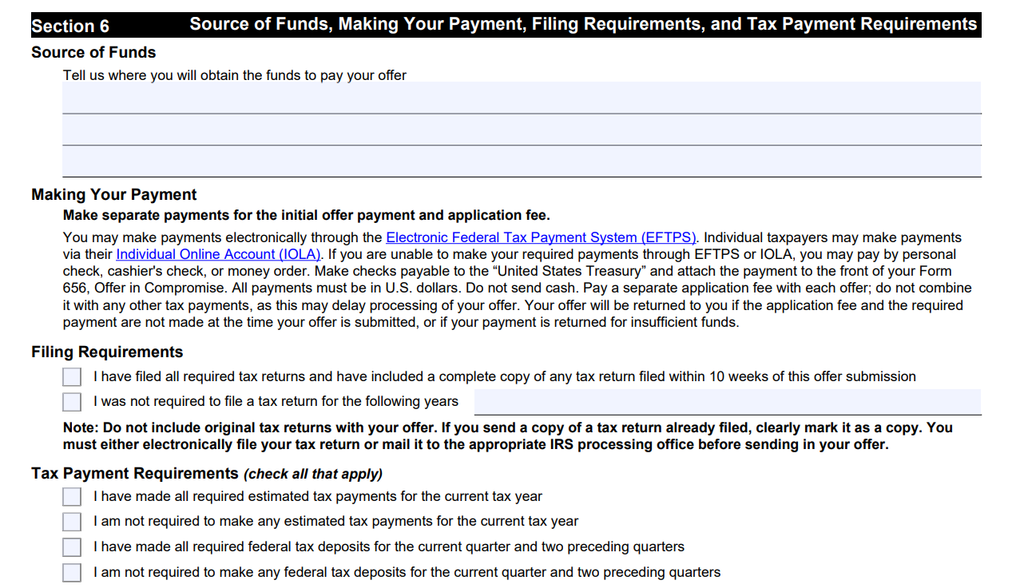
Section 6: Source of Funds and Filing Requirements
- What it asks
- Where the offer money will come from, and confirmation that you are in filing compliance.
- What to enter
- The source, such as savings, a loan, or help from family.
- Double-check
- All required returns are filed and current estimated payments or deposits are made.
- Common mistake
- Missing compliance requirements, which lets the IRS return the offer unreviewed.
Sections 7, 8 & 9: Offer Terms, Signatures, Paid Preparer
- Section 7
- Read the terms. You agree, among other things, to stay compliant for five years after acceptance.
- Section 8
- Every required taxpayer signs and dates. For joint debts, both spouses sign.
- Section 9
- Paid preparer details, if someone prepared the form for you.
- Representation
- File Form 2848 so a representative can act for you. Form 8821 only allows viewing your tax information.
Not sure your numbers will hold up?
A tax attorney and CPA can review your financial statements before the IRS does.
Request a ConsultationHow to Calculate a Defensible Form 656 Offer Amount
The IRS does not accept offers based on a percentage of what you owe. It calculates your reasonable collection potential: what it believes it could collect from your assets and future income.
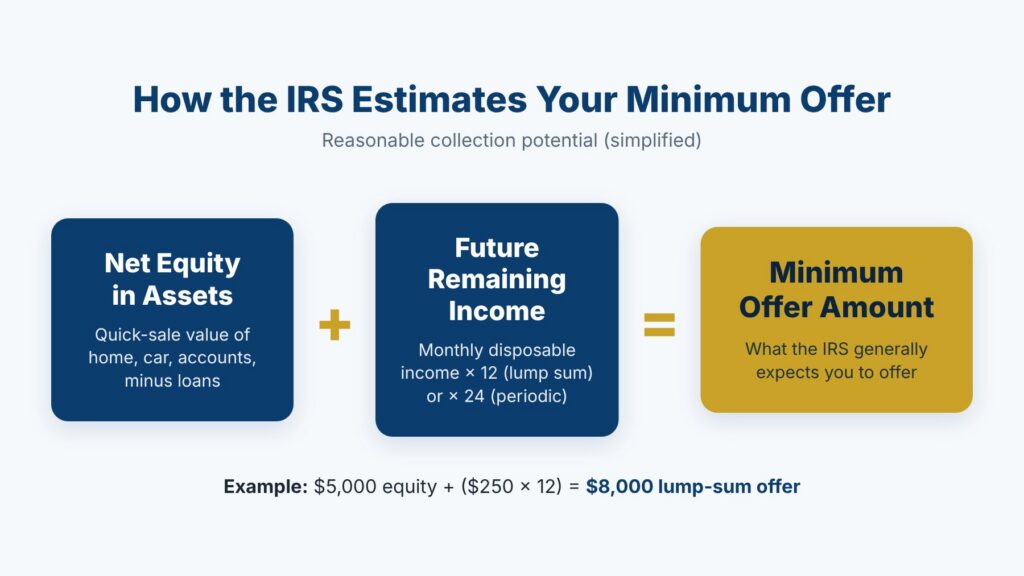
Worked example: net asset equity of $5,000 and $250 a month left after IRS-allowable expenses gives a lump-sum offer of $5,000 + ($250 × 12) = $8,000, or a periodic offer of $5,000 + ($250 × 24) = $11,000.
20% down: $0
over up to 24 months
Simplified estimate only. The IRS values assets at quick-sale value, applies its own national and local expense standards, and reviews your full Form 433-A (OIC) or 433-B (OIC). Your actual acceptable offer may be higher or lower. Not legal advice.
Start with Form 433-A (OIC) for individuals or Form 433-B (OIC) for businesses, and remember:
- Review your asset equity and the IRS income-and-expense figures line by line.
- Do not pick an arbitrary percentage of your tax debt.
- If you ask for less than the formula, document the special circumstances that justify it.
Sample IRS Offer in Compromise Letter
A supporting letter is not required in every case, but it can explain circumstances the forms do not capture. It never replaces the required forms. Use only facts you can prove. This is an illustrative example, not an official IRS template, and it does not guarantee acceptance.
[Your Full Legal Name]
[Your Mailing Address]
[City, State, ZIP Code]
[Date]
Internal Revenue Service
[Applicable OIC Processing Office]
Subject: Supporting Statement for Offer in Compromise
To Whom It May Concern:
I am submitting this statement in support of my Offer in Compromise application concerning my outstanding federal tax liabilities for [identify the relevant tax periods].
My current financial circumstances limit my ability to pay the full amount owed. My household income is approximately [$ amount] per month, and my necessary monthly living expenses total approximately [$ amount]. My financial disclosures also identify my available assets, outstanding liabilities, and other relevant obligations.
My circumstances are affected by [briefly describe the actual circumstances, such as reduced income, unemployment, or significant medical expenses]. I have included supporting records relevant to these circumstances and to the financial information provided with my application.
Based on my disclosed financial circumstances, I am proposing an offer of [$ amount], payable under the payment option selected in my Form 656. I respectfully request that the IRS evaluate my proposal under the applicable Offer in Compromise rules and the financial information provided.
I certify that the information I have supplied is accurate and complete to the best of my knowledge.
Thank you for your consideration.
Sincerely,
[Your Signature]
[Your Printed Name]
[Date]
7 Costly Mistakes That Sink Offers in Compromise
| Mistake | Why it hurts | How to avoid it |
|---|---|---|
| Unfiled returns | The IRS returns the offer unprocessed | File every required return before applying |
| Missing tax periods | The omitted debt stays fully owed | Match the form to your IRS transcripts |
| Arbitrary offer amount | IRS asks for more or rejects | Use the reasonable collection potential formula |
| Numbers that do not match | Raises credibility questions | Cross-check Form 656, 433-A/B, and your letter |
| Missing fee or payment | Offer may be returned | Pay $205 + initial payment unless low-income certified |
| No proof of hardship | Claims are disregarded | Attach medical bills, pay stubs, and similar records |
| Missed IRS deadlines | Offer can be closed | Answer every information request on time |
Form 656 Submission Checklist
Before you submit, confirm your package includes:
- Completed and signed Form 656
- Completed Form 433-A (OIC), Form 433-B (OIC), or both
- Required financial records and supporting documents
- Evidence for any special circumstances
- $205 application fee and initial payment (unless low-income certified)
- Correctly recorded payment details
- Form 2848, if a representative is acting for you
- The application checklist from the current Form 656-B booklet
Should You Mail Form 656 or Apply Online?
Eligible individuals can apply through their IRS Individual Online Account. If you mail your application, use the processing address in the current Form 656-B booklet. Do not mail a duplicate after applying online, and keep a full copy of everything you send.
What Happens After You Submit?
- Review time: Many months; complex cases can approach 24 months.
- Collection: The IRS generally does not levy while an offer is pending, though it may still file a federal tax lien. See how to remove an IRS tax lien or release a levy.
- Information requests: Answer every one by its deadline.
- If accepted: File and pay on time for five years. The IRS keeps refunds due through the calendar year the offer is accepted.
- If rejected: You generally have 30 days to appeal, usually on Form 13711. Read what you need to know about IRS appeals.
When Should You Hire an Offer in Compromise Attorney?
You can file Form 656 yourself. Professional help matters most when:
- You have both business and personal tax debts.
- You own real estate, investments, or other assets that raise your offer amount.
- The IRS is questioning your financial disclosures.
- You need to justify an offer below the formula amount.
- Your offer was rejected and you want to appeal.
- You have unfiled returns or other open issues. A tax attorney for back taxes can sequence these correctly.
How Verni Tax Law Can Help With Form 656
Verni Tax Law helps individuals and businesses prepare accurate offers and resolve difficult IRS collection issues. Anthony N. Verni is a tax attorney, Certified Public Accountant, and MBA with more than 20 years of experience practicing before the IRS.
- Confirm whether an OIC fits your situation
- Analyze your financial statements and spot issues that affect your offer
- Prepare a supporting letter that matches your evidence
- Respond to IRS questions and advise you after a rejection
Conclusion
A successful offer starts with three things: the right form, an offer amount backed by your financial statements, and complete documentation. A good letter tells your story, but the IRS decides based on its rules and your evidence. Check every tax period, payment term, and record before you file.
Ready to Settle Your IRS Debt the Right Way?
Talk with Anthony N. Verni, tax attorney and CPA, about whether an Offer in Compromise fits your situation.
Contact Verni Tax LawFAQs
What is IRS Form 656 used for?
Is a separate offer letter required with Form 656?
Can I fill out Form 656 myself?
Can I submit Form 656 without an initial payment?
How long does the IRS take to decide on an offer?
Is the initial payment refunded if my offer is rejected?
What happens if the IRS rejects my offer?
This article provides general information and is not legal advice. IRS rules, fees, and thresholds change, so confirm current requirements in the latest Form 656-B booklet or with a qualified tax professional.