
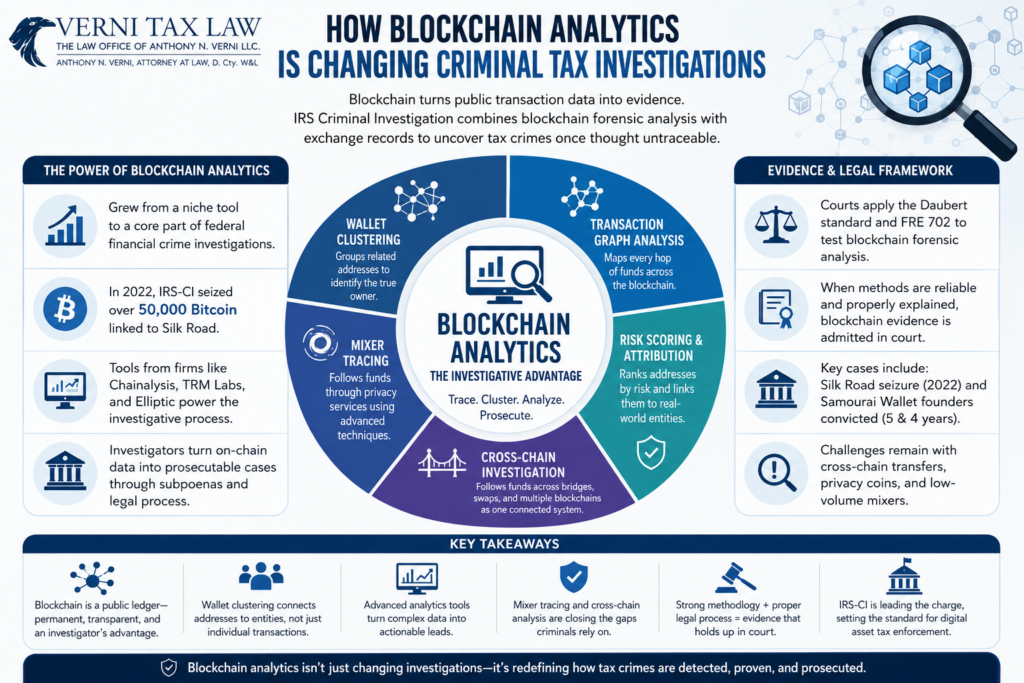
Blockchain analytics is changing criminal tax investigations by turning public transaction data into evidence investigators can trace, cluster, and present in court. IRS Criminal Investigation now pairs blockchain forensic analysis with exchange records to unmask taxpayers who once assumed crypto was untraceable.
This article breaks down the exact techniques agents use, from wallet clustering to mixer tracing, and where courts still push back.
Key Takeaways
- Wallet clustering groups related addresses using shared transaction inputs and change address patterns
- IRS-CI used blockchain analysis to seize over 50,000 Bitcoin tied to Silk Road in 2022
- Samourai Wallet’s founders got 5 and 4 years in prison for operating an unlicensed mixer service
- The IRS has issued John Doe summonses to Coinbase, Kraken, Circle, and Poloniex since 2016
- Courts apply the Daubert standard and FRE 702 to test blockchain forensic analysis in criminal trials
- Cross-chain transfers and privacy coins remain the toughest evidentiary challenges for prosecutors today
Growth of Blockchain Forensics in Financial Crime Investigations
Blockchain forensics grew from a niche research tool into a core part of federal law enforcement, since public ledgers hold a permanent record any investigator can query. IRS-CI now uses blockchain forensic analysis on nearly every digital asset case, not just the largest ones.
In 2022, agents used these methods to seize more than 50,000 Bitcoin tied to Silk Road, one of the largest crypto seizures in history. Firms like Chainalysis, TRM Labs, and Elliptic supply the software, while IRS criminal investigation teams supply the legal process, often through exchange subpoenas, to turn on-chain data into a prosecutable case.
Understanding Wallet Clustering Technology
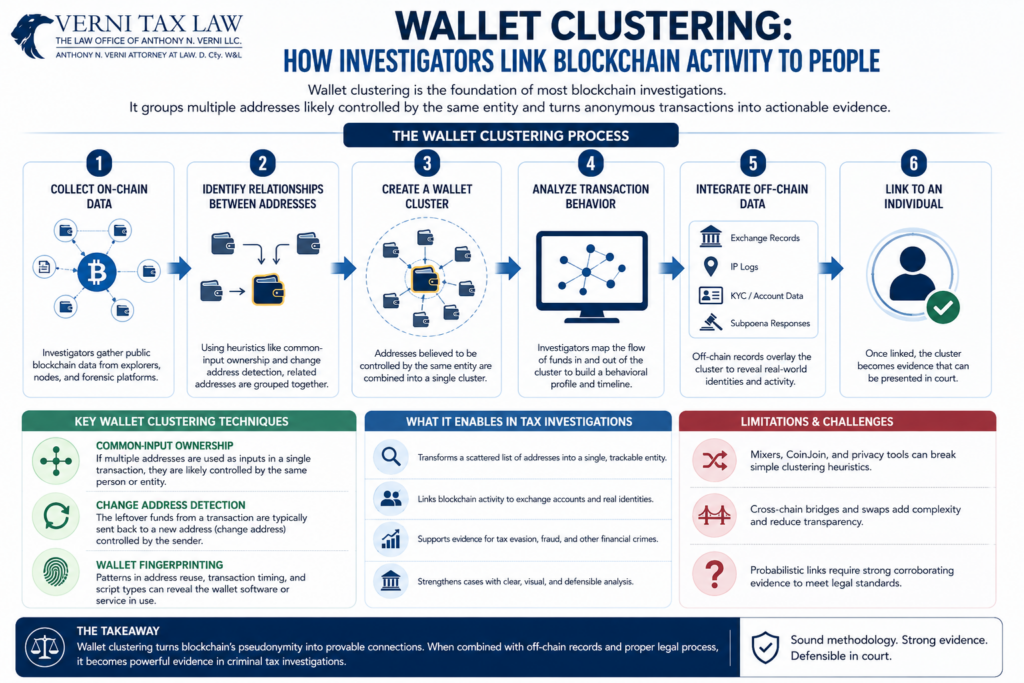
Wallet clustering groups multiple blockchain addresses into one entity when evidence shows they share the same controller. This single technique underlies almost every major crypto prosecution of the past decade, from ransomware seizures to tax fraud cases.
What Is Wallet Clustering?
Wallet clustering groups blockchain addresses likely controlled by the same person or service into a single unit. Investigators rely on shared transaction inputs, change address behavior, and wallet software fingerprints to make that call. A cluster does not name a person; it shows that several addresses probably belong to one wallet.
Common Wallet Clustering Techniques Used by Investigators
Common-input-ownership heuristics assume that if multiple addresses fund one transaction together, one person controls all of them. Change address detection flags the leftover output sent back to the sender in a typical transaction. Both are core cryptocurrency investigation techniques taught inside federal training programs and used daily by commercial platforms like Chainalysis Reactor.
How Wallet Clustering Links Transactions to Individuals
Wallet clustering turns a scattered list of addresses into a single behavioral profile investigators can follow. Once a cluster is built, agents overlay exchange data, IP logs, and account records to attach a real name to it, making a case prosecutable.
Blockchain Analytics Tools Used During Tax Investigations
Tax investigators use a small set of core tools to convert raw ledger data into usable leads. Blockchain forensic analysis platforms combine transaction graphing, risk scoring, and cross-chain tracking into one workflow built for courtroom use.
Transaction Graph Analysis
Transaction graphing maps every hop a fund takes from a known starting point, such as a fraud wallet, to its final destination. Investigators use these cryptocurrency investigation techniques to visualize thousands of connected addresses at once instead of tracing each transaction by hand.
Risk Scoring and Address Attribution
Risk scoring assigns a numeric exposure level to a wallet based on its links to exchanges, mixers, or sanctioned entities. This layer of blockchain forensic analysis helps agents prioritize which addresses deserve a deeper look before requesting exchange records.
Cross-Chain Investigation Capabilities
Criminals increasingly move funds across different blockchains using bridges and token swaps to break the trail. Modern cryptocurrency investigation techniques now correlate transactions across networks, a form of financial surveillance that treats separate blockchains as one connected system rather than isolated ledgers.
Mixer Tracing: Following Funds Through Privacy Services
Mixer tracing follows funds through services designed specifically to break the link between sender and receiver. Recent prosecutions show that even non-custodial mixers no longer guarantee anonymity in court.
How Cryptocurrency Mixers Work
A mixer pools cryptocurrency from many users and redistributes it, making the original source harder to identify. Mixer tracing starts the moment funds enter a pool like Whirlpool, before any output leaves it. Samourai Wallet’s founders still faced prosecution despite never holding customer funds; proof the non-custodial design alone doesn’t resolve every evidentiary challenge.
Modern Techniques for Tracing Mixed Transactions
Mixer tracing now relies on timing analysis, amount correlation, and behavioral fingerprints left behind even after coins pass through a mixing pool. Investigators developed these cryptocurrency investigation techniques specifically because CoinJoin defeats simple common-input clustering, forcing analysts to look at patterns across many transactions instead of one.
Current Limitations of Mixer Tracing
Mixer tracing works best when investigators have a known starting point and enough transaction volume to spot patterns. Cross-chain bridges, privacy coins, and low-volume mixers still create real evidentiary challenges, since probabilistic attribution is not the same as certainty in front of a jury.
Exchange Subpoenas and Customer Identification
Exchange subpoenas remain the single most reliable way to attach a name to a wallet address. Once blockchain analysis narrows a case to a specific platform, a subpoena or summons closes the identity gap.
KYC Records and Exchange Compliance
Exchanges collect know-your-customer records, including government ID, address, and banking details, under the Bank Secrecy Act. These KYC files turn exchange subpoenas into a direct path from an address to a legal name.
Connecting Wallet Addresses to Taxpayers
The IRS has served John Doe summonses on Coinbase, Kraken, Circle, and Poloniex since 2016. Coinbase alone turned over records for roughly 13,000 customers in that first round. Exchange subpoenas like these feed directly into IRS criminal investigation referrals once the data shows a pattern of unreported income.
International Cooperation Between Exchanges and Authorities
Foreign exchanges increasingly cooperate with U.S. authorities through treaty requests and joint task forces, closing off jurisdictions that once felt safe. This growing financial surveillance network means an offshore exchange is no longer an automatic dead end for investigators.
Evidentiary Challenges in Blockchain Tax Cases
Blockchain evidence must meet the same courtroom standards as any other forensic science before a jury sees it. Courts apply the Daubert standard and Federal Rules of Evidence 702, 901, and 1006 to test whether a clustering method is reliable enough to support a conviction in tax litigation.
Attribution and Ownership Issues
A wallet cluster shows control, not identity, which creates one of the sharpest evidentiary challenges in these cases. Defense attorneys regularly argue that shared custody, stolen keys, or custodial services could explain a cluster without proving their client controlled it.
Cross-Chain Transfers and Privacy Coins
Assets that move across blockchains or convert into privacy coins like Monero resist standard cryptocurrency investigation techniques almost entirely. These transfers remain one of the least solved evidentiary challenges in blockchain forensics today, and prosecutors often need corroborating evidence beyond the chain itself.
Expert Witnesses and Digital Evidence
In United States v. Sterlingov, the court found Chainalysis Reactor testimony admissible under Daubert after reviewing the analyst’s experience and the tool’s track record. That ruling now anchors tax litigation involving blockchain evidence, though courts still weigh corroborating proof rather than accepting software output alone.
Common Tax Crimes Supported by Blockchain Evidence
Blockchain evidence now supports a wide range of tax charges beyond simple underreporting.
Unreported Cryptocurrency Income
Wallet activity that never appears on a tax return is one of the clearest IRS audit triggers blockchain analytics can surface. When the pattern looks deliberate, civil exposure can escalate into tax evasion penalties under federal law.
Money Laundering and Offshore Asset Concealment
Funds routed through offshore exchanges or shell wallets to hide their origin point toward offshore tax evasion, and blockchain tracing often uncovers the layering before a taxpayer expects it. These patterns can support separate criminal tax charges alongside money laundering counts.
NFT, DeFi, and Staking Income Investigations
The IRS increasingly applies AI-driven IRS enforcement tools to flag NFT sales, DeFi swaps, and staking rewards that never hit a tax return. This kind of automated IRS enforcement cross-references wallet activity against filed returns far faster than a manual review ever could, and AI-driven IRS enforcement keeps expanding to new token types each filing season.
Best Practices for Cryptocurrency Compliance
Staying ahead of blockchain forensics starts long before an exchange subpoena ever arrives.
- Keep a running ledger of every wallet you control, including cold storage and hardware devices
- Treat mixer or privacy coin use as a red flag for your own recordkeeping, not just IRS attention
- Reconcile broker 1099-DA data against your own records every filing season
- Save exchange KYC confirmations and transaction exports for at least six years
- Report staking, airdrops, and DeFi income the year you gain control of it, not when you cash out
- Assume every wallet you have ever used could be pulled into a cluster someday
- Treat any letter tied to exchange subpoenas as a signal to review your full crypto history, not just the account named
- Watch for IRS audit triggers like round-number transfers or wallet activity that never matches a filed return
- Understand that tax evasion penalties and criminal tax charges can both stem from the same unreported wallet activity
- Review crypto FBAR reporting and FATCA compliance yearly if any exchange you use sits outside the U.S.
- Recognize that offshore tax evasion patterns are exactly what cross-border financial surveillance is built to catch
Working With Experienced Tax Counsel
An experienced tax fraud attorney can spot exposure in your wallet history before an agent does. Early counsel changes the trajectory of a case, often keeping a criminal tax defense matter from ever reaching indictment.
How Verni Tax Law Assists in Blockchain Tax Investigations
Verni Tax Law helps clients respond to blockchain-driven tax cases with the same forensic mindset investigators use against them. As an attorney, CPA, and MBA with more than 25 years of experience, Anthony N. Verni built his practice specifically around this kind of tax fraud attorney work, where accounting detail and legal strategy have to move together.
IRS Audit and Criminal Investigation Defense
Anthony N. Verni provides direct IRS audit defense and criminal tax defense representation when a blockchain-driven case reaches your door.
- He reviews the same clustering and exchange data investigators used before deciding on a strategy
- He represents clients personally before IRS-CI and in federal court when a matter turns criminal
- He handles every case from the first call to the final resolution
- He builds IRS audit defense strategy around the same clustering and subpoena data the government relies on
If you’ve received a John Doe summons letter or a notice tied to exchange records, book a confidential consultation before responding to the IRS.
Digital Asset Tax Compliance Strategies
He structures ongoing compliance plans that account for FATCA compliance and crypto FBAR reporting across every exchange and wallet a client uses, foreign or domestic. This proactive work often prevents the kind of gap that blockchain analytics later exploits.
Voluntary Disclosure and Risk Mitigation
Anthony N. Verni evaluates whether current FBAR reporting requirements and FBAR and FATCA reporting rules call for a voluntary disclosure before the IRS opens its own file. Getting FBAR reporting requirements and FBAR and FATCA reporting obligations right the first time is far cheaper than fixing them after a summons arrives, and coming forward early is almost always the stronger legal position.
Conclusion: Blockchain Analytics Is Reshaping Tax Enforcement
Blockchain forensic analysis has moved from an experimental technique to the backbone of modern crypto tax enforcement. Wallet clustering, mixer tracing, and exchange subpoenas now work together as a single investigative pipeline, and courts increasingly accept the resulting evidence under Daubert and the Federal Rules of Evidence. This evolution of IRS tax enforcement means taxpayers can no longer assume a wallet address offers real anonymity, a shift built on automated IRS enforcement systems that never existed a decade ago.
Verni Tax Law exists for exactly this shift. Anthony N. Verni’s combined background as an attorney, CPA, and MBA means he reads blockchain evidence the way the government does, then builds the tax litigation or compliance strategy around it before a small issue becomes a criminal one.
If a wallet, exchange notice, or summons letter has you concerned, contact Verni Tax Law for a confidential consultation today.
FAQs
What is wallet clustering in blockchain investigations?
Wallet clustering groups blockchain addresses likely controlled by one person or service, using shared transaction inputs and change address patterns as evidence.
How do investigators trace cryptocurrency mixers?
Investigators use timing analysis, amount correlation, and behavioral fingerprints to follow funds even after they pass through a mixing pool.
What are exchange subpoenas in crypto investigations?
Exchange subpoenas, including John Doe summonses, compel platforms like Coinbase and Kraken to disclose KYC records tied to specific transaction activity.
Can blockchain analytics identify wallet owners?
Yes, when combined with exchange KYC data, though clustering alone shows control patterns, not confirmed identity, without that additional link.
What evidence can blockchain analytics provide in tax cases?
Blockchain analytics can show transaction timing, wallet clusters, fund flow between exchanges, and connections to known illicit addresses or services.
Are cryptocurrency transactions truly anonymous?
No. Public blockchains record every transaction permanently, and clustering plus exchange records routinely connect wallet activity to real identities.
What blockchain tools do tax investigators use?
IRS-CI relies on commercial platforms like Chainalysis Reactor, TRM Labs, and Elliptic for transaction graphing, risk scoring, and cross-chain analysis.
Can blockchain evidence be used in court?
Yes. Courts have admitted Chainalysis Reactor testimony under Daubert, most notably in United States v. Sterlingov in 2024.
What should crypto investors do to maintain compliance?
Track every wallet you control, reconcile Form 1099-DA data yearly, and report staking or DeFi income the year you gain control of it.
How can a tax attorney help during a blockchain tax investigation?
A tax attorney can review the same forensic data investigators use, evaluate voluntary disclosure options, and represent you directly before IRS-CI.