

Yes, you can still receive a tax refund for an old unfiled return if you meet the IRS requirements and file before the applicable deadline. However, the IRS generally limits refunds for withholding and estimated tax payments to a specific period. Waiting too long can permanently cost you money, even when you qualify for a refund.
The IRS 3-year refund rule follows federal tax law, including Internal Revenue Code Section 6511. Your deadline depends on when you file, when you paid your taxes, and whether a legal exception applies.
Key Takeaways
- The IRS generally gives you three years from the return’s due date to claim certain refunds on unfiled returns.
- The 2022 tax refund deadline was generally April 15, 2026, which has passed.
- The 2023 refund deadline is generally April 15, 2027.
- The 2024 refund deadline is generally April 15, 2028.
- Special circumstances can extend certain refund deadlines.
- You may still need to file even when the IRS can no longer issue your refund.
Can You Still Get a Tax Refund if You Never Filed Your Tax Return?
Yes, you can claim a refund on an eligible past-due return if you meet the filing deadline and payment requirements. The IRS generally requires taxpayers to file within three years of the return’s due date to claim refunds involving withholding or estimated tax payments.
The deadline does not automatically restart when you decide to file. Your eligibility depends on the tax year, payment history, and applicable law.
Three separate questions matter:
- Refund eligibility: Did you pay more tax than you owed, or qualify for a refundable credit?
- Refund deadline: Did you file your refund claim within the legally allowed period?
- Refund amount: How much can the IRS return under the payment lookback rules?
Understanding these differences helps you determine how many years back you can file taxes and whether filing an old return will recover money.

How Does the IRS 3-Year Refund Rule Work for Old Unfiled Returns?
The IRS 3-year refund rule generally limits refund claims to three years after filing a return or two years after paying the tax, whichever period ends later. Special rules apply when you never filed the original return.
When Does the 3-Year Refund Deadline Start?
For federal income tax withholding and estimated payments, the IRS generally treats the payments as made on the return’s original due date, regardless of filing extensions.
| For example, withholding for the 2022 tax year generally counts as paid on April 15, 2023. The ordinary refund deadline was April 15, 2026. |
Other payments can have different dates. Your payment records help determine the applicable deadline.
What Is the Difference Between the Refund Deadline and the Lookback Period?
The refund deadline determines when you must submit your claim. The lookback period limits how much money the IRS can return.
Under Section 6511, a claim filed within the three-year period generally limits the refund to qualifying payments made during the preceding three years, plus any applicable filing extension period.
If you file outside that period, the alternative two-year payment rule can apply. Meeting one deadline does not guarantee recovery of every historical payment.
The statute of limitations for unfiled tax returns therefore affects both the timing of your claim and the amount you can recover.
How Far Back Can You Get a Tax Refund?
You can generally claim a refund for an eligible tax year within three years of its return due date, subject to the payment rules and exceptions. The deadline is not the same for every type of payment.
The Difference Between Filing a Return and Claiming a Refund
Filing a return reports your income, deductions, credits, and tax liability. Claiming a refund asks the IRS to return an overpayment or issue an eligible refundable credit.
You can still have a filing obligation after your refund rights expire. Losing a refund does not automatically remove your duty to file.
Can You Claim a Refund for a Return Filed Late?
Yes, provided your refund claim meets the applicable deadline. Filing late does not automatically disqualify you, but missing the refund deadline can prevent you from recovering money.
The following dates reflect the ordinary deadlines for withholding and estimated tax refunds, subject to exceptions.
| Tax year | General refund deadline | What you should do |
| 2022 | April 15, 2026, passed | Check whether a legal exception applies. |
| 2023 | April 15, 2027 | Prepare and submit your eligible return promptly. |
| 2024 | April 15, 2028 | Confirm your refund eligibility and file promptly. |
These dates follow the IRS guidance for prior-year Earned Income Tax Credit claims and ordinary refund deadlines.
Do Tax Credits and Withholding Affect Your Refund Deadline?
Yes, refundable tax credits and withholding can affect the amount you receive, but they do not automatically extend the deadline.
The Earned Income Tax Credit (EITC) is a refundable credit for eligible workers with qualifying income. You must file a federal return to claim it, even if you otherwise have no filing requirement.
The IRS lists April 15, 2027, as the ordinary deadline for claiming an eligible 2023 EITC refund and April 15, 2028, for 2024.
Your final refund can also decrease because of tax adjustments or qualifying debt offsets, including certain past-due federal debts and child support.
Examples of the IRS 3-Year Refund Rule
The result depends on the tax year, payment date, and filing date. These examples illustrate how the rules work for common situations.
Example 1: Filing Within Three Years of the Deadline
A taxpayer has an eligible 2023 overpayment from paycheck withholding. Filing the return by April 15, 2027, generally keeps the claim within the ordinary three-year period. The IRS must still verify eligibility and calculate the amount allowed.
Example 2: Filing After the Three-Year Window
A taxpayer waits until October 2026 to claim a refund for 2022 withholding. The ordinary April 15, 2026, deadline has passed.
The taxpayer should check for a valid statutory exception. Without an applicable exception, the IRS generally cannot issue that refund.
Example 3: When You Paid Tax After Filing
A taxpayer files a return and later makes an additional tax payment. The two-year period after that payment can affect the refund deadline.
Section 6511 generally uses whichever ends later: three years after filing or two years after payment. The payment lookback rules still restrict the amount recoverable.
Are There Exceptions to the IRS 3-Year Refund Rule?
Yes, federal law provides exceptions that can extend certain refund deadlines. However, you must meet the specific requirements for each exception.
Relevant situations include:
- Financial disability: Certain periods can be excluded if a medically determinable impairment prevents you from managing your financial affairs and statutory conditions are met.
- Federally declared disasters: Qualifying taxpayers can receive additional time under applicable relief provisions.
- Military service: Special rules can extend deadlines for qualifying taxpayers serving in designated combat zones.
- Bad debts and worthless securities: Certain claims have a separate seven-year deadline.
Financial hardship alone does not extend the deadline. Review the facts and applicable law before assuming an exception applies.
What Happens If You Have Multiple Years of Unfiled Tax Returns?
You should review every missing tax year separately because filing duties and refund rights can differ. Filing multiple years of overdue tax returns requires more than preparing several forms and sending them together.
How to Identify Which Tax Years You Still Need to File
List every year you missed, including years when you earned wages, operated a business, or received other taxable income. Check your IRS account and notices for missing returns.
How to Obtain IRS Wage and Income Transcripts
An IRS wage and income transcript shows information reported to the IRS on Forms W-2, 1099, and other information returns.
You can request transcripts through the IRS Get Transcript service. Use these records to rebuild missing income information when original documents are unavailable.
What If You Owe Taxes Instead of Receiving a Refund?
You should still address the missing returns. The refund deadline does not automatically eliminate unpaid tax or your filing duties.
The IRS can assess tax and pursue collection when the law permits. Depending on your circumstances, payment plans or other resolution options may help.

What Are the Risks of Not Filing Old Tax Returns?
Leaving unfiled tax returns unresolved can create financial and legal problems, even when you believe you are due a refund.
The main risks include:
- Losing your refund: Once the applicable deadline expires, you can lose the right to recover eligible overpayments.
- Penalties and interest: Returns with unpaid tax can lead to additional charges.
- IRS substitute returns: The IRS can prepare a return using available information, potentially missing deductions or credits you could claim.
- Collection action: Unpaid assessed taxes can lead to levies or federal tax liens.
- Missing Social Security credits: Self-employed people who fail to report income can lose credits toward retirement or disability benefits.
- Loan delays: Lenders can request filed returns when reviewing mortgage or business loan applications.
The IRS advises taxpayers to file past-due returns even when they cannot pay the full balance.
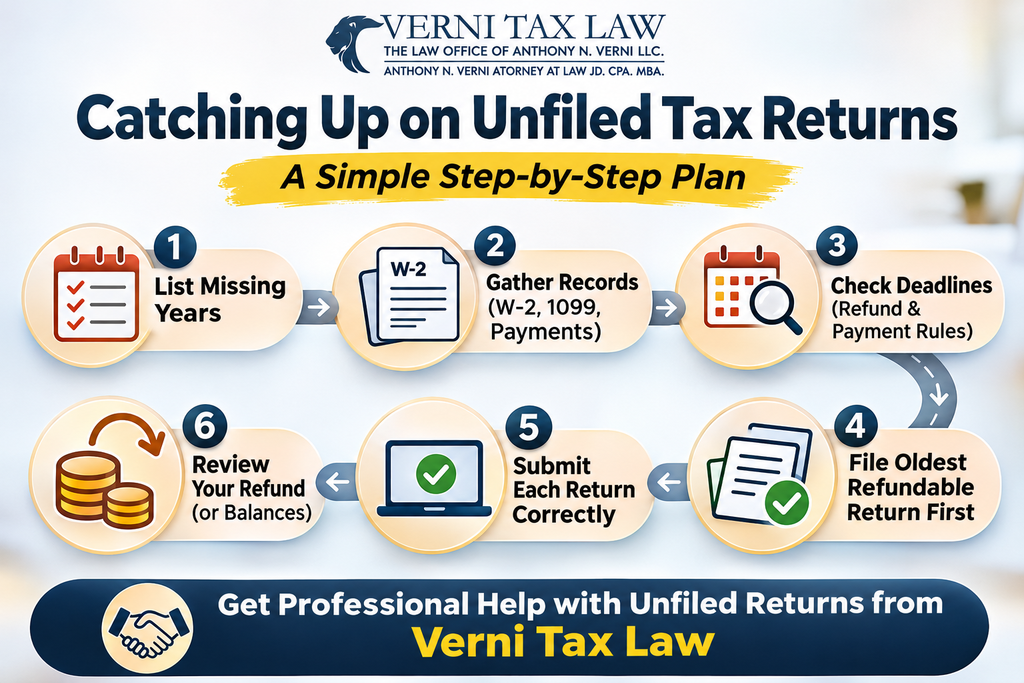
What Should You Do If Your Old Tax Refund Deadline Is Approaching or Has Passed?
Act promptly and assess each tax year separately. A clear plan helps protect any remaining refund rights while addressing other filing duties.
- List every missing year. Record the tax year, original due date, and known filing status.
- Gather payment records. Collect Forms W-2 and 1099, estimated tax payment records, and IRS notices.
- Check each deadline. Review the original due date, actual payment dates, and any qualifying extensions or statutory relief.
- Prepare the oldest potentially refundable return first. Prioritize the year with the earliest remaining refund deadline.
- Submit each return correctly. Follow current IRS instructions for prior-year returns and retain proof of mailing or electronic acceptance.
- Review refund adjustments. Check for IRS notices, tax balances, and qualifying offsets that could reduce your payment.
If you need to catch up on unfiled tax returns, do not wait until every year is ready before addressing an urgent refund deadline.
Filing can remain necessary even when a refund is no longer available. Professional help with unfiled tax returns can clarify the filing requirements and potential consequences.
When Should You Get Professional Help With Unfiled Tax Returns?
Seek professional help when missing returns involve significant balances, complex income, or possible IRS enforcement.
Consider speaking with a tax attorney if:
- You received an IRS notice about missing returns or unpaid taxes.
- Several years involve business income or foreign financial accounts.
- You face possible fraud allegations or a criminal tax investigation.
- You need to assess a refund exception or disputed payment date.
- You need help choosing among options for addressing unfiled taxes.
- You are unsure whether the IRS six-year rule for unfiled tax returns applies to your circumstances.
The six-year period is not a universal rule that limits every IRS review to six years. Filing history, income omissions, and other facts can affect the applicable rules.
How Verni Tax Law Can Help With Unfiled Tax Returns
Verni Tax Law can help you assess old filing obligations, protect your legal position, and address IRS concerns. Anthony N. Verni is an attorney, Certified Public Accountant (CPA), and MBA with more than 20 years of experience practicing before the IRS, according to his professional biography.
His work includes failure-to-file matters, civil tax controversies, and other federal tax compliance issues. His legal and accounting background helps him review both the tax figures and the legal rules that affect your case.
He can help you with:
- Refund deadline reviews: Assess the relevant filing dates, payment history, and possible statutory exceptions.
- Prior-year return planning: Identify missing returns and prioritize years with urgent refund deadlines.
- IRS notice responses: Review notices and help address outstanding filing or payment issues.
- Tax liability resolution: Evaluate available approaches when overdue returns show unpaid tax.
- Complex compliance matters: Address cases involving foreign income, reporting duties, or potential tax enforcement.
Anthony N. Verni will review your circumstances and explain the legal and practical options available. His approach emphasizes direct attorney involvement and case-specific advice. Book a consultation now.
Conclusion
The IRS 3-year refund rule can prevent taxpayers from recovering money when they delay filing old returns. Your refund rights depend on the applicable deadline, payment history, and any valid exception. As of October 2026, the ordinary refund deadline for 2022 has passed, while eligible 2023 and 2024 claims generally remain within their respective periods. Do not assume that every old refund is lost, or that every late return qualifies for payment.
Anthony N. Verni of Verni Tax Law can help you assess your filing history and determine whether a refund claim remains available. He can also advise you on overdue filing obligations and IRS disputes.
Contact Verni Tax Law to discuss your unfiled returns and determine the next steps for your tax situation.
FAQs
Can I get a tax refund if I file three years late?
Yes, sometimes. You can receive a refund if your claim meets the applicable deadline and payment rules, including any valid exception.
Does the three-year rule start when I finally file my missing return?
No, not always. Withholding and estimated payments generally count as paid on the original return due date, regardless of filing extensions.
Can I claim an old Earned Income Tax Credit refund?
Yes, if you meet the deadline. The ordinary deadline for claiming a 2023 EITC refund is April 15, 2027, and for 2024 it is April 15, 2028.
Can I still file a return after the refund deadline?
Yes. You may still need to file an overdue return after refund rights expire, especially when you owe tax or have an outstanding filing obligation.