

The Offshore Voluntary Disclosure Program (OVDP) closed on September 28, 2018. What replaced it is the Voluntary Disclosure Practice (VDP), a domestic and offshore option administered by IRS Criminal Investigation (IRS-CI) for taxpayers with willful, criminal tax exposure.
VDP covers any willful noncompliance, offshore or domestic, and it existed as a general practice long before OVDP ever did. In 2026, current VDP rules under IRM 9.5.11.9 govern every case filed today, while a separate set of proposed revisions, opened for public comment on December 22, 2025 and closed March 22, 2026, would change the penalty structure once finalized. The IRS has stated that the proposal creates no rights until it takes effect.
Key Takeaways
- OVDP ended September 28, 2018; VDP is not a rebranded offshore program; it is a broader, older practice.
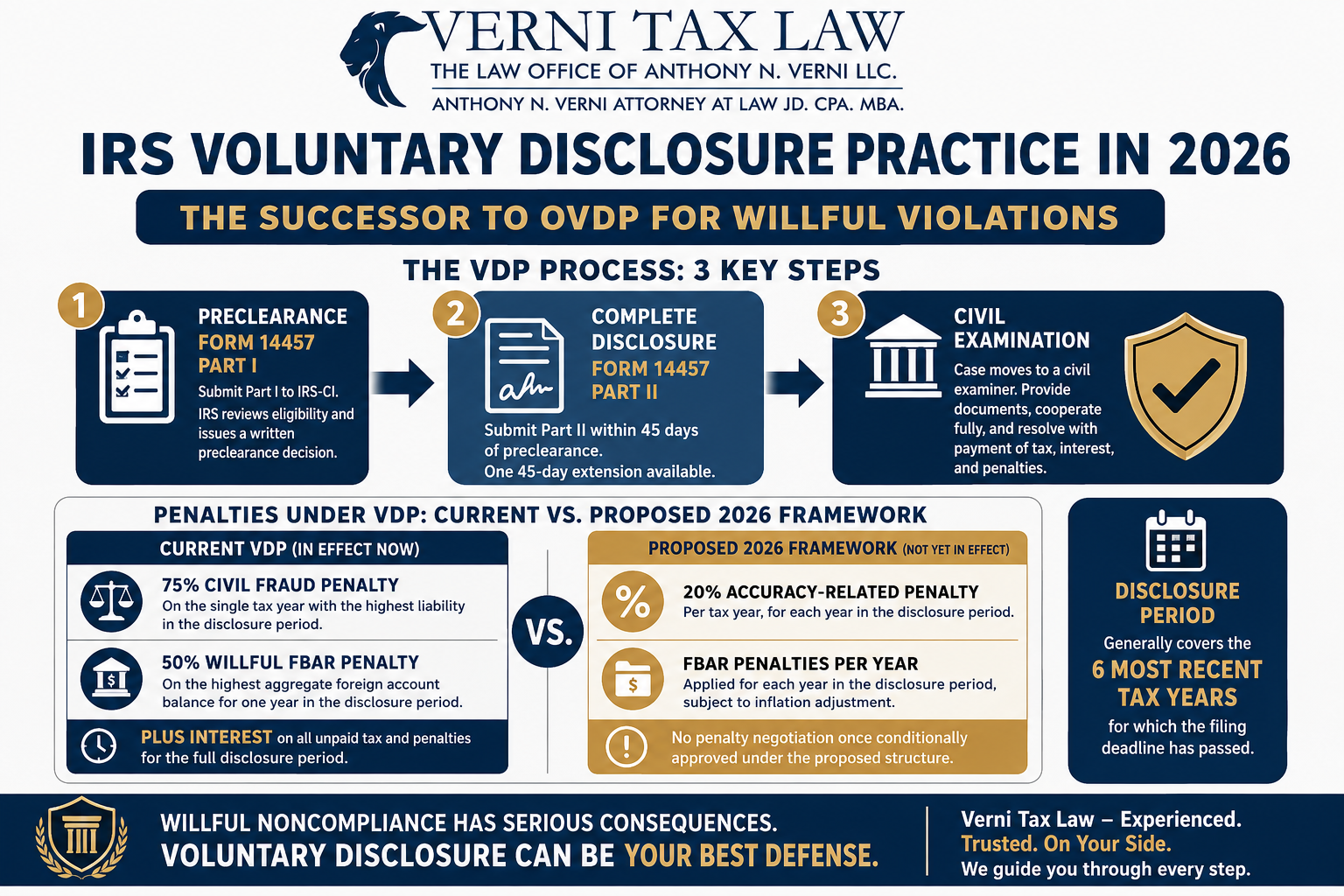
- Current civil penalties generally include a 75% civil fraud penalty on one tax year and a 50% willful FBAR penalty.
- The proposed 2026 framework would replace those with a 20% accuracy-related penalty per year and per-year FBAR penalties, but this is not yet in effect.
- The disclosure period generally covers the six most recent tax years for which the filing deadline has passed.
- Form 14457 preclearance (Part I) must be followed by Part II within 45 days, with one 45-day extension available.
- A voluntary disclosure never guarantees immunity from prosecution, though it is a factor CI weighs.
Is IRS Voluntary Disclosure Practice in 2026 Really the Successor to OVDP?
No, VDP is the compliance option available to willful taxpayers now that OVDP is gone, but it is a different tool with a different scope, built on a practice that predates OVDP by decades.
What Changed When OVDP Closed in 2018?
OVDP was a standalone offshore program that let taxpayers disclose foreign accounts for a fixed 27.5% (or 50%, in flagged-institution cases) penalty on the highest account balance, covering up to eight years of returns. Once it closed, that specific penalty structure and the eight-year lookback disappeared with it. Taxpayers with willful offshore exposure did not lose an option, though. They shifted to the general voluntary disclosure practice that IRS-CI had operated since long before OVDP existed.
How the Current VDP Replaced OVDP
The current framework took effect in November 2018, weeks after OVDP’s closing date. It folded offshore disclosures into the same track used for domestic willful noncompliance, unreported income, false returns, and unfiled information returns. Offshore disclosure after OVDP closed now runs through the identical Form 14457 process used for a domestic case; there is no separate offshore intake form anymore.
Who Oversees the Program
IRS Criminal Investigation administers VDP, not a civil compliance unit. Every Form 14457 goes to CI-Headquarters-Global Operations Policy & Support for review, and only after preliminary acceptance does a case move to a civil examiner.
Who Should Consider IRS Voluntary Disclosure in 2026?
Taxpayers whose failure to file, pay, or report was intentional, not accidental, are the intended audience for VDP. The IRS defines willfulness as an intentional, deliberate act to hide income or assets to avoid filing requirements or tax payment.
Willful FBAR Violations
A willful FBAR disclosure program applies when a taxpayer knowingly failed to file FinCEN Form 114 for foreign accounts exceeding $10,000 in aggregate value. FBAR filing requirements apply to signature authority as well as ownership, so a person managing a foreign business account for someone else can still trigger the obligation. Willful FBAR penalties under current guidance run as high as 50% of the account’s peak balance for one year in the disclosure period.
Unreported Offshore Income
Interest, dividends, rental income, and business income earned abroad and never reported on a U.S. return fall squarely inside VDP’s scope when the omission was deliberate. FATCA reporting requirements now mean most foreign banks already report U.S. account holders to the IRS, which shrinks the window for coming forward before the IRS finds the account on its own.
Undisclosed Foreign Accounts
A foreign bank account, brokerage account, or foreign pension that was never reported on Form 8938 or an FBAR, and where the taxpayer knew reporting was required, fits the VDP profile. Quiet disclosure FBAR risks are filing amended returns or late FBARs without going through VDP, or the Streamlined Procedures leaves willful conduct exposed, since the IRS reviews these filings for irregularities and does not treat a quiet correction as protection from prosecution.
Cryptocurrency and Digital Asset Reporting Issues
Digital asset transactions, including crypto-to-crypto trades and unreported gains, fall under the same willfulness standard as any other unreported income. The IRS has expanded its digital asset enforcement significantly since 2021, and taxpayers who intentionally left crypto gains off their returns face the identical VDP eligibility analysis as someone who hid a foreign brokerage account.
Who Does NOT Qualify for the Voluntary Disclosure Practice?
Taxpayers whose conduct was not willful, or who are already under IRS scrutiny, are excluded from VDP by design.
Non-Willful Taxpayers
If the failure was a genuine mistake, negligence, or a misunderstanding of a filing rule, VDP is the wrong tool. The IRS explicitly states that a narrative describing mere negligence or carelessness will be denied at the clearance stage. Non-willful taxpayers should instead consider amended returns, delinquent return procedures, or the Streamlined Filing Compliance Procedures.
Taxpayers Already Under IRS Investigation
A disclosure is only timely if it arrives before the IRS opens a civil exam or criminal investigation, before a third party alerts the IRS to the noncompliance, or before the IRS gets information about it through an enforcement action such as a summons or search warrant. Once any of those triggers happens, VDP is off the table for that taxpayer.
Situations Better Suited for Other Programs
Taxpayers with illegal-source income cannot use VDP at all, since the practice is limited to income from legal sources. Someone who simply forgot to report a small foreign account, with no intent to conceal it, is generally better served by an amended return or the Streamlined Procedures, both of which carry far lower penalty exposure than VDP’s fraud-based framework.
How the IRS Voluntary Disclosure Process Works
The process runs through Form 14457 in two parts, followed by a civil examination that converts the disclosure into a final resolution.
Step 1: IRS CI Preclearance (Form 14457 Part I)
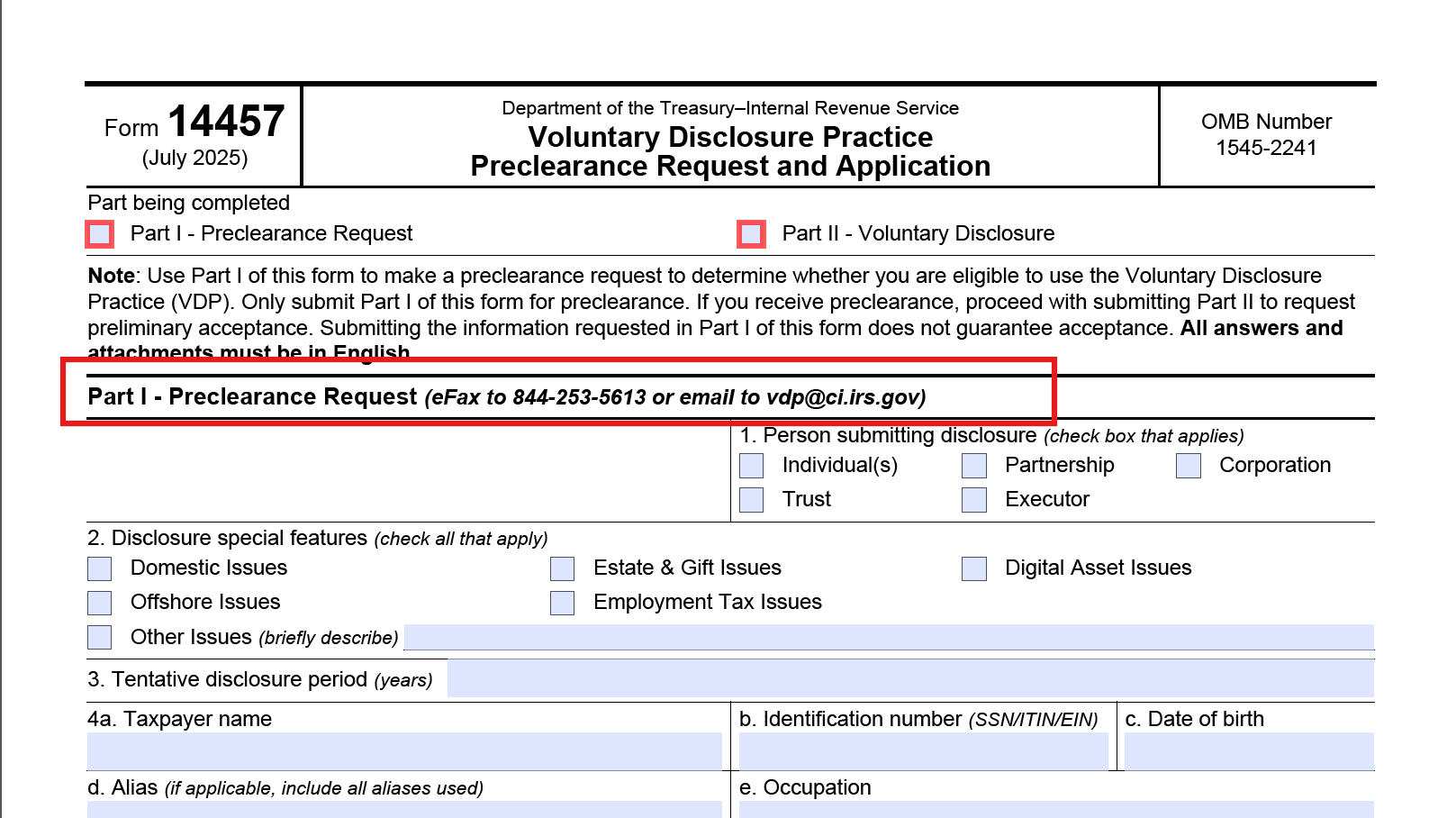
Part I asks whether the taxpayer, spouse, or related entities are already under examination or investigation, and whether any income comes from illegal sources. CI reviews this submission and issues a written preclearance decision. Preclearance confirms eligibility to proceed; it does not guarantee that the disclosure itself will be accepted.
Step 2: Complete Disclosure (Form 14457 Part II)
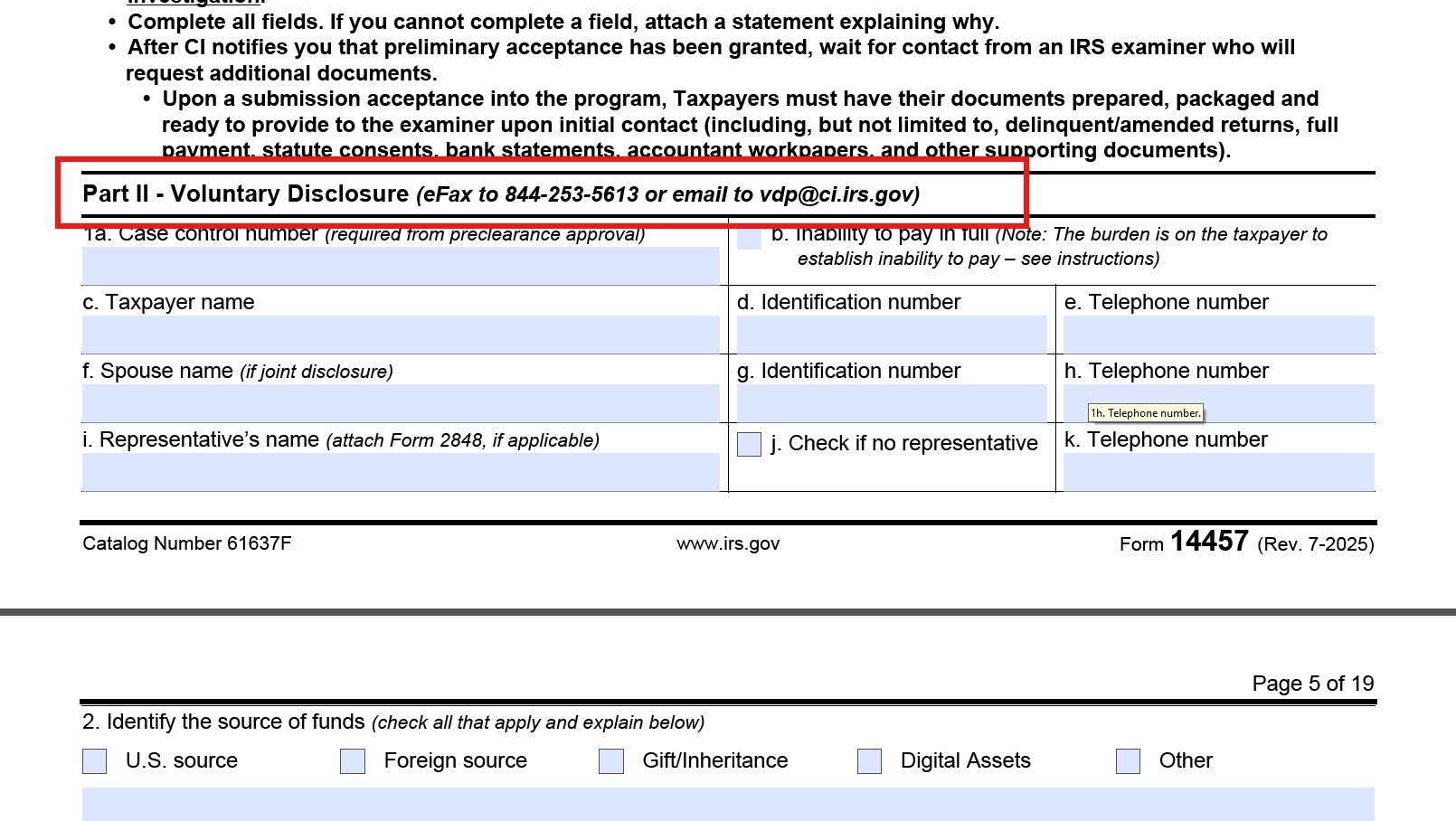
Part II requires a signed, sworn narrative describing the full history of the noncompliance, every professional advisor involved, and both favorable and unfavorable facts. An incomplete narrative gets a 14-day window to fix before CI denies preliminary acceptance outright.
How Long Does A Taxpayer Have To Submit Part II?
A taxpayer has 45 days from the date of the preclearance letter to submit Part II. One additional 45-day extension is available on written request to the IRS’s voluntary disclosure email address, but no more than one extension will be granted under any circumstances.
Step 3: Civil Examination
Once CI issues a preliminary acceptance letter, the case moves to a civil examiner who requests supporting documents and a signed acknowledgment of the willful failure to comply. The taxpayer must cooperate fully; failure to do so can trigger a request to revoke the preliminary acceptance and send the matter back to CI for possible criminal evaluation.
Final Resolution and Payment
The case closes with full payment of tax, interest, and assessed penalties, generally through a closing agreement. Full payment, or a secured full-pay installment agreement, is a condition of the practice, not an optional add-on.
Penalties Under the IRS Voluntary Disclosure Practice
- Civil fraud penalty: currently 75% of the underpayment for the single tax year with the highest liability in the disclosure period.
- Willful FBAR penalty: currently up to 50% of the highest aggregate foreign account balance for one year in the disclosure period, though examiners retain discretion to apply the non-willful penalty instead.
- Interest: assessed on all unpaid tax and penalties for the full disclosure period.
- Proposed 2026 revision: would replace the 75% fraud penalty with a 20% accuracy-related penalty per year, and would apply FBAR penalties per year, subject to inflation adjustment, rather than as a single-year assessment. The IRS has not confirmed whether those FBAR penalties will sit at the $10,000 non-willful level.
- No penalty negotiation once conditionally approved: the IRS has stated that no deviations from the assessed penalty framework will be permitted after conditional approval under the proposed structure.
How Many Years Does IRS VDP Require You to Disclose?
The disclosure period generally covers the six most recent tax years for which the filing due date has passed.
Does Current VDP Automatically Mean Six Years?
Not automatically in every case, but six years is the standard scope under current guidance. The exact years included shift based on when Part II is actually received by CI, since the lookback runs backward from that submission date rather than from the date the taxpayer first contacted the IRS or filed Part I.
What Happens If the Willful Conduct Goes Back 10, 15, Or 20 Years?
The disclosure filings themselves are typically limited to the six-year period, but the examiner retains authority to expand the scope of the civil examination if the case does not resolve through agreement, or if the facts uncovered during the exam point to a longer pattern of noncompliance. A taxpayer with a decade or more of willful conduct should expect the examiner to ask about, and potentially document, years outside the six-year filing window even if formal returns are not required for all of them.
Does IRS VDP Guarantee Immunity From Criminal Prosecution?
No. The IRS states directly that a voluntary disclosure does not automatically guarantee immunity from prosecution.
A timely, truthful, and complete disclosure is one factor CI weighs, alongside every other fact in the case, when deciding whether to recommend prosecution to the Department of Justice. In practice, this functions as:
- A structured mechanism for coming forward before the IRS finds the conduct independently,
- One input among several that CI considers in its charging recommendation,
- A route that has historically limited criminal-prosecution exposure for cooperative, complete disclosures, and
- A path back to full civil compliance, provided the taxpayer meets every procedural requirement.
The Voluntary Disclosure Practice creates no substantive or procedural right to non-prosecution, and CI’s determinations on timeliness, completeness, and truthfulness are not subject to administrative or judicial appeal.
What Happens If You Don’t Make a Voluntary Disclosure?
Willful noncompliance that goes undisclosed carries escalating exposure the longer it sits unaddressed.
Increased IRS Enforcement
FBAR and FATCA compliance data-sharing agreements with foreign banks give the IRS visibility into offshore accounts that did not exist a decade ago. Waiting increases the odds the IRS identifies the account through third-party reporting before a taxpayer comes forward, which cuts off VDP eligibility entirely.
Criminal Investigation Risks
Criminal tax exposure for offshore violations includes felony charges under 26 U.S.C. § 7201 for tax evasion and § 7206 for filing false returns, alongside willful FBAR violations that carry their own separate criminal penalties. These are prosecutable independent of any civil penalty assessment.
Large Civil Penalties
Once the IRS identifies unreported income or accounts on its own, the taxpayer loses access to VDP’s structured penalty framework and faces standard civil fraud penalties, FBAR penalties, and accuracy-related penalties without any of VDP’s negotiated resolution path or its consideration against a criminal referral.
How Is IRS VDP Different From Streamlined Filing Compliance Procedures?
VDP and the Streamlined Filing Compliance Procedures serve two different taxpayer populations, split entirely by whether the underlying conduct was willful.
The table below reflects that taxpayers concerned about willful conduct and criminal liability go through VDP, while streamlined FBAR filing through the Streamlined Domestic or Foreign Offshore Procedures is reserved for negligence, inadvertence, or a good-faith misunderstanding of the law. Late FBAR filing procedures outside either program, sometimes called quiet disclosures, do not offer criminal-prosecution consideration and remain subject to full examination.
| Question | VDP | Streamlined |
| Willfulness | Designed for willful conduct | Non-willful conduct |
| Criminal exposure | Central consideration | Not designed as criminal-disclosure protection |
| Form 14457 | Yes | No |
| Preclearance | Yes | No |
| Foreign compliance | Can apply | Yes, where eligible |
| Core decision | Criminal-risk resolution | Non-willful correction |
How Verni Tax Law Helps With IRS Voluntary Disclosure Cases
Anthony N. Verni has represented taxpayers through offshore disclosure matters since 2009. As an attorney, CPA, and MBA who personally handles every case, he brings legal, accounting, and financial analysis to a single file rather than splitting it across departments.
Verni Tax Law helps taxpayers with:
- Evaluating whether specific conduct meets the willfulness standard before a disclosure is ever filed
- Preparing Form 14457 Part I and Part II, including the sworn narrative CI requires
- Direct representation before IRS Criminal Investigation throughout the preclearance and disclosure review
- Defense during the civil examination phase, including penalty negotiation and closing agreement review
IRS Criminal Investigation Representation
Because VDP runs through IRS-CI rather than a civil unit, direct experience with how CI evaluates disclosures matters. He communicates with CI-Headquarters-Global Operations Policy & Support on preclearance status, timeliness questions, and disqualifying-factor issues as they come up.
Civil Examination Defense
Once a case moves to a civil examiner, the focus shifts to penalty computation, documentation requests, and the closing agreement. He represents clients through that entire phase, working to keep the resolution consistent with what the disclosure actually supports.
Book a confidential consultation with Anthony N. Verni to review your specific facts before any disclosure is filed.
Conclusion
The Voluntary Disclosure Practice is the compliance path for taxpayers whose noncompliance was willful, not the offshore-specific successor OVDP once was. Current rules impose a 75% civil fraud penalty and a 50% willful FBAR penalty over a six-year lookback, while a December 2025 IRS proposal would replace that structure with a 20% accuracy-related penalty and per-year FBAR assessments once finalized. Timeliness decides eligibility, and no disclosure, current or proposed, guarantees immunity from prosecution.
Anthony N. Verni has guided taxpayers through offshore and domestic disclosure matters since 2009, including the transition from OVDP into the current VDP framework, and he personally reviews every case he takes on as both attorney and CPA. His firm evaluates willfulness before filing, prepares the Form 14457 narrative CI requires, and represents clients through both the criminal investigation and civil examination stages of a disclosure.
If you have undisclosed foreign accounts, unreported offshore income, or willful FBAR exposure, connect with Anthony N. Verni before deciding how to proceed.
FAQs
What is the IRS Voluntary Disclosure Practice?
It is IRS-CI’s compliance option for taxpayers with willful tax or reporting violations, letting them disclose noncompliance and pay owed tax and penalties before facing potential criminal referral.
Is the Voluntary Disclosure Practice the replacement for OVDP?
No, not directly. VDP is a broader, older practice that now also covers offshore cases; OVDP was one offshore-specific program that closed in 2018.
Who qualifies for the IRS Voluntary Disclosure Practice?
Taxpayers whose failure to report income, file returns, or disclose foreign accounts was willful, and who have not yet been contacted by the IRS about the noncompliance.
What is Form 14457 used for?
It is the two-part application, Preclearance and Voluntary Disclosure, used to request and complete participation in VDP.
What penalties apply under the Voluntary Disclosure Practice?
Currently, a 75% civil fraud penalty on one year and a 50% willful FBAR penalty on one year, plus interest, though a 2026 proposal would lower these to 20% and a per-year FBAR rate.
What happens if I don’t voluntarily disclose offshore accounts?
You risk the IRS identifying the account through FATCA reporting first, which ends VDP eligibility and exposes you to full civil fraud penalties and possible criminal prosecution.
Can I reduce FBAR penalties through voluntary disclosure?
Yes, VDP’s structured framework and examiner discretion to apply the non-willful FBAR rate instead of the 50% willful rate can reduce total exposure compared to a full examination.
What’s the difference between VDP and Streamlined Filing Compliance Procedures?
VDP is for willful conduct with criminal exposure; Streamlined is for non-willful conduct and offers no protection against criminal referral.
Can cryptocurrency reporting issues be resolved through the VDP?
Yes, intentionally unreported crypto gains or transactions are evaluated under the same willfulness standard as any other unreported income.
Should I hire an IRS voluntary disclosure attorney before contacting the IRS?
Yes, an IRS voluntary disclosure attorney can assess willfulness and timeliness before any filing, since a wrong move on either question can eliminate program eligibility permanently.