

The One Big Beautiful Bill Act (OBBBA) did not lower the FATCA or Form 8938 dollar thresholds. If you hold foreign bank accounts, foreign investments, or other overseas assets, your reporting limits for the 2025 and 2026 tax years are the same ones that have applied since 2011. OBBBA raised two unrelated IRS reporting thresholds, and those changes got mixed up with FATCA in online discussion.
Key Takeaways
- OBBBA (Pub. L. 119-21) was signed into law on July 4, 2025, and it left Form 8938 and FBAR thresholds untouched.
- Form 8938 thresholds still start at $50,000 for single filers living in the U.S. and reach $600,000 for married couples abroad.
- The FBAR threshold stays flat at $10,000, no matter your filing status or where you live.
- OBBBA raised the Form 1099-K threshold back to more than $20,000 and 200 transactions, and the Form 1099-NEC/1099-MISC threshold from $600 to $2,000.
- Under IRC Section 6038D(a), the Treasury Secretary can only raise the $50,000 FATCA threshold.
- A FATCA tax attorney can confirm exactly which reporting rules apply to your specific accounts and filing status.
What Is the OBBBA FATCA Threshold Change?
There is no OBBBA FATCA threshold change. OBBBA did not touch the dollar figures in Form 8938 or replace them with a lower number. The Form 8938 thresholds set when FATCA became law in 2010 remain exactly as they were before OBBBA passed.
- The statutory reporting threshold. This is the dollar amount written into the Internal Revenue Code, currently $50,000 as the base figure under Section 6038D.
- Treasury’s regulatory authority. This is the power Congress gave the Treasury Secretary to adjust certain thresholds by regulation.
- The actual reporting obligation under current IRS instructions. This is what a taxpayer must do right now, based on the Form 8938 instructions in effect today.
OBBBA’s real information-reporting changes involve Form 1099-K and Forms 1099-MISC/1099-NEC, not FATCA. OBBBA restored the 1099-K threshold to more than $20,000 and more than 200 transactions, and it raised the Section 6041 threshold from $600 to $2,000 for payments made after 2025. Neither change affects whether you need to file Form 8938.
New Treasury Authority Explained
OBBBA created no new Treasury authority over FATCA reporting thresholds. The authority Treasury already has comes from Section 6038D(a) of the tax code, which was written into law when FATCA passed in 2010, well before OBBBA existed.
That existing statute sets the FATCA/Form 8938 threshold at $50,000, “or such higher dollar amount as the Secretary may prescribe.” It lets the Treasury raise the threshold above $50,000. It does not give the Treasury the power to push the threshold below $50,000. Anyone framing OBBBA as giving Treasury a green light to shrink FATCA reporting limits is describing authority that does not exist in the statute.
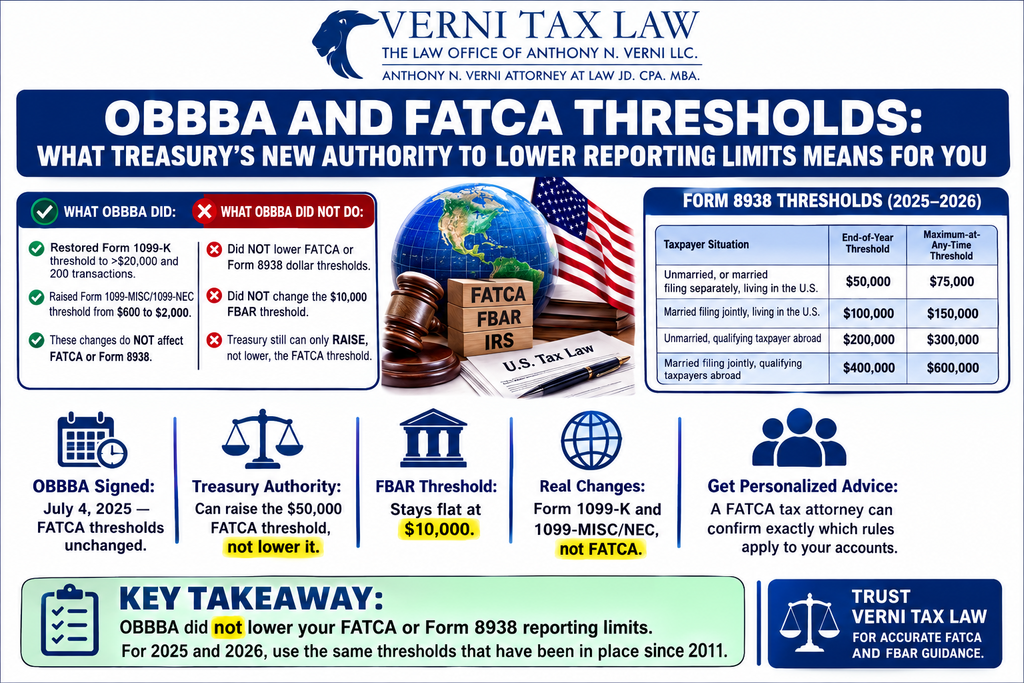
How Treasury’s Authority Could Change FATCA Reporting Requirements
Treasury’s authority under current law could only raise the FATCA threshold, never lower it, and Treasury has not exercised that authority at all since 2011.
Current FATCA Reporting Rules for Individuals
FATCA reporting requirements for individuals depend on two things: filing status and where you live. A specified individual must file Form 8938 if the total value of specified foreign financial assets exceeds the applicable threshold at year-end or at any point during the year, whichever test the taxpayer hits first.
You generally need a U.S. income tax filing obligation for Form 8938 to apply at all. Someone with no income tax return filing requirement does not have a separate, standalone Form 8938 obligation, regardless of how much foreign wealth they hold.
Potential Lower Thresholds Under OBBBA
No lower FATCA threshold exists under OBBBA, and none has been proposed in the enacted statute, in Treasury guidance, or in proposed regulations issued after OBBBA’s passage. Treasury and the IRS have released proposed regulations addressing the 1099-K and Section 6041 changes, but nothing in that rulemaking activity touches Section 6038D or Form 8938.
If a future law or regulation ever did lower FATCA thresholds, it would need new statutory language, since the current Section 6038D(a) language caps Treasury’s discretion at raising the number. Until that happens, treat any claim of a specific lower dollar figure as speculation.
Who May Be Affected by Lower Reporting Limits
No one is currently affected by lower FATCA reporting limits, because no lower limits exist. The people who should still pay attention are those closest to the current thresholds: individuals with foreign account balances hovering near $50,000, $100,000, $200,000, or $400,000, depending on their filing status and residency.
Understanding Form 8938 Threshold Changes in 2026
There are no Form 8938 threshold changes in 2026. The dollar figures that applied for the 2025 tax year carry forward unchanged into 2026 filings, and the IRS has issued no notice altering them.
The table below lists the thresholds that determine whether you need to file Form 8938 for the 2025 and 2026 tax years.
| Taxpayer Situation | End-of-Year Threshold | Maximum-at-Any-Time Threshold |
| Unmarried, or married filing separately, living in the U.S. | $50,000 | $75,000 |
| Married filing jointly, living in the U.S. | $100,000 | $150,000 |
| Unmarried, qualifying taxpayer abroad | $200,000 | $300,000 |
| Married filing jointly, qualifying taxpayers abroad | $400,000 | $600,000 |
A married couple abroad whose accounts never exceed $400,000 at year-end but spike to $650,000 midyear must still file, because they crossed the $600,000 maximum-at-any-time line. Filing status changes the numbers substantially, and living abroad roughly quadruples the threshold compared to a single filer living in the U.S.
Which OBBBA Reporting Thresholds Actually Changed, and Why Should FATCA Taxpayers Care?
The OBBBA reporting thresholds that actually changed involve Form 1099-K and Forms 1099-MISC/1099-NEC, and taxpayers should care mainly so they stop mistaking these for Form 8938 threshold changes in 2026.
Why the OBBBA Form 1099-K Change Is Not a FATCA Change
Section 70432 of OBBBA restored the federal Form 1099-K threshold to more than $20,000 in payments and more than 200 transactions, reversing the much lower threshold that the American Rescue Plan Act had set at $600. The change applies retroactively to the ARPA amendment, meaning the lower $600 figure never fully took effect in practice for most taxpayers before being reversed.
Form 1099-K tracks payments processed through third-party settlement networks, such as payment apps and online marketplaces. It has nothing to do with foreign financial accounts or FATCA and Form 8938 requirements.
Why the $2,000 Form 1099-MISC/1099-NEC Threshold Is Also Not a FATCA Threshold
Section 70433 of OBBBA raised the Section 6041 reporting threshold from $600 to $2,000 for payments made after December 31, 2025, and before January 1, 2027, with an inflation adjustment applying to later years. This threshold governs when a business must issue a Form 1099-MISC or 1099-NEC to a domestic contractor or vendor.
That $2,000 figure applies to domestic payment reporting between U.S. businesses and payees. It sits in a completely different part of the tax code than Section 6038D, and it carries no connection to FATCA data sharing between foreign banks and the IRS.
OBBBA International Tax Reporting Changes for U.S. Taxpayers Abroad
The OBBBA international tax reporting changes that matter most for Americans abroad involve business and investment income rules.
Impact on Americans Living Overseas
OBBBA extended and adjusted several individual tax provisions, including deductions for tips and overtime pay, but taxpayers cannot combine the Foreign Earned Income Exclusion with these new deductions for the same income. Expats need to run the numbers both ways, comparing the FEIE against the Foreign Tax Credit, to see which produces a better result under the new rules.
Impact on Foreign Bank Accounts
FBAR reporting for foreign bank accounts remains untouched by OBBBA. The $10,000 aggregate threshold under the Bank Secrecy Act still triggers a FinCEN Form 114 filing whenever the combined maximum value of foreign accounts crosses that line at any point in the year.
Impact on Foreign Investments and Assets
Form 8938 still covers a broader range of specified foreign financial assets than FBAR, including foreign stock, partnership interests, and certain foreign pensions. OBBBA did not narrow or expand that asset list, and it did not change the thresholds that apply to those assets.
Increased IRS Data Matching and Enforcement
The IRS continues to receive account data directly from foreign financial institutions under FATCA’s separate institutional reporting requirements, independent of anything in OBBBA. That data-matching capability, combined with information the IRS already receives, is what drives most FATCA enforcement activity.
Who Should Be Concerned About FATCA Threshold Reductions?
No one needs to be concerned about an actual FATCA threshold reduction today, since none exists. The taxpayers who should stay alert are those whose situations put them closest to the existing lines.
- U.S. citizens with foreign bank accounts near the $50,000 or $75,000 marks should track balances year-round rather than estimating at tax time.
- Expats with overseas assets near $200,000 or $300,000 should confirm they still qualify for the higher abroad thresholds under the IRS residency tests.
- Dual citizens and foreign residents sometimes assume citizenship in another country changes their U.S. filing duty; it does not, if they remain a U.S. person for tax purposes.
- Business owners with foreign entities face separate reporting layers under other code sections and should not assume Form 8938 covers every disclosure their structure requires.
What Should a Taxpayer With Foreign Accounts Do Right Now If the FATCA Threshold May Change?
A taxpayer with foreign accounts should build an accurate, current picture of every foreign asset now, rather than waiting for a threshold change that has not happened. This protects against both Form 8938 filing mistakes and unnecessary anxiety about rules that have not moved.
The Safest Threshold-Management Workflow for Taxpayers
- List every foreign financial asset you hold, not just bank accounts, including brokerage accounts, foreign pensions, and ownership interests in foreign entities.
- Calculate both the year-end value and the maximum value the assets reached at any point during the year.
- Determine whether you qualify for the higher overseas thresholds based on your tax home and physical presence.
- Run the separate FBAR $10,000 test, since it applies independently of the Form 8938 thresholds.
- Check the current IRS Form 8938 instructions before filing, since the IRS updates the instructions each year even when the dollar thresholds stay the same.
The IRS states directly that taxpayers may have to file both Form 8938 and the FBAR and that the two requirements are separate. Filing one does not satisfy the other.
What to Do if Your Assets Sit Close to a Reporting Threshold
Keep a running, year-round record of foreign asset values instead of reconstructing balances for the first time at filing season. A documented history lets you determine quickly whether any future law change actually affects your numbers.
How Verni Tax Law Helps With FATCA and FBAR Compliance
Confusion around OBBBA and FATCA thresholds is exactly the kind of issue that benefits from a second, qualified set of eyes before you file. Anthony N. Verni brings more than 25 years of experience as an attorney, CPA, and MBA to FATCA and FBAR matters, and he has represented clients through offshore disclosure programs since 2009.
As an FBAR and FATCA compliance attorney, Anthony N. Verni personally reviews each client’s account history, determines which thresholds actually apply, and identifies whether past filings need correction before the IRS raises the issue first.
- Reviewing your full foreign asset picture to confirm which Form 8938 and FBAR thresholds apply to your filing status and residency
- Correcting a missed Form 8938 filing or FBAR filing through the appropriate IRS disclosure procedure
- Representing clients directly before the IRS on FATCA data-matching notices and account discrepancies
- Advising on cross-border business structures where multiple reporting regimes overlap
If you are unsure where your accounts stand, or you have gone years without addressing a FATCA filing process you did not know applied to you, book a consultation with Anthony N. Verni to get a clear, accurate answer.
Conclusion
FATCA and Form 8938 thresholds have not changed under OBBBA, and Treasury’s existing statutory authority under Section 6038D permits only an increase to the $50,000 base figure, never a reduction. The real OBBBA reporting changes, the 1099-K reversal to $20,000 and 200 transactions and the 6041 increase to $2,000, sit in a different part of the tax code and do not touch foreign asset disclosure at all.
Taxpayers with foreign accounts should keep filing under the current Form 8938 and FBAR thresholds and stay current on official IRS guidance rather than reacting to inaccurate claims about lower limits.
Anthony N. Verni built his practice on exactly this kind of precision. With dual credentials as an attorney and CPA and direct experience representing clients through IRS offshore disclosure programs since 2009, he personally handles every FATCA and FBAR matter he takes on. His clients get a direct, accurate reading of the law instead of secondhand interpretations. Contact Verni Tax Law today to confirm exactly where your foreign reporting obligations stand.
FAQs
What FATCA threshold changes are included in OBBBA?
None. OBBBA left every Form 8938 and FBAR dollar threshold exactly as it was before the law passed.
Can Treasury lower FATCA reporting thresholds under OBBBA?
No. Existing law under Section 6038D(a) only lets Treasury raise the $50,000 base threshold, not lower it, and OBBBA added no new authority.
Will Form 8938 thresholds change in 2026?
No. The 2025 thresholds carry forward unchanged into the 2026 filing season under current IRS guidance.
Who may be affected by lower FATCA reporting limits?
No one currently, since no lower limits exist; taxpayers near the existing $50,000 to $600,000 thresholds should simply track balances closely.
Does OBBBA change FBAR filing requirements?
No. The FBAR threshold remains a flat $10,000 aggregate at any time during the year, unaffected by OBBBA.
What is the difference between FATCA Form 8938 and FBAR?
Form 8938 is filed with your IRS tax return and covers a broader asset range; the FBAR is filed separately with FinCEN and covers foreign accounts at a flat $10,000 threshold.
Do expats need to worry about new FATCA rules in 2026?
No new FATCA rules exist for 2026; expats should focus on confirming they use the correct higher overseas thresholds already in place.
What happens if I fail to report foreign assets?
Penalties start at $10,000 per unfiled Form 8938 and can increase substantially if the IRS notifies you, and the failure continues.
Can a FATCA attorney help correct past reporting mistakes?
Yes. An attorney experienced in offshore disclosure can determine which correction procedure fits your situation and reduce penalty exposure.
Should I review my foreign accounts before new thresholds apply?
Review your accounts now regardless, since accurate records protect you whether or not any threshold ever changes.