

If you haven’t filed taxes in 5, 10, or 15 years, the IRS may assess unpaid taxes, charge penalties, or begin collection. Your actual risk depends on which returns you owed, whether the IRS assessed tax, and whether you have unpaid balances.
The good news is that you can still take steps to resolve old filing problems. The right approach starts with checking your records, identifying missing returns, and reviewing any existing tax debt.
Key Takeaways
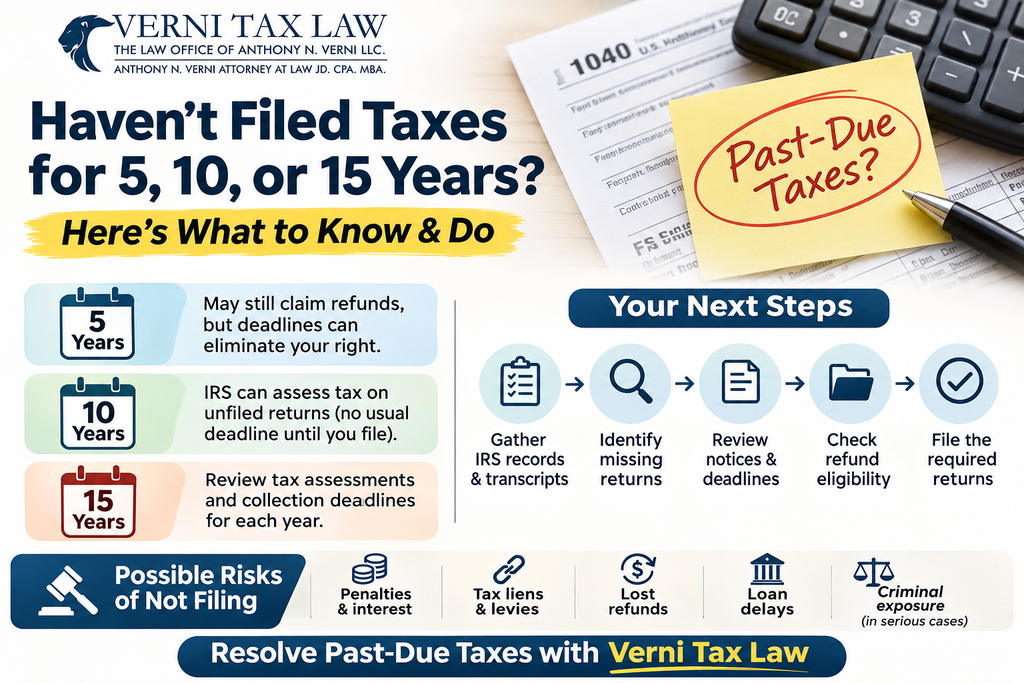
- 5 years: You may still claim certain refunds, but deadlines can eliminate your right to recover money.
- 10 years: The IRS may assess tax on unfiled returns because the usual assessment deadline does not begin until you file.
- 15 years: Old tax debts require a review of assessment dates and collection deadlines.
- 6-year rule: The IRS uses six years as a compliance guideline in certain cases, not a universal rule for every taxpayer.
- 10-year collection period: This generally starts when the IRS assesses tax, not when the original return was due.
How Many Years Can You Go Without Filing Taxes?
There is no universal deadline that lets you safely ignore required federal tax returns. The IRS can generally assess tax at any time when you fail to file a required return.
The time limit depends on whether you need to file, claim a refund, or resolve an existing tax balance.
The IRS generally advises taxpayers to file every required past-due return, even when they cannot pay the full amount.
Does the IRS Have a Time Limit to Assess Tax on Unfiled Returns?
Generally, no. The usual three-year assessment period does not begin when you never file a required return.
The IRS may use information from employers, banks, and other payers to assess tax. The IRS statute of limitations on unfiled tax returns therefore differs from the rules for returns filed on time.
What Happens If You Haven’t Filed Taxes in 5 Years?
Five years without filing does not automatically mean you owe five years of back taxes. First, determine which returns you were legally required to file.
You May Owe Nothing, Owe Back Taxes, or Be Entitled to Refunds
Your outcome depends on your income, withholding, filing status, and other tax facts for each year.
| For example, an employee whose employer withheld enough federal income tax may have no unpaid balance. A self-employed person who failed to pay income and self-employment taxes may face a different result. |
The penalties for not filing taxes for years generally depend on whether you owed tax and the applicable filing and payment rules.
Some Older Tax Refunds May Already Be Unavailable
The general federal refund deadline is the later of three years after filing a return or two years after paying the tax, subject to additional rules and exceptions. The amount you can recover also depends on when you paid the tax.
| For example, someone reviewing missing returns in 2026 should check refund deadlines immediately. They should not assume the IRS will refund all old withholding or tax credits. |
What Should Someone With Five Missing Returns Do First?
Start by collecting records before estimating what you owe.
- Obtain available IRS accounts and wage-and-income transcripts.
- Identify which years require returns.
- Review IRS notices and deadlines.
- Check whether refunds remain available.
- Prepare the required returns using the correct year’s forms.
Five years of missing returns calls for a records review, not assumptions about the outcome.
What Happens If You Haven’t Filed Taxes in 10 Years?
If you have not filed taxes in ten years, the IRS may have assessed tax using information available to it. You need to review each missing return and any existing assessment before deciding how to proceed.
The IRS May Have Assessed Tax Even Though You Never Filed
A substitute for return is a tax return the IRS prepares using available information when a taxpayer fails to file.
- The IRS version may omit deductions and credits you could claim.
- As a result, its calculation may show more tax than your accurate return would show.
- You may be able to submit your own return to correct the figures.
- The proper process depends on the assessment and any notice you received.
If you receive a notice of deficiency, check its deadline immediately. Certain notices provide 90 days to petition the U.S. Tax Court, or 150 days if you qualify under the rule for people outside the United States.
Does the IRS’s Ten-Year Collection Rule Mean the Debt Disappears?
No. The IRS generally has ten years from the assessment date to collect a tax debt, but certain events can suspend or extend that period.
- The IRS unfiled tax returns process can create assessments long after the original filing deadline.
- This means the age of the tax year does not establish the collection deadline.
- Each assessment can have its own collection expiration date.
- Review your account transcripts and notices before assuming an old balance has expired.
What Happens If You Haven’t Filed Taxes in 15 Years?
After 15 years, you need a year-by-year review of missing returns, tax assessments, payments, and collection deadlines.
Can Old Tax Debts Still Be Collected After 15 Years?
Yes, in some cases. A debt from a tax year 15 years ago may remain collectible if the IRS assessed it later or the collection period was suspended or extended.
Check the assessment date for each balance. Review any collection notices and legal events that affected the deadline.
Do not assume that how far back the IRS can go for unfiled taxes has one answer for every taxpayer.
What If the IRS Has Never Contacted You?
No. A lack of IRS notices does not prove that you filed every required return or owe nothing.
The IRS may hold income information reported by employers, banks, and other payers. Start by checking available records and determining which returns remain outstanding.
For a 15-year case, review the records and liabilities before paying a balance or proposing a settlement.
Can You Face Criminal Penalties for Willful Non-Filing?
Yes. Willfully failing to file a required return can lead to criminal prosecution in appropriate cases.
However, a long filing delay does not automatically mean you will face criminal charges. The facts, evidence of intent, income involved, and conduct matter.
If you concealed income, received an investigation notice, or fear possible criminal exposure, seek advice from a tax attorney before contacting investigators.
What Is the IRS Six-Year Rule for Unfiled Tax Returns?
The six-year rule is an IRS compliance guideline used in certain situations, not a universal legal deadline that limits every case to six years.
Does the Six-Year Rule Apply to Everyone?
No. The IRS may consider six years of returns when deciding how to address filing noncompliance, but the required filing period depends on the facts.
Do not assume that filing only six years of returns will resolve every case. The IRS may require additional returns depending on your circumstances.
How Is the Six-Year Rule Different From the Collection Time Limit?
The six-year guideline concerns filing compliance, while the ten-year collection period generally begins when the IRS assesses tax.
The IRS statute of limitations on unfiled tax returns does not create an automatic six-year cutoff for assessing tax on required returns that were never filed.
What Other Problems Can Unfiled Taxes Cause?
Unfiled returns can create financial and legal problems even when you have not received a recent IRS notice.
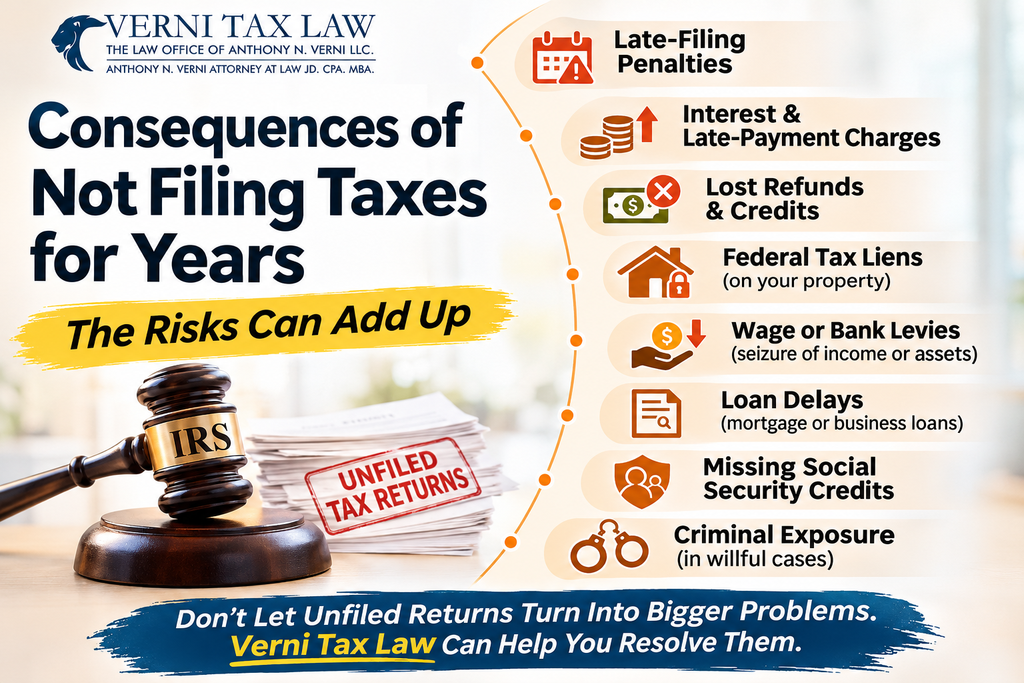
Possible consequences include:
- Late-filing penalties: These generally apply when you owe tax and fail to file on time.
- Late-payment penalties and interest: Unpaid tax can grow while charges continue to accrue.
- Refund losses: You may lose refunds or credits when the applicable deadline expires.
- Federal tax liens: A lien is a legal claim against property to secure a tax debt.
- Wage or bank levies: A levy allows the IRS to seize certain income or assets to collect a debt.
- Loan delays: Lenders may ask for filed returns when reviewing mortgage or business loan applications.
- Missing Social Security credits: Unreported self-employment income may not count toward Social Security benefits.
- Criminal exposure: Willful violations can lead to prosecution in serious cases.
The penalties for not filing taxes for years depend on the return, unpaid tax, and facts of the case. Penalty relief may be available to eligible taxpayers, but it does not automatically erase the underlying tax.

How to File Multiple Years of Unfiled Tax Returns
You can catch up on unfiled tax returns legally by establishing which returns are missing, gathering records, filing the required returns, and addressing any resulting balance.
Step 1: Find Out Which Tax Returns Are Missing
Start with your IRS account and available transcripts.
- Tax account transcripts: Show assessments, payments, and recorded account activity.
- Wage and income transcripts: Show information reported on forms such as W-2s and 1099s.
- Copies of prior returns: Help confirm what you filed previously.
Step 2: Identify the Years You Were Required to File
If you have multiple years of unfiled taxes, review each tax year separately. Filing duties depend on income, age, filing status, income sources, and that year’s tax rules.
Someone earning wages may face different filing requirements from a self-employed person with business income. Do not apply today’s income thresholds to every past year.
Step 3: Reconstruct Missing Income and Expense Records
Gather W-2s, 1099s, bank statements, business records, and proof of tax payments.
Contact employers and payers when documents are missing. Review the IRS guidance on filing past-due tax returns.
Step 4: Prepare and Submit the Required Returns
Use the forms and instructions for each tax year. Check current IRS filing procedures because older returns may not qualify for current-year electronic filing.
If the IRS prepared a substitute return, review the notice and follow the correct process to submit your own accurate return.
Step 5: Resolve Any Resulting Balance
Filing and paying are separate responsibilities. You should not delay required returns simply because you cannot afford the full balance.
After filing, review IRS tax debt settlement options and available relief.
Depending on your finances and eligibility, these can include:
- An IRS installment agreement for back taxes, which lets you pay over time.
- A partial-payment installment agreement, which may allow payments below the amount needed to pay the debt in full before collection deadlines.
- An Offer in Compromise, which may settle eligible tax debt for less than the full balance.
- Penalty relief for eligible taxpayers.
Filing all required returns is generally necessary for many payment and relief options.
When Should You Contact a Tax Attorney for Unfiled Taxes?
Contact a tax attorney when missing returns involve significant debt, collection action, or possible criminal exposure.
Professional help is especially useful when:
- The IRS has prepared substitute returns or assessed tax you dispute.
- You received a notice of deficiency or a collection deadline.
- The IRS has filed a lien or started a levy.
- You need to assess whether you qualify for an Offer in Compromise.
- You need options for addressing penalties on unfiled taxes.
- Your case involves foreign accounts, offshore income, or possible tax fraud.
A tax attorney can review the records, assess your legal position, and help select an appropriate response.
What Is the Safest Way to Resolve Years of Unfiled Taxes?
The safest approach is to identify missing returns, verify assessments, and file every required return. Then review the balance, refund deadlines, collection periods, and available relief. Do not assume that five, ten, or fifteen years automatically means prosecution, forgiveness, or an expired debt. If substantial liabilities or criminal concerns exist, consult a qualified tax attorney before taking action.
How Verni Tax Law Can Help With Unfiled Tax Returns
Verni Tax Law can help you address years of missing returns and related IRS problems through direct legal representation. Anthony N. Verni combines tax law experience with CPA and MBA credentials to assess your filing history, review IRS assessments, and develop a response based on your circumstances.
His services can help you:
- Review missing returns and existing IRS assessments.
- Challenge incorrect substitute returns and tax calculations.
- Assess collection deadlines and potential defenses.
- Review IRS tax liens and levies and available response options.
- Evaluate payment plans, penalty relief, and settlement eligibility.
- Address serious tax matters involving possible fraud or criminal exposure.
Anthony N. Verni has more than 20 years of experience practicing before the IRS. His practice serves U.S. taxpayers and international clients facing civil and criminal tax matters.
If you need help resolving years of back taxes, schedule a consultation to review your options and determine the appropriate next steps.
Conclusion
Failing to file taxes for five, ten, or fifteen years does not produce the same result for every taxpayer. Your filing duties, unpaid balances, refund deadlines, and IRS assessment history determine what happens next. The IRS generally has no assessment time limit for required returns that remain unfiled, while its ten-year collection period usually starts when it assesses tax.
The safest response is to verify the facts, file required returns, and address any balance through an appropriate resolution option. Anthony N. Verni can help you assess your legal position and respond to complex IRS issues.
FAQs
Can the IRS find out if you haven’t filed taxes in 10 or 15 years?
Yes. The IRS receives income reports from employers, banks, and other payers, which can help identify missing returns and assess potential tax liabilities.
What happens if you haven’t filed taxes for years but don’t owe anything?
You may still need to file required returns. You generally avoid failure-to-pay penalties when you owe no tax, but other filing consequences can apply.
Can you file taxes from 10 or 15 years ago?
Yes, you can generally submit required old returns, but refund claims face deadlines and filing procedures depend on the tax year.
Do back taxes disappear after 10 years?
No. The ten-year collection period generally starts at assessment, and certain events can suspend or extend it.
Can you get a tax refund if you haven’t filed for five years?
Sometimes. The general deadline is the later of three years after filing or two years after paying, subject to refund limits and exceptions.
What is the first thing to do if you haven’t filed taxes in 15 years?
Obtain IRS transcripts, review notices and assessments, identify missing returns, and check collection deadlines before paying or proposing a settlement.