
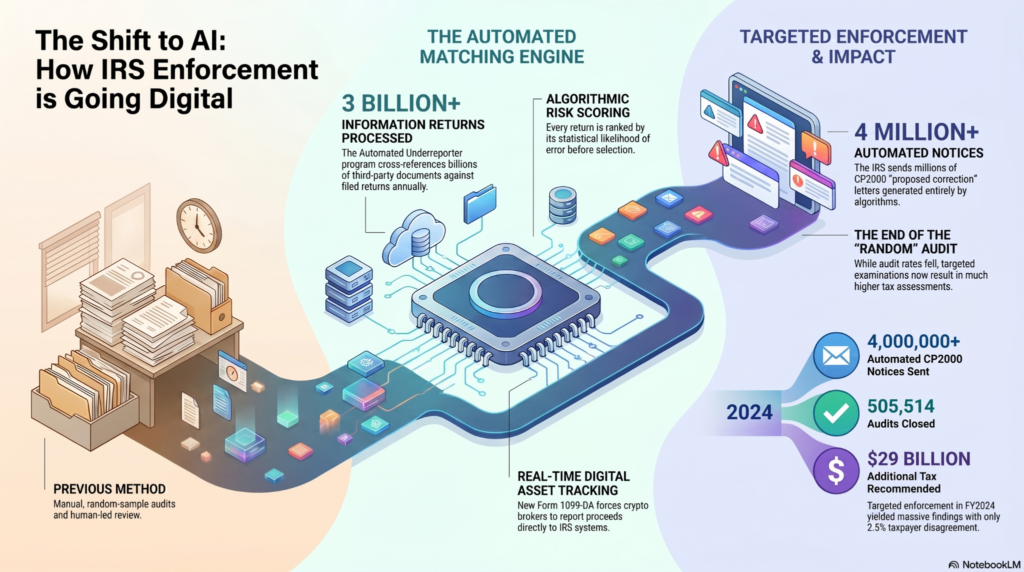
IRS enforcement is already automated for most of the matching work, and automated compliance matching now drives the majority of notices taxpayers receive before a human examiner ever opens a file. The Automated Underreporter program alone compares more than 3 billion information returns against filed tax returns every year.
This is the current operating model, funded by the Inflation Reduction Act and built on machine learning tools the IRS has already deployed against partnerships, crypto exchanges, and individual filers.
This article breaks down exactly how that automation works, where it still fails, and what to do if an algorithm flags your account.
| Key TakeawaysThe IRS matches more than 3 billion information returns each year and sends over 4 million CP2000 notices annuallyThe IRS closed 505,514 audits in FY2024, recommending $29 billion in additional taxA March 2026 TIGTA report found 92% of closed Large Partnership Compliance examinations resulted in no change to the returnForm 1099-DA now requires brokers to report digital asset proceeds for transactions starting January 1, 2025, with cost basis required starting January 1, 2026The IRS workforce dropped 25%, from 103,000 to 77,000 employees, between January and May 2025 |
The IRS Modernization Mandate: Moving Beyond Manual Audits
The IRS is moving away from manual, random-sample audits toward AI compliance monitoring that scores every return for risk before a human ever sees it. This shift started with the Inflation Reduction Act and is now the backbone of how the agency selects who gets examined.
How Inflation Reduction Act Funding Fueled Federal Tech Upgrades
The Inflation Reduction Act gave the IRS $78.9 billion in mandatory funding in 2022, with 58%, or $45.6 billion, earmarked for tax law enforcement. Congress later rescinded large portions of that money. As of March 2025, the Treasury Inspector General for Tax Administration reported the available balance had dropped to $37.6 billion, with $13.8 billion already spent.
This funding paid for the data science teams now running automated regulatory compliance models against large partnerships and corporations. The IRS has said its business systems modernization money will likely run out by fiscal year 2026, which puts real pressure on the agency to lean harder on the automation it has already built.
The Shift From Random Selection to High-Probability Algorithmic Scoring
Algorithmic scoring is the process of ranking every filed tax return by its statistical likelihood of containing an error, then sending only the highest-risk returns to a human auditor. Audit rates fell sharply over the last decade. The individual audit rate dropped from 0.9% for tax year 2010 to 0.25% for tax year 2019, according to the Government Accountability Office.
Fewer audits do not mean less enforcement. The IRS now uses regulatory matching systems to pick targets, which is why audits that do happen increasingly result in additional tax owed rather than a clean pass.
The Mechanics of Automated Compliance Matching Systems
Automated compliance matching works by cross-referencing every income document a third party files against the return you submit, then flagging the gap. This single mechanism generates more enforcement contact with taxpayers than all IRS auditors combined.
Cross-Referencing Form 1099-DA and Digital Assets in Real Time
Form 1099-DA is a new IRS information return that digital asset brokers must file to report a customer’s cryptocurrency and NFT sale proceeds. Brokers must report gross proceeds for transactions effected on or after January 1, 2025, and they must report cost basis for transactions on or after January 1, 2026.
This closes a major gap. Crypto exchanges now report your trades directly to the IRS, the same way a stock brokerage already does on Form 1099-B. Once that data lands in IRS systems, IRS audits for foreign income and unreported digital asset gains both run through the same matching engine.
How FATCA and FBAR Discrepancy Engines Trigger Automated CP2000 Notices
A CP2000 notice is an automated letter the IRS sends when third-party data does not match your tax return. It is not a bill and not a formal audit, just a proposed correction. The IRS sends more than 4 million of these notices every year, generated by its Automated Underreporter program.
Foreign banks now report account balances and identifying information for U.S. account holders to the IRS automatically. FBAR and FATCA basics matter here because a foreign account reported under one law but missing from the other is exactly the kind of mismatch this system was built to catch.
Why Third-Party Verification Leaves No Blind Spots
Third-party verification means the IRS receives a copy of nearly every financial document that affects your return before you ever file it. Employers send W-2s, banks send 1099-INTs, brokers send 1099-Bs, and now digital asset platforms send 1099-DAs.
What triggers an IRS audit today is almost always a documented mismatch between what a third party reported and what a taxpayer claimed, which is why foreign asset reporting errors get caught faster than they did even five years ago.
AI Compliance Monitoring in Large Partnerships and Complex Corporate Structures
AI compliance monitoring at the entity level focuses on structures too complex for a single examiner to untangle by hand, like multi-tiered partnerships with hundreds of related entities. The IRS built specific machine learning tools for exactly this problem.
Targeting the Multi-Tiered Pass-Through: Relationship-Based Machine Learning
The Large Partnership Compliance model is an IRS machine learning tool that maps ownership relationships across nested partnership structures to flag compliance risk. First used in April 2023, it identified 150 large partnerships for further review, leading to 82 high-risk returns selected for tax year 2021 audits, compared to almost none in prior years.
A March 2026 Treasury Inspector General for Tax Administration report found that of the partnership examinations the IRS had closed under this program, 92% ended with no change to the return. That single number suggests the model still needs refinement even as it expands.
How Anomaly Detection Models Spot Artificial Deductions Across Global Networks
Anomaly detection is a machine learning technique that flags transactions or deductions that fall outside the normal pattern for a similar taxpayer. The IRS applies this approach to corporations with $10 million to $250 million in assets through a tool the agency calls the Line Anomaly Recommender.
This matters most for international structures. A deduction that looks ordinary on a single entity’s return can look artificial once the model compares it against related entities across a global ownership chain, which is exactly the kind of pattern a human reviewer working alone would likely miss.
The Risks Facing Individual Taxpayers in the Era of Compliance Automation Software
Relying on generic compliance automation software without professional review leaves individual taxpayers exposed precisely because the software catches the easy mismatches but misses the legal nuance that determines whether a flag becomes a real liability.
The “No-Change Audit” Decline: Why Every Flag Means a High Likelihood of Additional Tax
A no-change audit is an examination that ends with no adjustment to the taxpayer’s reported liability. The Government Accountability Office found that no-change rates for individual audits have generally declined since 2010, because the IRS now selects fewer returns, but picks the ones most likely to owe more.
In FY2024, the IRS closed 505,514 audits and recommended more than $29 billion in additional tax, with only 2.5% of taxpayers disagreeing with the result. If your return gets flagged today, the odds you owe nothing are lower than they were a decade ago.
How Algorithmic Flags Quickly Escalate Into Severe Criminal Tax Investigations
An algorithmic flag escalates fastest when the underlying issue involves unreported foreign accounts or assets, since those cases already sit closest to the criminal threshold. In FY2024 alone, the IRS closed 2,481 criminal tax investigations and referred 1,794 of them for prosecution.
FATCA violations become criminal tax exposure when a taxpayer’s foreign account activity shows a pattern of concealment rather than a one-time mistake. A simple FBAR penalty notice can turn into a far more serious problem once an examiner sees repeated, unexplained gaps across multiple years.
Defending Against an Automated Tax Enforcement Pipeline
Software alone cannot defend a taxpayer once an automated system escalates a case past the notice stage, because the next steps require legal judgment, not better data entry.
Why Corporate Compliance Portals Lack True Protection Against IRS Enforcement
A compliance portal can track deadlines and file forms, but it cannot evaluate whether your specific facts support a reasonable cause defense or a willfulness argument. These compliance technology solutions are built for routine filing, not for the judgment calls that decide whether a penalty gets reduced or eliminated.
Once the IRS treats a case as a willfulness question, the stakes change completely. A portal cannot tell you when that line has been crossed, and most are not designed to try.
The Critical Importance of Attorney-Client Privilege in Remediation Procedures
Attorney-client privilege protects communications between you and your lawyer from being disclosed to the IRS, while conversations with an accountant or a software vendor generally are not protected. That distinction becomes critical the moment a civil inquiry could turn into a criminal referral.
I have found that taxpayers who bring their full account history to Verni Tax Law before responding to a notice resolve cases faster than those who try to fix the gap themselves first. – Anthony N. Verni
Anthony N. Verni holds dual qualifications as an Attorney and CPA with 25 years of experience, and he personally reviews every case rather than routing it through junior staff. His Offshore Voluntary Disclosure Program representation is built around exactly this kind of exposure, where regulatory matching systems have already surfaced a discrepancy, and the response needs legal precision, not a generic template.
Adapting Your Legal Strategy to an Automated Compliance Grid
IRS enforcement has already become automated where it matters most: matching, scoring, and flagging. The open question is no longer whether automated compliance matching will expand, since the data shows it already has, but whether taxpayers update their own compliance habits to match a system that now catches mismatches within months instead of years.
Verni Tax Law has built its practice around this exact shift. With 25 years of handling FBAR, FATCA, and offshore disclosure cases, Anthony N. Verni knows how an automated flag turns into a real exposure and what it takes to resolve it before that happens.
He reviews your filing history, identifies the gap before the IRS escalates it, and applies compliance technology solutions backed by direct attorney judgment. If an automated notice has already reached you, contact Verni Tax Law today for a confidential case review.
FAQs
What exactly does automated compliance matching mean for international tax filings?
It means the IRS compares foreign account data from FATCA reports, FBAR filings, and Form 1099-DA against your return automatically, flagging gaps before any examiner reviews the file.
How is IRS enforcement utilizing modern AI compliance monitoring models?
The IRS uses machine learning models, including the Large Partnership Compliance model, to rank returns by risk; this model flagged 150 large partnerships for review as of 2023.
What are the severe risks of relying entirely on standard corporate compliance automation software?
Software can miss the legal distinction between an honest mistake and willful conduct, which is the single factor that determines whether Form 8938 filing mistakes trigger a $10,000 penalty or a far larger one.
How can international business enterprises safely implement automated regulatory compliance guardrails?
Pair automated TIN matching and transaction monitoring with periodic attorney review, since software alone cannot certify non-willfulness or assess FATCA non-compliance risks before filing.
Do federal regulatory matching systems actively cross-reference offshore crypto exchange accounts?
Yes. Form 1099-DA requires digital asset brokers to report gross proceeds starting with 2025 transactions, feeding directly into the same systems used for IRS foreign account enforcement.
What defensive legal compliance technology solutions are available to resolve unfiled asset reports?
The IRS Streamlined Filing Compliance Procedures and the Voluntary Disclosure Practice are the two paths to fix FATCA non-compliance before IRS notices escalate into a formal exam.