

Form 1099-DA is an information return that tells the IRS what a broker recorded for your digital asset sales, and starting with 2026 transactions, brokers must also report cost basis for covered assets. For 2026 and later sales, covered digital assets move into full basis reporting, meaning the IRS now receives both what you sold your crypto for and what the broker believes you paid for it.
A crypto cost basis IRS mismatch happens when your 1099-DA shows proceeds that look like pure profit, when a large share of that number is actually your original investment coming back to you.
The IRS system does not know that unless basis is reported correctly, and it will flag the gap. The fix is reconciling broker statements, wallet records, acquisition history, the 1099-DA itself, and Form 8949 and Schedule D before you file.
Key takeaways
- 2025 sales: brokers generally reported gross proceeds only, with basis reporting optional.
- 2026 and forward: covered digital assets require mandatory basis reporting under the finalized 2026 Form 1099-DA instructions.
- A 1099-DA showing $100,000 in proceeds does not mean $100,000 in taxable gain.
- CP2000 notices tied to crypto often overstate tax owed because the IRS assumes zero basis when none is reported.
- Rev. Proc. 2024-28 requires wallet-by-wallet cost basis tracking starting January 1, 2025.
- The accuracy-related penalty under IRC Section 6662 is 20%; civil fraud penalties can reach 75%.
What Is Form 1099-DA?
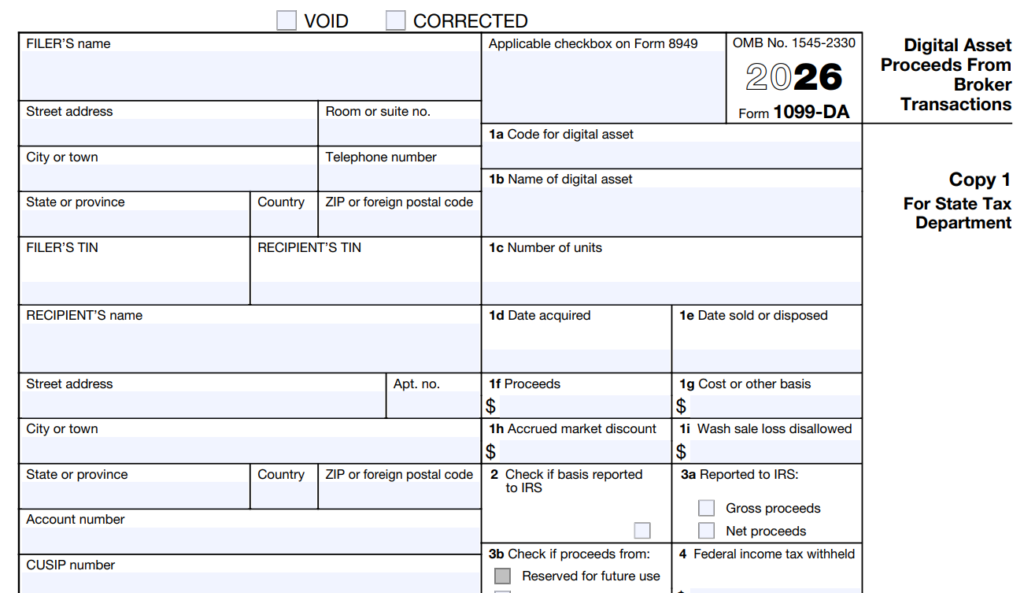
Form 1099-DA is the information return brokers use to report digital asset sales, exchanges, and dispositions to both the taxpayer and the IRS. It works like Form 1099-B for stocks, except it covers cryptocurrency, stablecoins, and NFTs, and it is filed per transaction rather than as a yearly total.
Who Will Receive Form 1099-DA?
Anyone who sold or disposed of digital assets through a custodial broker, exchange, or hosted wallet provider will likely receive one. This includes crypto exchanges, digital asset payment processors, and platforms facilitating NFT sales above the de minimis thresholds.
Which Digital Assets Are Covered?
Cryptocurrency, specified NFTs, and qualifying stablecoins are covered, with narrow carve-outs. A digital asset is any digital representation of value recorded on a cryptographically secured distributed ledger, such as a blockchain. Sales of $600 or less by a payment processor, stablecoin sales of $10,000 or less, and specified NFT sales of $600 or less generally fall below the reporting threshold.
What Does the IRS Actually See When a Broker Issues Form 1099-DA?
The IRS sees gross proceeds, acquisition and disposal dates, and, for covered assets sold after 2025, the cost basis on file with the broker. That data feeds the Automated Underreporter program, the same system that already cross-checks W-2s, 1099-Bs, and 1099-Ks against filed returns.
What Can Be Matched To Your Return?
Proceeds, transaction dates, and asset type are compared against your Form 8949 and Schedule D entries. Where a broker also reports basis, that figure gets compared to what you claim as cost.
Why $100,000 Of Proceeds Isn’t $100,000 Of Tax Owed
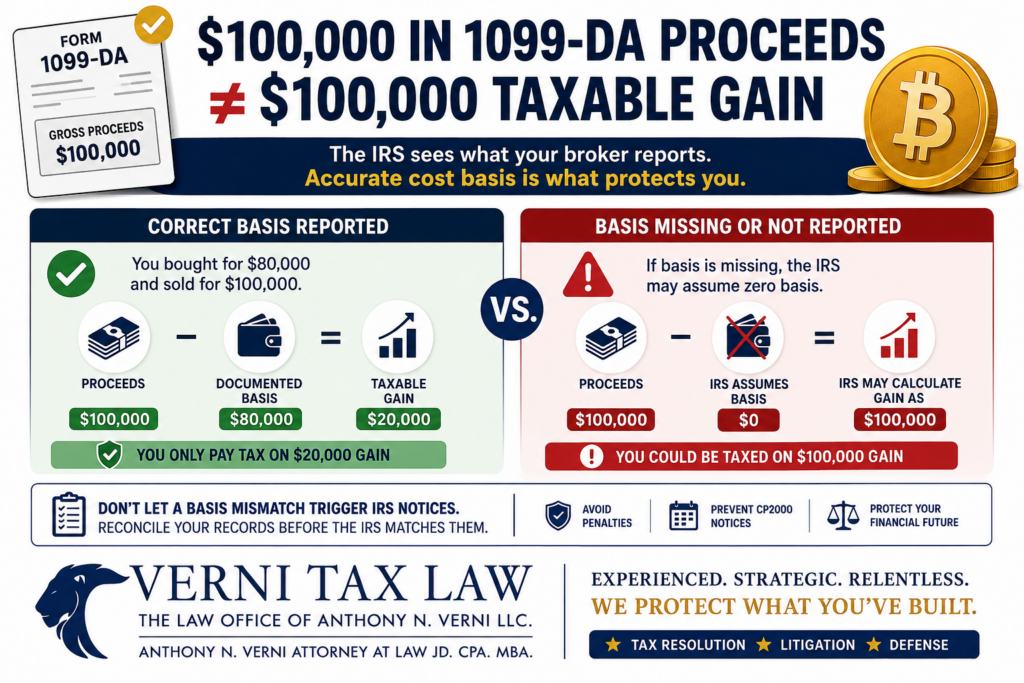
If you buy $80,000 of Bitcoin and sell it for $100,000, your taxable gain is $20,000, not the full amount in Box 1f. When a broker leaves the basis blank, standard practice for 2025 sales, the matching system has no way to know that on its own.
How IRS Matching Will Change Crypto Enforcement in 2026
Matching gets sharper in 2026 because brokers must now report basis for covered assets, closing the gap that made 2025 data unreliable for enforcement. More complete data means fewer false positives, but genuine underreporting gets caught faster too.
How the Matching System Works
The Automated Underreporter program compares every information return filed under your Social Security number against your Form 1040. A discrepancy above the threshold generates a CP2000 automatically, before any human reviews the file.
What Happens When Income Doesn’t Match
You receive a CP2000 proposing additional tax, interest, and often a 20% accuracy-related penalty. It is not a bill or a formal audit, but ignoring it converts the proposal into an actual assessment.
Mandatory basis reporting on 2026 sales gives the IRS a far more complete data set than it had for 2025, part of the broader IRS enforcement of digital assets rollout. One tax resolution firm reported reducing a client’s proposed crypto assessment from over $400,000 to $15,000 once proper basis records were supplied.
Digital Asset Broker Reporting Requirements
Digital asset broker reporting 2026 rules require custodial brokers to report gross proceeds on every sale and cost basis on any covered security, meaning any digital asset acquired on or after January 1, 2026. Noncovered assets, generally acquired before that date, only require voluntary basis reporting.
What Brokers Must Report
Date acquired, date sold, proceeds, and, for covered assets, adjusted basis. Lots sold in a single transaction may still need separate 1099-DA forms if the units carry different covered or noncovered status.
Cost Basis Rules Under Rev. Proc. 2024-28
Since January 1, 2025, taxpayers must track basis wallet-by-wallet rather than pooling holdings together. Two methods apply: FIFO by default, or specific identification, designated before the sale settles.
Gross Proceeds Vs Taxable Gain
The table below shows how the same $100,000 in reported proceeds produces very different outcomes depending on the documented basis.
| Scenario | Proceeds | Documented Basis | Taxable Gain |
| Basis fully documented | $100,000 | $80,000 | $20,000 |
| Basis missing, IRS assumes zero | $100,000 | $0 | $100,000 |
| Broker basis overstated | $100,000 | $95,000 | $5,000, pending correction |
Common Crypto Tax Mistakes That Trigger IRS Problems
Investors most often get flagged for reporting wallet-to-wallet transfers as taxable sales, forgetting staking and airdrop income, mixing accounting methods across exchanges, and assuming a transfer off an exchange erases the reporting trail. A crypto tax attorney 1099-DA review typically catches these gaps before the IRS does.
What to Do Before the IRS Matches Your Records
Reconcile every exchange account, wallet, and acquisition record against your 1099-DA before you file, not after a notice arrives. Waiting for a CP2000 means responding under a 30-day clock instead of controlling the timeline yourself.
Review Every Exchange Account
Pull complete transaction histories from every platform used, including ones closed years ago. A missing account is one of the most common causes of accidental underreporting.
Reconcile Wallet Transactions
Match self-custodial wallet activity against exchange records so transfers between your own wallets aren’t mistaken for sales. This matters most for anyone who moved assets into cold storage.
Verify Cost Basis Before Filing
Confirm the basis your software or broker reports against your original purchase records, including acquisition fees, which are frequently left out and inflate reported gain.
Correct Past Reporting Errors
Amending under your own timeline carries far less exposure than waiting for the IRS to find the error first.
The 1099-DA Is Right on Proceeds but Wrong or Missing on Basis: What Now?
Basis missing: Reconstruct it from your own acquisition records rather than reporting zero. Confirm whether the asset is covered or noncovered, keep the purchase confirmations, and report the actual figure.
Broker’s basis is wrong: Do not quietly override the number without paper backing it up. Find out why the figures differ; most often a missed transfer-in cost, then request a corrected form. If the broker won’t fix it, the instructions permit an adjustment on Form 8949 with an explanation.
Transaction isn’t yours: Wrong taxpayer ID, duplicate reporting, and bad transfer-in data are separate problems from a basis dispute. Resolve them with the broker directly and keep every record of the exchange.
What Happens If the IRS Finds a Mismatch?
A mismatch typically starts with a CP2000 proposing tax, interest, and a penalty, and can escalate to a full audit if the gap is large or unresolved.
CP2000 Notices
The notice proposes a dollar amount and gives 30 days to agree or dispute it with documentation. Many CP2000 amounts assume zero basis, so the proposed number is often far higher than what’s actually owed.
IRS Crypto Audits
An unresolved CP2000, or a larger unexplained gap, can trigger a full examination. An IRS crypto tax audit lawyer typically requests complete wallet and exchange histories before responding, since a partial record understates your defense.
Penalties And Interest
The standard accuracy-related penalty is 20% of the underpayment under IRC Section 6662. Interest accrues from the original due date, regardless of any extension filed.
Criminal Investigation Risk
Willful failure to report crypto income can expose a taxpayer to civil fraud and criminal tax exposure in crypto cases, with civil fraud penalties reaching 75%. Whether cryptocurrency transactions can remain hidden from the IRS stopped being a realistic question once a broker started issuing a matching 1099-DA.
Options for Taxpayers With Unreported Crypto Gains
- Amended returns: Correcting a prior return before the IRS makes contact generally produces a better outcome than waiting for a notice. Interest still applies, but voluntary correction removes much of the leverage the IRS would otherwise hold on penalties.
- Voluntary compliance: Coming forward before an examination begins is treated very differently from responding after a CP2000 arrives. Blockchain analytics and crypto tax investigations have made unreported activity far easier to trace, which makes early correction more valuable each year that passes.
- Payment options: Installment agreements and offers in compromise remain available for balances too large to pay at once, and applying after the return is corrected keeps the debt from becoming a lien or levy.
- Legal representation: A cryptocurrency tax attorney can assert attorney-client privilege over communications in a way an accountant cannot, which matters once criminal exposure is even a remote possibility.
How Verni Tax Law Helps Crypto Investors Resolve IRS Issues
Anthony N. Verni is a licensed attorney, CPA, and MBA who has handled complex federal tax matters for more than 25 years, and he personally manages every case from intake through resolution.
- Reviews your 1099-DA, exchange records, and wallet history to find where reported proceeds diverge from actual taxable gain
- Responds to CP2000 notices and audit requests with documentation built to withstand examiner scrutiny
- Prepares amended returns and voluntary corrections before the IRS makes first contact
- Represents clients in civil tax litigation and negotiates installment agreements or offers in compromise
- Defends taxpayers facing civil fraud or criminal referral exposure tied to crypto reporting
If a 1099-DA has raised questions about what you actually owe, book a confidential consultation with Anthony N. Verni before the IRS sends the first notice.
Conclusion: Early Action Can Prevent Criminal Consequences
Form 1099-DA gives the IRS proceeds data it never had before, and starting with 2026 sales, basis data as well. A mismatch between what your 1099-DA shows and what you report does not mean you owe tax on the full proceeds figure, but proving that takes documentation gathered before filing, not after a CP2000 arrives. Taxpayers who reconcile broker records, wallet activity, and cost basis ahead of time control the outcome; those who wait respond to a number the IRS already set.
Anthony N. Verni from Verni Tax Law built his practice on personally handling every case, pairing attorney, CPA, and MBA credentials that most tax resolution firms cannot match. He has represented taxpayers through IRS matching disputes, CP2000 responses, and audits long before Form 1099-DA existed, and he applies that same document-first approach to digital asset cases now.
If your 1099-DA doesn’t match your own records, contact Verni Tax Law for a confidential case review before the IRS opens a file on the discrepancy.
FAQs
What is Form 1099-DA?
It is the IRS information return brokers use to report digital asset sale proceeds, and starting with 2026 sales, cost basis for covered assets.
Who will receive Form 1099-DA in 2026?
Anyone who sold cryptocurrency, specified NFTs, or qualifying stablecoins through a custodial exchange above the de minimis thresholds will generally receive one.
How does the IRS match crypto transactions?
The Automated Underreporter program compares 1099-DA proceeds and basis data against your Form 8949 and Schedule D entries.
What happens if my crypto cost basis doesn’t match IRS records?
A crypto cost basis IRS mismatch typically triggers a CP2000 proposing additional tax within 30 days of the notice date.
Can the IRS audit unreported cryptocurrency gains?
Yes. Unreported gains can trigger a full examination, especially where 1099-DA proceeds show no corresponding gain on the return.
What penalties apply for failing to report crypto income?
The standard accuracy-related penalty is 20% of the underpayment; civil fraud penalties can reach 75% where the IRS proves willfulness.
Should I amend past crypto returns before receiving Form 1099-DA?
Yes. Voluntary correction before IRS contact generally results in lower penalty exposure than waiting for a notice.
How do I calculate crypto cost basis correctly?
Use FIFO or specific identification on a wallet-by-wallet basis under Rev. Proc. 2024-28, including acquisition fees paid.
Does Form 1099-DA include DeFi, NFTs, and staking income?
Specified NFT sales are covered directly; staking rewards are separately reportable as income, and non-custodial DeFi platforms sit outside broker reporting after a 2025 repeal.
When should I hire a crypto tax attorney?
Hire a crypto tax attorney as soon as you receive a CP2000, an audit letter, or discover a basis mismatch, since early representation limits both penalty and criminal exposure.