
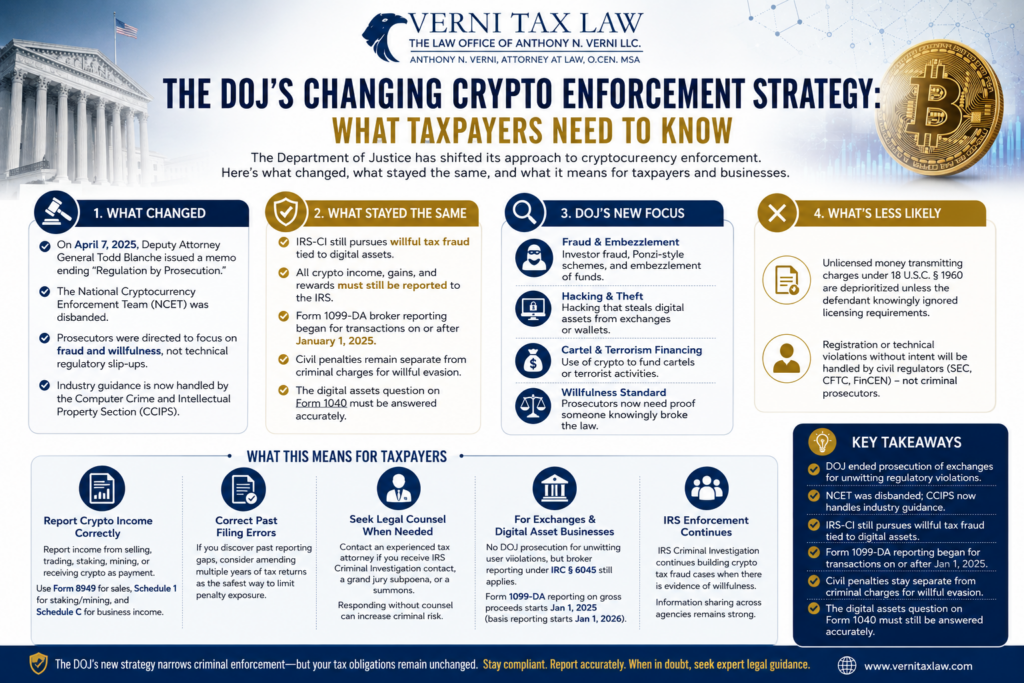
The Department of Justice made a shift away from regulation by prosecution on April 7, 2025, when Deputy Attorney General Todd Blanche issued a memo telling prosecutors to stop treating crypto exchanges and wallet providers as criminal targets for the acts of their users. This changes what counts as risky for crypto holders, but it does not erase the tax reporting duties tied to every trade, sale, or reward you receive.
The memo, titled “Ending Regulation By Prosecution,” disbanded the National Cryptocurrency Enforcement Team and redirected federal attorneys toward a focus on fraud and willfulness instead of technical regulatory slip-ups. Here is what changed, what stayed the same, and how to keep your filings clean under the new rules.
Key Takeaways
- DOJ’s April 7, 2025, memo ended prosecution of exchanges for unwitting regulatory violations
- NCET was disbanded; CCIPS now handles industry guidance
- IRS-CI still pursues willful tax fraud tied to digital assets
- Form 1099-DA broker reporting began for transactions on or after January 1, 2025
- Civil penalties stay separate from criminal charges for willful evasion
- The digital assets question on Form 1040 must still be answered accurately
The DOJ’s New Crypto Enforcement Strategy
The DOJ’s new crypto enforcement strategy stops prosecutors from charging exchanges, mixers, or wallet providers for regulatory violations committed by their users. Blanche’s memo called the prior approach “reckless,” directing the Market Integrity and Major Frauds Unit to stop cryptocurrency enforcement and hand industry guidance to the Computer Crime and Intellectual Property Section.
This does not mean digital asset crime goes unpunished. The memo keeps prosecution alive for embezzlement, investor fraud, hacking, and cartel or terrorism financing that uses crypto as the payment rail.
What “Regulation by Prosecution” Means
Regulation by prosecution is when the government uses criminal charges, instead of formal rulemaking, to set the standards an industry must follow. DOJ applied this to crypto by charging exchanges under money transmitter and Bank Secrecy Act laws for compliance gaps their users triggered, not fraud the exchange itself committed. Blanche’s memo ends that practice, leaving rulemaking to the SEC, CFTC, and FinCEN.
The Shift Toward Fraud and Willfulness Cases
DOJ’s focus on fraud and willfulness means prosecutors now need proof that someone knowingly broke the law before bringing digital asset charges tied to registration or licensing.
Intentional Tax Evasion vs Compliance Errors
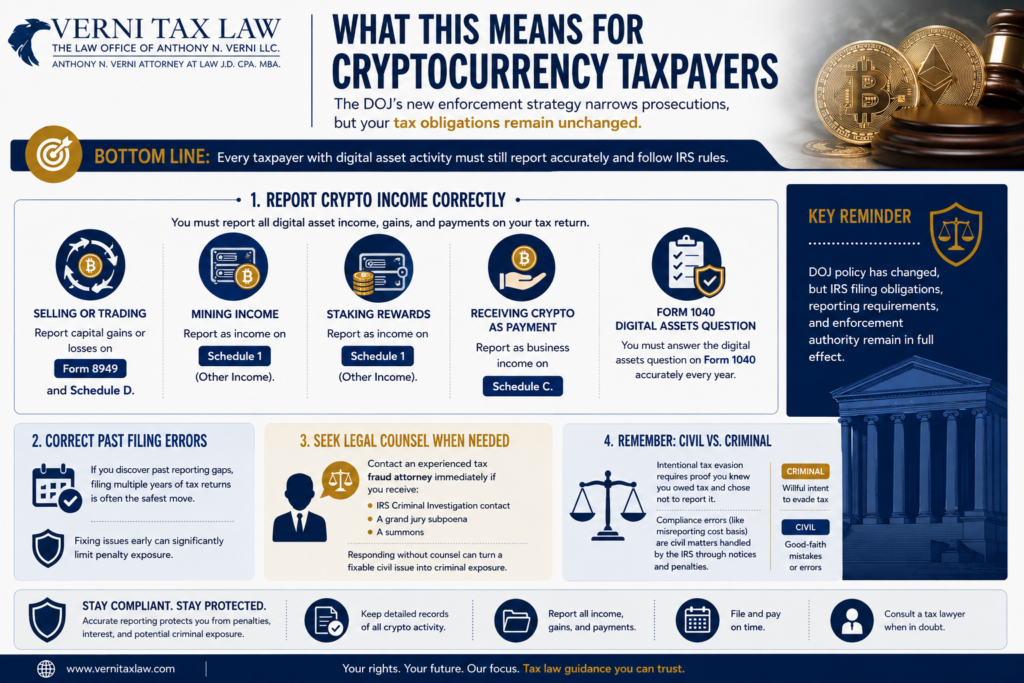
Intentional tax evasion requires proof that you knew you owed tax and chose not to report it. A compliance error, like misreporting cost basis, stays a civil matter the IRS handles through notices and penalties.
Criminal Fraud as the Primary Enforcement Target
DOJ now prioritizes embezzlement of investor funds, Ponzi-style crypto schemes, and hacking that steals digital assets from exchanges or wallets. These cases use the same fraud statutes as traditional financial crimes.
Cases Less Likely to Receive Criminal Prosecution
Unlicensed money transmitting charges under 18 U.S.C. § 1960 are now deprioritized unless a defendant knowingly ignored a licensing requirement. Registration violations without evidence of intent go to civil regulators instead.
What This Means for Cryptocurrency Taxpayers
Implications for taxpayers and exchanges center on the DOJ narrowing its prosecutions and not touching IRS filing obligations. Every taxpayer with digital asset activity still answers the digital assets question on Form 1040 and reports gains, losses, and income from crypto.
Reporting Cryptocurrency Income Correctly
You must report digital asset income from selling, trading, staking, mining, or receiving crypto as payment, per IRS guidance. Sales go on Form 8949; staking and mining income goes on Schedule 1; business payments go on Schedule C.
Correcting Past Filing Errors
Filing multiple years of tax returns to fix past crypto reporting gaps is often the safest move once you spot an error. Resolving past tax compliance issues early generally limits penalty exposure.
When Taxpayers Should Seek Legal Counsel
Call an experienced tax fraud attorney the moment you receive IRS Criminal Investigation contact, a grand jury subpoena, or a summons. Responding without counsel can turn a fixable civil issue into criminal exposure.
How Exchanges and Digital Asset Businesses Are Affected
Exchanges and wallet providers no longer face DOJ prosecution for the unwitting regulatory violations of their end users, but broker reporting duties under IRC Section 6045 still apply. Brokers must report gross proceeds on Form 1099-DA for transactions from January 1, 2025 onward, with basis reporting starting January 1, 2026.
FinCEN reporting duties, including AML and Bank Secrecy Act programs, remain untouched; DOJ pulled back on charging unwitting violations, not the underlying rules. Platforms that knowingly skip licensing or KYC still face DOJ scrutiny, since willfulness is the new trigger.
The Continued Role of the IRS in Crypto Enforcement
The IRS keeps its own enforcement authority separate from DOJ’s policy shift, and Criminal Investigation continues building crypto tax fraud cases for referral when evidence of willfulness exists.
Criminal Investigation Division Priorities
IRS Criminal Investigation prioritizes unreported crypto income tied to IRS audit triggers, structured transactions built to dodge reporting thresholds, and crypto used to hide income from a known tax debt.
Information Sharing Between Agencies
The Joint Chiefs of Global Tax Enforcement (J5), which includes IRS-CI, issued a notice to financial institutions flagging risk indicators tied to crypto assets, confirming ongoing tax fraud investigations across agencies.
Blockchain Analytics and Financial Intelligence
Blockchain-based tax enforcement relies on IRS data matching between broker-filed 1099-DA data and your return. Mismatches are a leading source of IRS audit investigations in crypto.
Civil Enforcement vs Criminal Enforcement
Civil and criminal crypto tax cases differ mainly in intent. The table below breaks down civil noncompliance versus criminal willfulness under current IRS and DOJ standards.
| Factor | Civil Enforcement | Criminal Enforcement |
| Required intent | None or negligence | Willfulness |
| Typical trigger | Data mismatch, late filing | Concealment, false statements |
| Handling agency | IRS Examination | IRS-CI, DOJ |
| Common outcome | Penalties, interest | Charges, potential prison time |
Civil Penalties for Noncompliance
Civil penalties apply when a taxpayer underreports crypto gains without evidence of intent to defraud. These cases stay within IRS examination and are resolved through penalties, interest, and corrected filings.
Criminal Charges for Willful Conduct
Criminal tax evasion penalties apply once the IRS or DOJ shows you knew about a reporting duty and deliberately avoided it, such as hiding wallets or structuring deposits.
Factors That Increase Enforcement Risk
- Repeated failure to report despite receiving broker statements
- Structuring transactions to stay under reporting thresholds
- False statements made to IRS agents during an audit
Best Practices for Crypto Tax Compliance
Strong crypto tax compliance habits reduce audit risk and keep civil issues from turning criminal.
- Match wallet-to-wallet transfers against your own records, since IRS data matching catches gaps brokers cannot see
- Track cost basis at the wallet level starting January 1, 2025, since a universal basis pool no longer applies
- Treat staking and mining rewards as income the moment you gain control of the coins
- Keep a written log of the reasoning behind any gray-area position, like a hard fork or an airdrop
How Verni Tax Law Helps Crypto Taxpayers
Verni Tax Law turns DOJ and IRS policy shifts into a concrete filing and defense strategy, not just a headline to worry about. Anthony N. Verni holds licenses as an attorney, a CPA, and an MBA, and has represented U.S. taxpayers in IRS matters since 2009.
- He personally reviews every crypto tax matter, from unfiled returns to active IRS-CI contact
- He builds defense strategy around the civil-versus-criminal distinction the DOJ now applies
- He handles both filing and legal defense under one roof, holding CPA and attorney credentials
Book a confidential consultation with him to review your exposure before the IRS or DOJ contacts you first.
Audit Defense and Criminal Tax Representation
He represents clients through IRS crypto audits and, when a case escalates, through avoiding criminal tax charges with a coordinated strategy from the first IRS-CI interview. He guides clients through filing overdue tax returns and voluntary disclosure options built to bring past crypto activity into compliance.
He advises U.S. taxpayers and expats holding crypto on foreign exchanges, where FBAR and FATCA duties apply alongside standard digital asset rules.
Prepare for a Smarter Era of Crypto Enforcement
DOJ crypto enforcement now runs on a willfulness standard: prosecutors go after fraud, theft, and knowing evasion, not honest mistakes made by exchanges or filers. IRS reporting duties, from the digital assets question on Form 1040 to broker-filed Form 1099-DA data, stay fully in force regardless of DOJ’s narrower charging policy. Taxpayers who report accurately and fix past gaps proactively face a civil process at worst.
Verni Tax Law is built for exactly this moment in crypto tax enforcement. Anthony N. Verni combines attorney, CPA, and MBA credentials to review your crypto history, correct past errors, and stand between you and the IRS or DOJ if a case turns criminal.
Reach out today for a confidential case review before a routine notice becomes a bigger problem. Contact Verni Tax Law to schedule your consultation.
FAQs
What does the DOJ mean by “regulation by prosecution”?
It means using criminal charges to enforce rules instead of formal regulation. DOJ ended this practice for crypto exchanges in April 2025.
Why has the DOJ changed its crypto enforcement strategy?
Executive Order 14178 directed regulators, not prosecutors, to set digital asset rules. DOJ narrowed charges to fraud and willful conduct only.
What types of crypto cases are now a priority?
Investor fraud, embezzlement, hacking, and crypto tied to cartel, terrorism, or trafficking financing remain DOJ’s top priorities under the new policy.
Does the DOJ still prosecute cryptocurrency tax crimes?
Yes. Willful tax evasion involving digital assets stays a criminal matter, referred by IRS Criminal Investigation like any other fraud case.
How does the DOJ’s strategy affect crypto exchanges?
Exchanges no longer face charges for unwitting user violations. They still must meet FinCEN, AML, and IRS broker reporting duties in full.
Can reporting mistakes still lead to criminal charges?
No, honest mistakes stay civil. Criminal charges require proof you knowingly and willfully avoided a known reporting duty.
How does the IRS work with the DOJ on crypto investigations?
IRS Criminal Investigation builds evidence of willfulness, then refers qualifying cases to DOJ, while civil errors stay within IRS examination.
Should taxpayers amend previously unreported crypto income?
Yes, filing corrected or overdue returns before the IRS contacts you generally reduces penalty exposure compared to waiting.
How can taxpayers reduce crypto enforcement risks?
Report every transaction accurately, track wallet-level basis, and respond promptly to notices to keep matters civil, not criminal.
When should I contact a crypto tax attorney?
Contact one immediately upon IRS Criminal Investigation contact, a subpoena, or a summons, and before any voluntary disclosure involving crypto.