

If you missed FBAR and your U.S. tax return in the same year, one IRS program can usually fix both at once. The right path depends on whether you owe back tax, whether the mistake was honest, and whether the IRS has contacted you yet. Here’s what triggers penalties and how expat FBAR filing help, and late expat tax filing assistance work.
Key Takeaways
- FBAR applies once foreign accounts pass $10,000 combined, at any point in the year
- Non-willful FBAR penalties reach $16,536 per year; willful ones hit $165,353 or 50% of the balance
- Streamlined Filing Compliance Procedures ask for 3 years of tax returns and 6 years of FBARs
- Filing before IRS contact keeps penalty relief available
- Form 8938 penalties start at $10,000 and climb to $50,000 for continued non-compliance
Understanding FBAR and U.S. Tax Filing Obligations for Expats
FBAR (FinCEN Form 114) is a yearly report of foreign bank accounts, required once combined balances top $10,000 at any point in the year. It goes to FinCEN, not the IRS, and it’s separate from your tax return. Missing FBAR for U.S. expats is one of the most common FBAR filing mistakes to avoid.
U.S. Tax Filing Requirements for Americans Living Abroad
U.S. citizens owe a federal return on worldwide income no matter where they live, with an automatic extension to June 15 and a further one to October 15 via Form 4868. Living abroad doesn’t erase the duty, even when credits or the Foreign Earned Income Exclusion bring the bill to zero.
What Happens If You Miss Both FBAR and Tax Filings?
Missing both triggers two separate penalty tracks running at once, one from the IRS for the unfiled return, one from FinCEN for the missing FBAR. Left alone, both compound with interest.
Potential FBAR Penalties
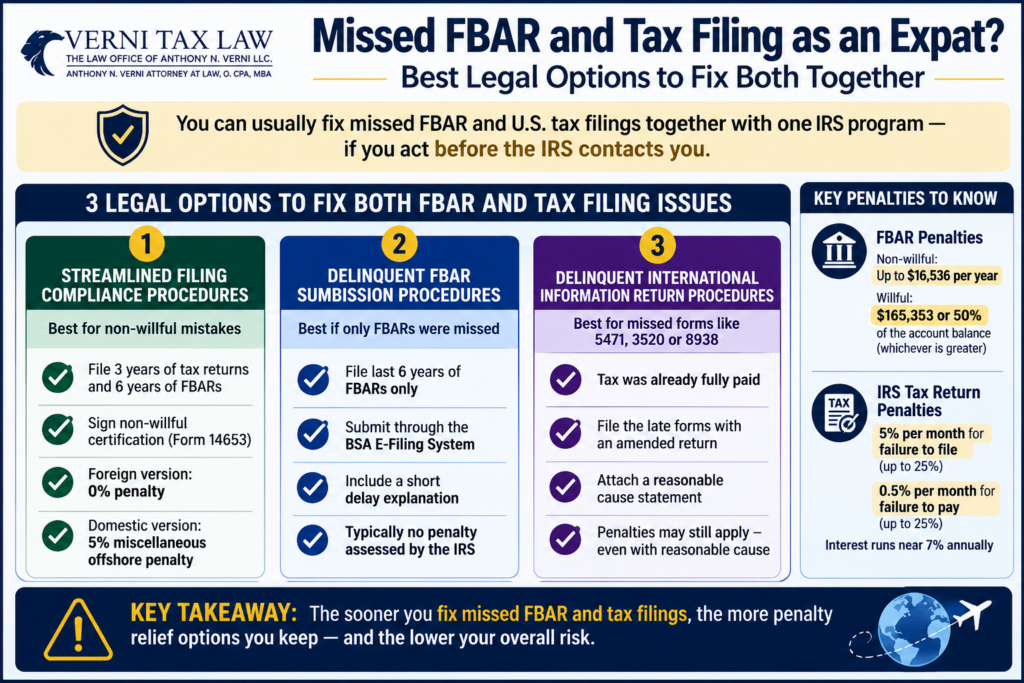
Non-willful FBAR penalties run up to $16,536 per year; willful violations reach the greater of $165,353 or 50% of the balance. Under Bittner v. United States (2023), non-willful penalties apply per report, not per account, softening exposure for filers with several small accounts. Criminal penalties, rare for honest mistakes, can reach $250,000 and five years in prison.
IRS Tax Return Penalties and Interest
The failure-to-file penalty is 5% of unpaid tax per month, capped at 25%; failure-to-pay adds 0.5% more, also capped at 25%. Interest runs near 7% annually, compounded daily, from April 15. Owe no tax under the FEIE or foreign tax credits? The failure-to-file penalty doesn’t apply at all.
Risks of Continued Non-Compliance
The longer both filings sit, the fewer options stay open. IRS foreign income audits and civil exams close the door on Streamlined FBAR filing the moment they start. Foreign banks already report account data under FATCA, so it’s often when, not if, the IRS matches numbers to your name.
Best Legal Options to Fix Both FBAR and Tax Filing Issues Together
Three IRS-recognized paths fix FBAR and tax gaps together, depending on whether unreported income is involved.
Streamlined Filing Compliance Procedures
Streamlined Filing Compliance Procedures require 3 years of tax returns and 6 years of FBARs, plus a signed non-willful certification on Form 14653. The foreign version waives FBAR and tax penalties entirely; the domestic version instead carries a 5% miscellaneous offshore penalty. This program gives delinquent tax return filing help for expats who need to file multiple years of unfiled tax returns alongside FBARs.
Delinquent FBAR Submission Procedures
This narrower path fits taxpayers who reported all foreign income correctly and only missed the FBAR. File 6 years through the BSA E-Filing System, attach a short delay explanation, and the IRS typically assesses no penalty. It’s the fastest late FBAR filing process of the three, with no amended returns involved.
Delinquent International Information Return Procedures
Use this if Forms 5471, 3520, or 8938 are missing but tax was fully paid. Late forms attach to an amended return with a reasonable cause statement, though penalties can still apply even with cause attached.
IRS Offshore Disclosure Help for Expats
IRS offshore disclosure help becomes necessary once unreported income needs to be disclosed. Streamlined procedures only work for non-willful conduct; anything else needs a different route.
When Voluntary Disclosure Is Necessary
Voluntary disclosure applies when conduct might look willful, meaning you knew about the filing duty and skipped it anyway. The IRS Criminal Investigation Voluntary Disclosure Practice trades a structured penalty for protection from criminal referral.
Non-Willful vs. Willful Violations
Non-willful means negligence or an honest mistake; willful means you knew the rule and ignored it, or avoided finding out on purpose. Courts treat willful blindness the same as willful conduct. This distinction decides which program above you can use.
Benefits of Proactive Disclosure Before IRS Contact
Filing before an IRS letter arrives keeps every relief program open, and missed FBAR deadline help works best when applied early. Once the IRS opens a contact or a civil exam, streamlined relief and delinquent procedures both close. Acting first is the biggest factor in how a case resolves.
How an Offshore Tax Compliance Lawyer Can Help
An offshore tax compliance lawyer reads your full fact pattern, meaning account history, prior filings, and reasons for missing them, before recommending a program.
Evaluating Your Offshore Compliance Risks
A proper risk review checks account values across all missed years, the source of the funds, and whether a prior “quiet disclosure” was ever attempted. This decides whether streamlined relief, delinquent procedures, or formal disclosure fits, since guessing wrong can forfeit protection for good.
Preparing Corrective Filings and Documentation
Corrective filings mean amended or original returns, FBARs, and any missing information returns, filed consistently so numbers match across every form. A skilled offshore tax compliance lawyer cross-checks bank statements against reported figures before submission, since mismatches trigger IRS follow-up.
Protecting Against Civil and Criminal Exposure
Every submission can still be selected for audit, so documentation has to hold up alone. Legal representation, protected by attorney-client privilege, matters most when facts are ambiguous enough that willfulness could go either way.
Combining FBAR and Tax Filing Service for Faster Compliance
A combined FBAR and tax filing service files tax returns, FBARs, and information returns as one coordinated submission, faster and more consistent than filing each piece separately.
Documents Needed for Corrective Filings
Gather bank statements for every foreign account across the filing years, plus year-end balances and prior returns if any were filed. Complete FBAR filing documents also include the account opening date and the foreign institution’s name and address.
Reporting Foreign Accounts, Assets, and Income
Every account that hit $10,000 in combined value needs FBAR reporting; foreign assets above the Form 8938 thresholds, starting at $200,000 for single filers abroad, need FATCA reporting too. Both forms can apply to one account at once.
Common Filing Errors Expats Should Avoid
- Reporting the year-end balance instead of the highest value the account hit all year
- Skipping joint accounts a spouse already reported, without the required Form 114a authorization
- Assuming foreign pension accounts are automatically FBAR-exempt
- One of the most frequent Form 8938 filing mistakes: filing it while forgetting the FBAR is separate
- Submitting a Streamlined package with income still missing from the amended returns
Expat Tax Penalty Relief Lawyer Strategies
An expat tax penalty relief lawyer builds a reasonable cause argument around specific facts, not general hardship, since vague statements rarely move an IRS reviewer. A case where a foreign accountant never mentioned U.S. filing duties, backed by dated emails showing the client asked about tax status, tends to succeed where a plain “I didn’t know” letter fails. Specific dates, named advisors, and documented steps toward compliance carry far more weight than broad claims of confusion.
How Verni Tax Law Helps Expats Resolve FBAR and Tax Issues
Verni Tax Law is led by Anthony N. Verni, an expat tax penalty relief lawyer who has represented offshore disclosure cases since 2009, spanning the OVDP program through 2018. He personally handles every case, with clients across the U.S. and abroad in countries including India, the Philippines, Germany, and Japan.
- Reviews your full account and filing history before recommending a program
- Prepares corrective FBARs, amended returns, and information returns together
- Represents clients through Streamlined Procedures, Delinquent FBAR Procedures, and voluntary disclosure
- Offers flexible consultations by phone, video, or in person, across time zones
Comprehensive Offshore Compliance Reviews
Anthony starts with a full review of your foreign accounts, prior filings, and the reasoning behind any gaps, since that determines which of the three IRS programs fits. His combined legal and accounting background means one person handles both the legal strategy and the numbers.
Tailored Disclosure and Defense Strategies
He builds a strategy around your specific risk profile instead of one fix for every client. If facts point toward willful exposure, his approach shifts to protecting you against civil and criminal risk rather than a standard streamlined filing. Book a confidential consultation to go over your facts directly with him.
Correct Offshore Filing Problems Before Penalties Escalate
Missed FBAR and missed tax returns almost always trace back to one root cause: a taxpayer who never knew the citizenship-based filing rule applied to them abroad. The fix depends entirely on facts, whether income was reported, whether conduct was willful, and whether the IRS has already made contact.
Anthony N. Verni brings a rare combination to this problem. He’s a licensed attorney, a CPA, and an MBA who has personally handled offshore disclosure cases since 2009, matching client facts to the correct IRS program instead of guessing.
Your case deserves that kind of direct review. Contact Verni Tax Law for a confidential consultation.
FAQs
Can I get expat FBAR filing help if I missed several years of filings?
Yes. Most programs cover 6 years of FBARs and 3 years of tax returns in one submission.
Should I use an offshore tax compliance lawyer for late FBAR and tax returns?
Yes, especially with unreported income, since the wrong program can permanently forfeit penalty relief.
Can an FBAR and tax filing service correct both issues at the same time?
Yes. Streamlined Filing Compliance Procedures file amended returns and delinquent FBARs together.
How can an expat tax penalty relief lawyer help reduce penalties?
By building a fact-specific reasonable cause argument with dates and named advisors, not a general hardship claim.
What IRS offshore disclosure help programs are available for expats?
Three: Streamlined Filing Compliance Procedures, Delinquent FBAR Submission Procedures, and Delinquent International Information Return Procedures.
What is the difference between FBAR and FATCA reporting?
FBAR reports foreign accounts over $10,000 to FinCEN; Form 8938 reports broader assets over $200,000 to the IRS.
Will the IRS penalize me if I voluntarily correct missed offshore filings?
Often no. Filing before IRS contact, under the right program, frequently results in $0 penalties.
What documents do I need to fix missed FBAR and tax filings?
Bank statements, year-end and highest balances, foreign institution details, and prior returns for those years.