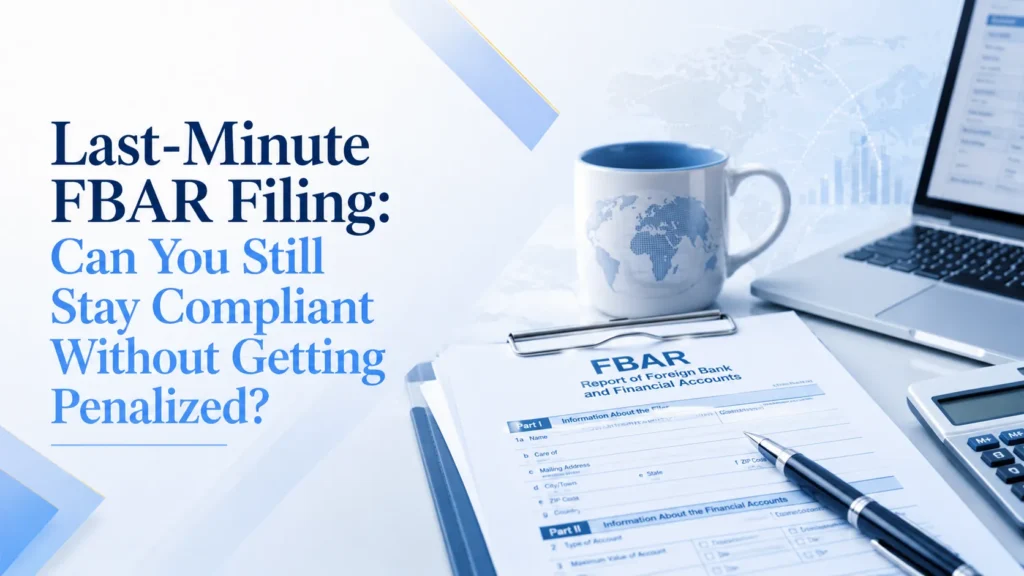
If you missed the FBAR filing deadline, you may still be able to fix it without heavy penalties. Last-minute FBAR filing depends on why the report was late and whether your foreign accounts were already reported. In this blog, we will explain your options for last-minute FBAR filing and how to regain compliance with less risk and clear next steps.
| Key TakeawaysThe FBAR deadline is April 15, with an automatic extension to October 15. No extra form is needed for that extension.You must file if your foreign accounts totaled over $10,000 at any point in the year.Non-willful FBAR penalties currently run over $16,000 per violation. Willful penalties can hit 50% of the account balance.The Delinquent FBAR Submission Procedures can result in zero penalties if all income was already reported correctly.The Streamlined Filing Procedures cover cases where both income and FBARs were missed. |
What Is an FBAR and Who Must File?
An FBAR is the Report of Foreign Bank and Financial Accounts, filed on FinCEN Form 114, and it tells the Treasury Department about money you hold outside the United States. It is not a tax form. It does not go to the IRS with your return. It goes straight to FinCEN, a separate bureau under the Treasury Department.
You must file one if you are a U.S. citizen, resident, or business with a financial interest in, or signature authority over, a foreign account that hit more than $10,000 at any single point during the year. That includes savings accounts, brokerage accounts, and mutual funds held overseas.
FBAR Filing Thresholds and Foreign Account Reporting Requirements
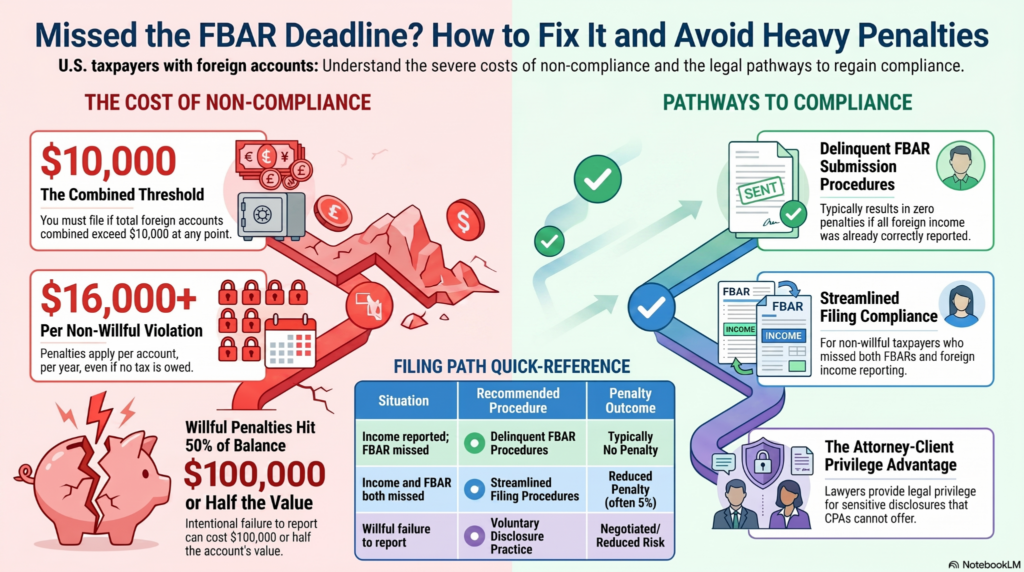
The $10,000 threshold applies to your combined foreign accounts, not each account separately. Someone with three accounts holding $4,000 each still has to file, because the total crosses $10,000.
If you have signature authority over a foreign account, say, you can approve wire transfers for a relative’s account abroad, that counts too. A few accounts are excluded, including those held inside an IRA or a retirement plan you participate in. In my practice, I regularly see clients surprised that a small, dormant savings account from years abroad still triggers foreign account reporting today.
What Happens If You Miss the FBAR Filing Deadline?
Missing the deadline exposes you to civil penalties and, in serious cases, criminal charges, but the size of the consequence depends almost entirely on whether the IRS labels your conduct willful or non-willful. A late filer who acts quickly and has a clean tax history faces a very different outcome than someone the IRS believes hid money on purpose.
FBARs are due April 15 for the prior calendar year, and FinCEN grants an automatic six-month extension to October 15 with zero paperwork required. Once October 15 passes with no filing, you are officially delinquent.
Civil FBAR Penalties Explained
Civil penalties apply when the IRS determines a filing violation occurred, and the dollar amount depends on whether the conduct was willful. Non-willful violations, meaning genuine mistakes, can currently draw a penalty north of $16,000 per account, per year, even when no tax was actually owed. Willful violations are far more severe, reaching the greater of $100,000 or 50% of the account balance at the time of the violation, and these figures rise each year with inflation.
A common mistake I see is people assuming the penalty applies once per filer. It applies per account, per year. Someone with four unreported foreign accounts over three years is not looking at one penalty. They are looking at a stack of them.
Criminal Penalties for Willful Noncompliance
Criminal exposure attaches when the IRS believes you knew about the reporting duty and deliberately ignored it. Willful FBAR violations can lead to fines up to $250,000 and prison time up to five years, and if the violation overlaps with other financial crimes, the numbers climb further.
How the IRS and FinCEN Identify Missing FBAR Filings
The IRS and FinCEN cross-check FBAR data against information that foreign banks now report directly under FATCA. Thousands of foreign financial institutions report U.S. account holder data straight to the IRS, which means FBAR and FATCA compliance are deeply linked. If a foreign bank reports your account and no matching FBAR shows up on your end, that mismatch gets flagged.
Last-Minute FBAR Filing Options Available in 2026
You can still file an FBAR after the deadline, and in many cases, doing so voluntarily, before any IRS contact, is what keeps the situation from escalating. The options available to you depend entirely on whether your tax returns have already reported the income tied to those foreign accounts.
The table below breaks down which path fits which situation, since picking the wrong one can create new problems instead of solving the old one.
| Situation | Available Option | Penalty Outcome |
| FBARs missed, but all foreign income was reported correctly | Delinquent FBAR Submission Procedures | Typically no penalty |
| FBARs missed, and foreign income was underreported, non-willfully | Streamlined Filing Compliance Procedures | Reduced penalty (often 5% of the highest balance) |
| Willful failure to report, higher legal risk | Voluntary Disclosure Practice | Negotiated penalty, reduced criminal exposure |
| Already under IRS audit or investigation | None of the above applies | Direct resolution with examiner or counsel required |
Can You Still File an FBAR After the Deadline?
Yes, you can file an FBAR after the deadline has passed, and the IRS explicitly tells late filers to submit as soon as possible to limit penalty exposure. No rule blocks late electronic filing through FinCEN’s BSA E-Filing System.
What changes after the deadline is the process. You no longer file a routine FBAR. You file it under one of the IRS-recognized late-filing pathways, with an explanation attached. Filing late without using one of these official routes is sometimes called a “quiet disclosure,” and the IRS has flagged this approach as risky since it skips the protections the formal procedures provide.
Same-Day FBAR Filing Service: How It Works
A same-day FBAR filing service gathers your account details, prepares FinCEN Form 114, and submits it electronically through the BSA E-Filing System within the same day, often within hours once your documentation is complete. Filing speed depends almost entirely on how fast you can supply account numbers, bank names, and maximum balances for the year.
If you already have bank statements showing year-end and peak balances for each foreign account, a same-day FBAR filing service can usually complete and submit your form before the close of business.
Streamlined Filing and Late Submission Procedures
Streamlined FBAR filing is built for taxpayers whose failure to report foreign income and file FBARs was non-willful, meaning it resulted from a mistake, not an attempt to hide money. This procedure requires filing amended or delinquent tax returns for three years plus FBARs for six years, along with a signed statement certifying the conduct was non-willful.
How to Avoid FBAR Penalties Fast
The fastest way to avoid FBAR penalties is to file before the IRS contacts you, since every recognized penalty-relief pathway requires that you act first. Once the IRS sends a notice or opens an examination, your options narrow significantly and the penalty calculus shifts against you.
Using Delinquent FBAR Submission Procedures
Delinquent FBAR submission procedures apply specifically when your income tax returns have already correctly reported all income from the foreign accounts in question, and the only problem is the missing FBAR itself. Under this procedure, you file the late FBARs electronically and attach a short statement explaining the delay.
The IRS states plainly that no penalty will be imposed under this procedure if income was properly reported and you have not already been contacted about an exam or delinquent returns. I typically recommend gathering every account’s statement history before filing, since a single overlooked account discovered later can undermine an otherwise clean submission.
Voluntary Disclosure Options for Higher-Risk Cases
The IRS Voluntary Disclosure Practice exists for taxpayers whose conduct may have been willful, offering a structured path to resolve criminal exposure through civil settlement instead. This route involves submitting detailed disclosures to IRS Criminal Investigation before moving to civil resolution, and it carries a much higher level of legal complexity than the Streamlined or Delinquent procedures.
Voluntary disclosure protections generally disappear the moment the IRS already knows your noncompliance from another source, such as a bank’s FATCA report or a whistleblower tip.
Documentation Needed to Support Late Filings
A complete late filing package needs account numbers, the name and address of each foreign institution, the type of account, and the maximum value reached during each year being reported.
- Year-end and peak balance statements for every foreign account
- Account opening and closing dates if applicable
- Prior filed tax returns for the years in question
- Records of any foreign income, interest, or dividends earned
- A clear, honest written explanation for the delay
Why Working With an FBAR Last-Minute Filing Lawyer Matters
An FBAR last-minute filing lawyer brings attorney-client privilege to a situation where what you say about why filings were missed can otherwise become evidence against you.
Attorney-Client Privilege and Risk Protection
Attorney-client privilege means communications between you and your lawyer about your FBAR situation generally cannot be disclosed to the IRS without your consent. This protection does not automatically extend to a CPA, bookkeeper, or general tax preparer handling the same conversation.
For anyone whose situation includes unreported income, multiple unfiled years, or any uncertainty about whether the original failure could be viewed as willful, this distinction is not a technicality. It is the difference between a private conversation and a discoverable record.
When a Tax Attorney Is Better Than DIY Filing
DIY filing works fine for someone with one small account, a clean compliance history, and full certainty that their conduct was non-willful. A tax attorney becomes the better option the moment any of those three things is uncertain, since incorrect self-certification under the Streamlined procedures carries its own legal risk.
A common mistake my clients make before reaching out is assuming all late FBAR situations are treated the same by the IRS. They are not. The procedure you qualify for, and the legal protection you have while pursuing it, both depend on details a layperson often cannot evaluate alone.
Step-by-Step Process for Urgent FBAR Filing Help
Urgent FBAR filing help moves through three stages: gathering your foreign account records, completing FinCEN Form 114 with full accuracy, and submitting it through the correct compliance procedure before the IRS makes first contact.
Gathering Foreign Account Information Quickly
Start by listing every foreign account you have had signature authority over or financial interest in during the years you need to file. For each one, pull the bank name, address, account number, and the highest balance reached that year, converted to U.S. dollars using the Treasury’s official exchange rate for that date.
After working with dozens of clients on this exact step, the pattern I notice is that people forget joint accounts and old accounts from a previous country of residence most often. Both still count.
Completing FinCEN Form 114 Correctly
FinCEN Form 114 asks for the filer’s identifying information first, followed by a separate entry for every reportable account, including its maximum value, account type, and the financial institution’s full name and address. Every field needs to match your supporting documentation exactly, since mismatches between the form and your records are what trigger follow-up scrutiny.
If someone else is filing on your behalf, FinCEN Form 114a authorizes that, and you keep it for your own records rather than submitting it with the FBAR itself.
Submitting Your FBAR Before Further Compliance Issues Arise
Submission happens electronically through FinCEN’s BSA E-Filing System, and for delinquent filings, the system lets you select a reason for the late submission directly on the cover page. Save your confirmation email or page immediately, since that confirmation is your only proof of timely action if questions come up later.
The clock that matters most here is not the original April 15 deadline. It is the gap between today and the day the IRS might independently learn about your accounts through FATCA reporting from the foreign bank itself.
How Verni Tax Law Helps Clients Resolve Urgent FBAR Problems
Verni Tax Law can help you resolve a last-minute FBAR problem because Anthony N. Verni has handled offshore disclosure cases since 2009, including matters through every phase of the Offshore Voluntary Disclosure Program before it closed in 2018. That history means your case is reviewed by someone who has already seen how the IRS treats this exact type of filing, not someone learning the rules alongside you.
Fast-Track FBAR Compliance Solutions
Anthony N. Verni moves quickly because he has already built the document checklist, the IRS contact protocols, and the e-filing workflow most firms have to construct from scratch for every new client.
Strategic Guidance for Complex International Tax Issues
Cases involving multiple countries, foreign businesses, or signature authority over accounts you do not personally own need a strategy built around the specific facts. He has represented clients with accounts and ties across more than a dozen countries, and that range of experience shapes how we structure each disclosure to limit exposure on every front at once.
Take Action Before FBAR Penalties Escalate
Late FBAR filing does not have to end in maximum penalties. The outcome depends on one decision: filing voluntarily, under the correct IRS procedure, before any notice or examination begins. Non-willful delays with clean income reporting can often be resolved with zero penalty through the Delinquent FBAR Submission Procedures, while broader gaps in reported income call for the Streamlined process instead.
Contact us today for a confidential case review and find out which compliance path fits your situation.
FAQs
Can I get urgent FBAR filing help if the deadline has already passed?
Yes. The IRS allows late FBAR filing through recognized procedures like the Delinquent FBAR Submission Procedures, provided you act before any IRS contact.
How does a same-day FBAR filing service work?
It prepares and electronically submits FinCEN Form 114 within hours, once you provide account numbers, bank details, and maximum yearly balances.
Should I hire an FBAR last-minute filing lawyer for a late submission?
Yes, if there’s any uncertainty about willfulness or unreported income, since attorney-client privilege protects those conversations in ways a CPA cannot.
What is the fastest way to avoid FBAR penalties?
File voluntarily through the correct IRS procedure before receiving any notice or examination letter. Acting first is what preserves penalty relief.
Can an FBAR compliance service USA provider help with multiple foreign accounts?
Yes. A qualified provider reviews every account for reporting thresholds and prepares a consolidated FBAR covering all reportable accounts.
What penalties apply if I fail to file an FBAR on time?
Non-willful violations currently exceed $16,000 per account, per year. Willful violations can reach 50% of the account balance or $100,000, whichever is greater.
Can I correct previous years’ FBAR mistakes through a voluntary disclosure?
Yes, the IRS Voluntary Disclosure Practice covers willful past noncompliance, but it must be initiated before the IRS already knows about the issue.
How long does it take to complete a same-day FBAR filing service?
Often just hours, once you supply complete account documentation. Missing records, not the filing process itself, cause most delays.