
US citizens abroad still have to file a federal tax return every year, even if every dollar they earn comes from a foreign employer. The expat tax filing rules for 2026 cover three moving parts: the deadlines on the 2025 return, the Foreign Earned Income Exclusion limit, and the reporting forms tied to foreign accounts. Miss one and the IRS penalty clock starts even if no tax is owed.
Key takeaways
- US citizens and green card holders abroad must file if their income clears the standard filing thresholds, regardless of where they live or earn.
- The FEIE cap for the 2025 return (filed in 2026) is $130,000. The $132,900 figure applies to 2026 income, filed in 2027.
- Taxes owed are due April 15, 2026. Expats get an automatic filing extension to June 15, and a further extension to October 15 with Form 4868.
- The FBAR threshold is $10,000 in combined foreign accounts at any point in the year. It’s due April 15, automatically extended to October 15.
- Form 8938 for expats kicks in at $200,000 (single, year-end) or $400,000 (married filing jointly, year-end), far higher than the domestic thresholds.
- Missing years can usually be fixed through the Streamlined Filing Procedures without criminal exposure, but the window to use them narrows once the IRS contacts you first.
Do US Citizens Living Abroad Still Have to File US Taxes?
Yes. The United States taxes citizens and green card holders on worldwide income no matter where they live. Citizenship, not location, creates the filing obligation. Filing U.S. taxes from abroad is required once income crosses the standard thresholds, roughly $14,600 single or $29,200 married filing jointly, adjusted yearly. Self-employment adds $400 or more in net self-employment earnings requires filing regardless of total income, since self-employment tax applies on top.
June 15 vs. October 15: Which Deadline Applies to You?
June 15 is automatic; October 15 requires a form. Living abroad on April 15 gets you a built-in two-month extension to June 15, just a short statement attached to your return. If you still need more time, filing Form 4868 by June 15 pushes you to October 15. Neither date moves the payment deadline; interest still runs from April 15.
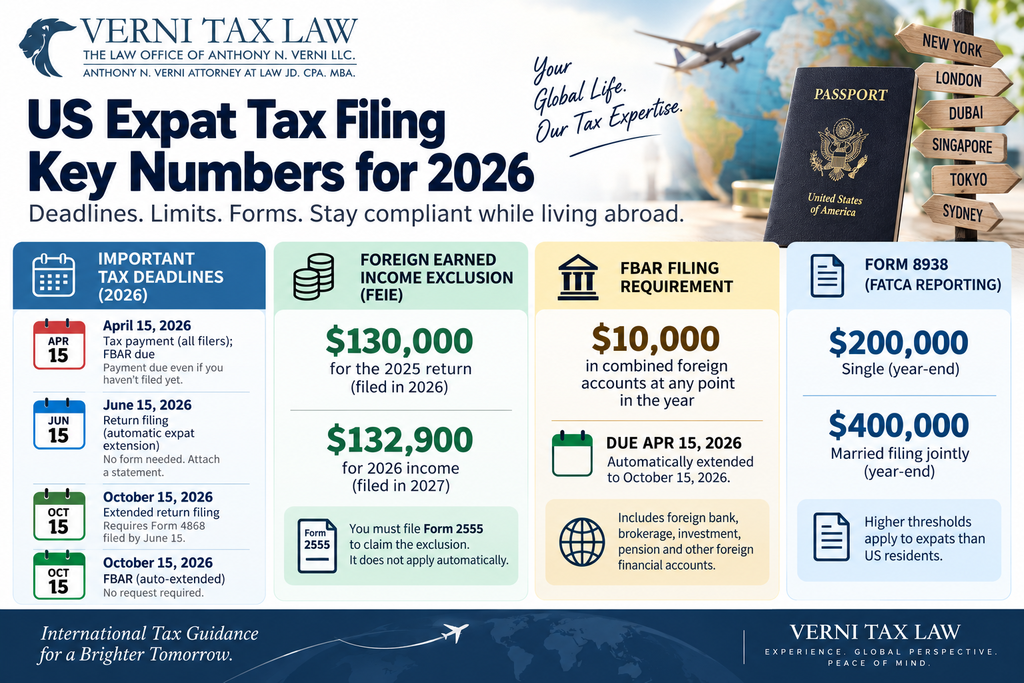
2026 US Expat Tax Deadlines at a Glance
Payment and filing run on separate clocks this season, and mixing them up is why many expats file on time and still get an interest notice later. The table below shows the four dates governing your 2025 return and FBAR.
| Deadline | What’s due | Notes |
| April 15, 2026 | Tax payment (all filers); FBAR | Payment due even if you haven’t filed yet |
| June 15, 2026 | Return filing (automatic expat extension) | No form needed; attach a statement |
| October 15, 2026 | Extended return filing | Requires Form 4868 filed by June 15 |
| October 15, 2026 | FBAR (auto-extended) | No request required |
April 15 Regular Tax Deadline
April 15, 2026 is when any 2025 tax balance is due, whether or not you’ve filed yet. Failure-to-pay penalties and interest start here regardless of which filing extension you use.
June 15 Automatic Expat Extension
June 15, 2026 is the automatic filing deadline for anyone whose tax home and residence were both outside the US and Puerto Rico on April 15. Attach a brief statement citing Treasury Regulation 1.6081-5(a). No advance request goes to the IRS.
October 15 Extended Filing Deadline
October 15 tax deadline status requires action before June 15. File Form 4868 by June 15, 2026, and your deadline moves to October 15, 2026, granted automatically.
FBAR Deadline and Automatic Extension
The FBAR deadline for 2026 for the 2025 reporting year is April 15, 2026, auto-extended to October 15 with no separate request, which is why many filers handle both on the same date.
What FEIE Limit Applies to a U.S. Expat Filing in 2026?
The Foreign Earned Income Exclusion 2026 planning amount depends on which tax year’s income you’re reporting.
2025 FEIE Limit: $130,000, the Figure That Applies This Filing Season
The return due by October 15, 2026 covers 2025 income, capped at $130,000 per qualifying person under IRS guidance. The $132,900 figure circulating widely applies to 2026 income, not reported until the return is filed in 2027. Claiming the exclusion now means using $130,000, not $132,900, and a Form 2555 is required either way; the exclusion never applies automatically.
Who Qualifies for the Foreign Earned Income Exclusion?
- You have foreign earned income from wages, salary, or self-employment performed abroad
- Your tax home is in a foreign country
- You meet either the physical presence test (330 full days abroad in a 12-month period) or the bona fide residence test (an uninterrupted full tax year as a resident of another country)
Passive income doesn’t qualify. Interest, dividends, rental income, capital gains, and pension distributions stay outside the exclusion no matter how long you’ve lived overseas.
Is the FEIE Automatically $130,000 if You Lived Abroad All Year?
No. $130,000 is a ceiling, capped at whichever is lower: the annual limit or actual qualifying foreign-earned income. Earn $70,000 abroad, exclude $70,000, not $130,000, and Form 2555 is still required to claim it.
Physical Presence Test and the 330-Day Rule
The physical presence test counts full 24-hour days outside the United States during any 12-month period you choose, and you need 330 of them. Travel days and transit through the US generally don’t count, so one unplanned trip home can push a borderline year below the threshold.
What Happens if a Married Couple Both Qualify for FEIE?
Each spouse claims separately on their own Form 2555. A couple who both qualify abroad can shelter up to $260,000 combined for 2025, since one spouse’s exclusion doesn’t reduce the other’s.
Do You Actually Qualify for FEIE? Check These Three Requirements Before Filing Form 2555
Requirement 1: Is Your Tax Home Actually in a Foreign Country?
Your tax home is your main place of business or employment, not necessarily your family home or where you’re registered to vote. A US citizen who works primarily abroad but keeps a house and voting registration stateside can still have a foreign tax home for FEIE purposes, but someone who maintains their primary business location in the US while living abroad generally doesn’t qualify.
Requirement 2: Do You Satisfy the 330-Day Physical Presence Test?
Track every day carefully, because the count is unforgiving. A single unplanned trip home for a family emergency, if it pushes you below 330 qualifying days in your chosen 12-month window, can disqualify the exclusion for that period entirely, even if you spent the rest of the year overseas.
Requirement 3: Could You Qualify Under the Bona Fide Residence Test Instead?
The bona fide residence test looks at intent and integration rather than a day count. It asks whether you established genuine residency in a foreign country for an entire uninterrupted tax year, factoring in local ties like a lease, local tax filings, and community involvement. It’s harder to document than the day-counting test but doesn’t penalize short return trips the way the physical presence test does.
FEIE or Foreign Tax Credit: Which One Should an Expat Evaluate Before Filing?
The FEIE excludes qualifying earned income from US tax entirely; the Foreign Tax Credit instead offsets US tax dollar-for-dollar based on foreign taxes actually paid.
- FEIE works best in low-tax or no-tax countries, where excluding income saves more than a credit would generate
- The Foreign Tax Credit works best in high-tax countries, since it can wipe out US tax entirely and even carry unused credit forward
- You generally cannot claim a Foreign Tax Credit for foreign taxes attributable to income you’ve already excluded under FEIE, since the IRS treats that income as already untaxed by the US
Can You Use FEIE and Foreign Tax Credits Together?
Yes, but only on separate pools of income. Income excluded under FEIE cannot also generate a Foreign Tax Credit, but income above the FEIE cap, or income that doesn’t qualify for exclusion at all, can still use the Foreign Tax Credit. A high earner in a high-tax country often excludes the first $130,000 with FEIE and then credits taxes paid on everything above that.
FBAR Filing Requirements for US Expats in 2026
FBAR filing requirements hinge on $10,000, combined, across every foreign account you hold or control.
Who must file:
- US citizens, including dual citizens living permanently abroad
- Green card holders, regardless of where they reside
- US persons with signature authority over a foreign account, even without ownership
- Anyone whose combined foreign account balances exceeded $10,000 on even a single day of the year
What foreign accounts must be reported includes checking and savings accounts, foreign brokerage and investment accounts, foreign pension accounts you’re a beneficiary of, and mobile payment or foreign fintech accounts holding a balance.
The $10,000 threshold is aggregate, so five accounts holding $2,500 each still triggers the filing requirement even though no single account crosses the line alone.
Which Forms Does a U.S. Expat Need to Check Before October 15, 2026?
Form 1040, the Core Federal Income Tax Return
Form 1040 reports worldwide income regardless of where it’s earned or where taxes were already paid locally. Every other international form attaches to this one.
Form 2555, When Claiming FEIE or Foreign Housing Benefits
Form 2555 is filed alongside Form 1040 to claim the FEIE, the foreign housing exclusion, or both. Without it, foreign earned income is fully taxable even if you’d otherwise qualify for the exclusion.
Form 4868, When June 15 Was Not Enough
Form 4868 extends your filing deadline from June 15 to October 15. It does not extend the payment deadline, which stays at April 15 regardless of when you actually file.
Form 2350, Extension for People Still Trying to Qualify for FEIE
Form 2350 applies to a narrower group: expats who need extra time specifically because they haven’t yet met the 330-day count or the bona fide residence period required for FEIE. It buys time to qualify, not just time to file.
FinCEN Form 114, the FBAR
Filed separately from your tax return through FinCEN’s BSA E-Filing System, not attached to Form 1040. FATCA reporting requirements on Form 8938 and the FBAR overlap in purpose but run through entirely different systems and penalty structures.
Form 8938, FATCA Reporting
Form 8938 filing requirements for U.S. expats have much higher thresholds than for US residents. A single filer abroad files at $200,000 in specified foreign assets on the last day of the year, or $300,000 at any point during the year. Married filing jointly, those thresholds double to $400,000 and $600,000.
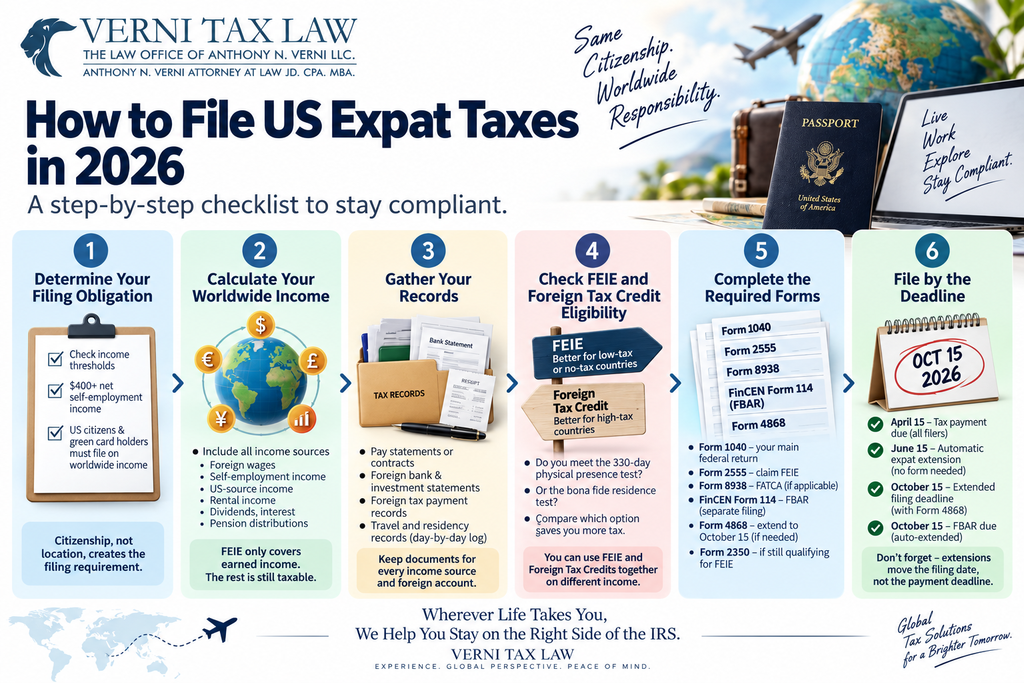
How to File US Expat Taxes in 2026: Step-by-Step Checklist
For 2026 U.S. expat taxes, start by gathering worldwide income, foreign bank/investment statements, and proof of foreign taxes paid; file Form 1040 and report worldwide income, then use Form 2555 if you qualify for the Foreign Earned Income Exclusion or Form 1116 for the Foreign Tax Credit. Check whether you also need FBAR (FinCEN Form 114) or Form 8938 for foreign accounts/assets.
Step 1: Determine Your US Filing Obligation
Check your gross income against the current filing threshold for your status, and separately check whether you cleared $400 in net self-employment income, since that triggers a filing requirement on its own regardless of total income.
Step 2: Calculate Your Worldwide Income
Add every source: foreign wages, foreign self-employment income, US-source income, foreign rental income, dividends, interest, and pension distributions. FEIE only shelters the earned-income portion, so the rest still lands on your return as taxable.
Step 3: Gather Foreign Income and Account Records
Pull twelve months of pay statements or self-employment records, along with year-end and monthly foreign bank and brokerage statements for every account. Documents needed for FBAR filing include the highest balance reached in each account during the year, not just the December 31 balance, since the reporting threshold looks at peak value.
Step 4: Determine FEIE and Foreign Tax Credit Eligibility
Count your qualifying days abroad against the physical presence test, or document your bona fide residence, then compare the tax outcome of excluding income under FEIE against crediting foreign taxes paid.
- Self-employed expat tax filing for FEIE reduces income tax but never touches self-employment tax, which applies to net self-employment earnings regardless of exclusion.
- Some countries have totalization agreements for self-employed expats that prevent double payment into both the US and the local social security system; check whether your country of residence has one before assuming both apply.
Step 5: Complete Form 1040 and Required International Forms
Attach Form 2555 if claiming FEIE, Form 8938 if FATCA thresholds apply, and any schedule needed for foreign tax credits or self-employment tax. U.S. tax treatment of foreign pensions varies by treaty and plan type, so a foreign retirement account often needs its own disclosure separate from the FBAR and Form 8938.
Step 6: File by the Applicable Deadline
File by June 15 if the automatic extension covers you, or submit Form 4868 before that date to push to October 15. File your FBAR by the same October 15 auto-extended date if you’re using it.
What Documents Do US Expats Need for Tax Filing?
Pay stubs, employment contracts, or a foreign equivalent of a W-2, along with any local tax withholding statements your employer issued.
Foreign Bank and Investment Statements
Monthly or year-end statements for every account, showing the highest balance reached, which is what both the FBAR and Form 8938 calculations rely on.
Foreign Tax Payment Records
Receipts or statements proving foreign tax actually paid, needed to support a Foreign Tax Credit claim and to avoid double taxation on income that doesn’t qualify for FEIE.
Travel and Residency Records
A day-by-day log of time spent inside and outside the US, since the physical presence test lives or dies on exact dates, not estimates.
What If You Missed Previous Years of US Expat Tax Returns?
Delinquent U.S. expat tax returns are more common, since a lot of Americans abroad simply never knew citizenship-based taxation applied to them. The fix usually isn’t as severe as people fear, but ignoring it makes penalties compound.
Streamlined Filing Procedures
The IRS Streamlined Foreign Offshore Procedures let eligible non-willful filers catch up by submitting three years of delinquent returns and six years of FBARs, generally without the failure-to-file and failure-to-pay penalties that would otherwise apply.
Catching up on unfiled U.S. tax returns this way requires certifying that the failure to file wasn’t willful, which is a legal standard worth reviewing with someone who handles these cases regularly before you sign it.
Can Expats Claim FEIE on Late Returns?
Generally yes, but the exclusion isn’t guaranteed once the IRS has already assessed a deficiency or contacted the taxpayer about the specific tax year in question. Filing before the IRS reaches out first preserves options that disappear once they do.
DIY Expat Tax Filing vs. Hiring an Expat CPA
DIY filing can work for a straightforward W-2 employee with one foreign bank account and no self-employment income. It gets considerably harder once FEIE, foreign tax credits, FBAR, Form 8938, and self-employment tax all apply in the same return, because each interacts with the others and a mistake in one often creates a downstream error in another.
An expat CPA earns their fee once a return involves multiple income types, multiple countries, or several years of catch-up filing. Expat tax preparation software generally isn’t built to flag interactions like whether excluding income under FEIE just closed the door on a Foreign Tax Credit you needed elsewhere, and that’s exactly the kind of mistake that turns into an IRS notice eighteen months later.
How Verni Tax Law’s US Expat Tax Services Help Filing Expat Taxes
Anthony N. Verni is a licensed attorney, a CPA, and holds an MBA, with over 25 years of experience handling federal and international tax matters, which makes him an expert in expat filing, where a missed FBAR or a wrong FEIE calculation can turn into both a tax problem and a penalty exposure problem at the same time.
His US expat tax services cover:
- Determining whether the Streamlined Filing Procedures fit your situation before you file anything
- Preparing Form 2555, Form 8938, and FBAR filings correctly the first time, including for self-employed expats juggling totalization agreements
- Representing clients already facing FBAR or FATCA penalty notices, negotiating directly with the IRS on their behalf
- Advising clients across time zones from Thailand to the Philippines to the UK, with consultations scheduled around local hours rather than US business hours
He personally reviews every case rather than handing it off, which matters most in cross-border filings where one overlooked detail in a foreign pension disclosure or a missed totalization agreement can cascade into years of correction work. If you need U.S. expat tax advice before October 15, or you’re trying to fix a missed Form 8938 filing or handle a last-minute FBAR filing, book a confidential consultation with Verni Tax Law before the deadline narrows your options.
Conclusion
US citizenship carries a tax filing duty that doesn’t end at the border, and the 2026 filing season layers three deadlines, a shifting FEIE limit, and two separate foreign-account reporting regimes onto that basic rule. Confirm your filing obligation first, calculate worldwide income second, then work through FEIE, Foreign Tax Credit, FBAR, and Form 8938 in that order, because each one depends on numbers the previous step produced.
At Verni Tax Law, Anthony N. Verni built his practice around exactly this kind of layered international filing problem. With dual credentials as an attorney and CPA and more than 25 years resolving federal and cross-border tax matters, he reviews each client’s situation personally, which is precisely what catches the FEIE and FBAR interactions that generic software misses.
If your 2025 return involves foreign income, foreign accounts, or a gap in prior-year filings, reach out to Verni Tax Law before October 15 closes the window on your easiest options. Contact Verni Tax Law to schedule a confidential case review.
FAQs
Do US citizens living abroad have to file US taxes in 2026?
Yes. Citizenship-based taxation means US citizens and green card holders file on worldwide income regardless of residence, once they clear the standard filing thresholds.
What is the foreign earned income exclusion for 2026?
For the 2025 return filed in 2026, the FEIE cap is $130,000 per qualifying person. The $132,900 figure applies to 2026 income filed in 2027.
What is the 2026 FEIE limit?
The limit for 2026 tax year income is $132,900 per qualifying person, filed on the return due in 2027, not the current filing season.
What is Form 2555 used for?
Form 2555 is filed with Form 1040 to claim the Foreign Earned Income Exclusion and the foreign housing exclusion or deduction.
Who qualifies for the foreign earned income exclusion?
Anyone with foreign earned income, a foreign tax home, and either 330 qualifying days abroad or a full year of bona fide foreign residence.
What is the physical presence test for expats?
It requires 330 full days physically outside the US during any 12-month period you select, not necessarily a calendar year.
What is the bona fide residence test?
It requires an uninterrupted full tax year of genuine residency in a foreign country, judged by intent and local ties rather than a day count.
What is the US expat tax filing deadline for 2026?
April 15 for payment, June 15 for the automatic expat filing extension, and October 15 with Form 4868 for the final extension.
Is October 15 the final tax deadline for US expats?
For most filers, yes. A further extension to December 15 exists only by written request and isn’t automatic.
What is the FBAR deadline in 2026?
April 15, 2026, automatically extended to October 15, 2026 with no request required.
Is the October 15 FBAR deadline automatic?
Yes. Unlike the tax return extension, the FBAR extension to October 15 requires no form or advance request at all.
What happens if I miss my US expat tax filing deadline?
Interest and penalties accrue on any unpaid tax from April 15, and separate FBAR penalties can apply if that filing is also late.
Do I need to file an FBAR if I live outside the US?
Yes, if your combined foreign account balances exceeded $10,000 at any point in the year, regardless of where you live.
What foreign accounts need to be reported to the IRS or FinCEN?
Foreign bank and brokerage accounts, foreign pension accounts you have an interest in, and foreign accounts you control but don’t own.
Should I hire an expat CPA to file my US taxes?
It’s worth it once FEIE, foreign tax credits, FBAR, and Form 8938 all apply together, since errors in one form often create errors in another.
How much does US expat tax preparation cost?
Costs vary by complexity, from a few hundred dollars for a simple W-2 return to several thousand for multi-year catch-up filings with FBAR and Form 8938.
Can I file US expat taxes online?
Yes, though many expat-specific IRS forms and the FBAR filing system have their own portals separate from standard consumer tax software.
Can I claim FEIE and the foreign tax credit together?
Yes, but not on the same dollar of income; FEIE-excluded income can’t also generate a foreign tax credit.
What should I do if I have not filed US taxes for several years?
Look into the Streamlined Filing Procedures before the IRS contacts you, since that eligibility window closes once they reach out first.
Can an expat get an extension beyond October 15?
Only with a written request for a discretionary extension to December 15, which the IRS grants case by case rather than automatically.