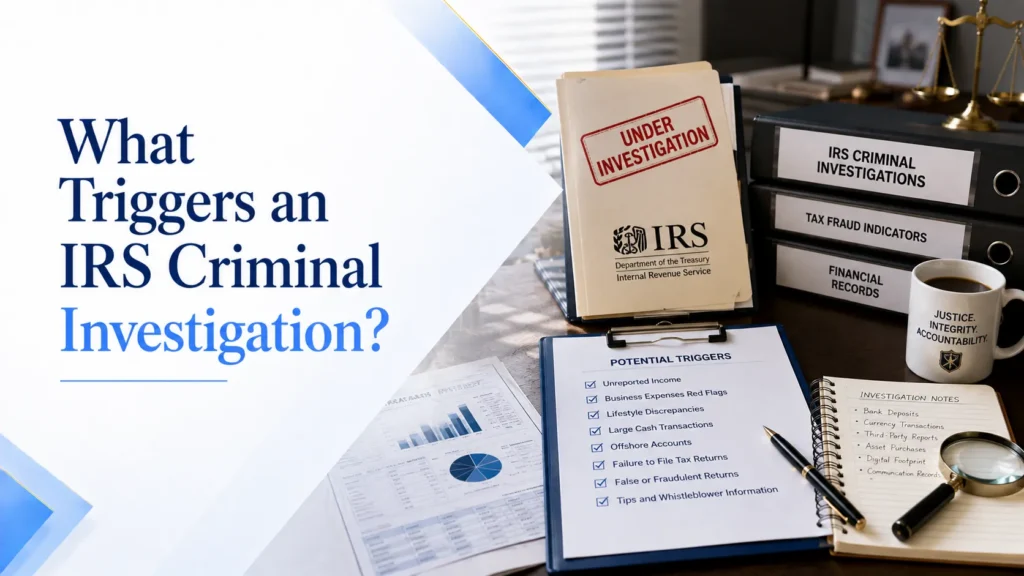
Criminal investigations generally require evidence of intentional wrongdoing, not a simple mistake or an inability to pay. The IRS opened 2,043 cases recommended for prosecution in fiscal year 2025 out of more than 160 million individual returns filed that year, so the odds of facing IRS criminal investigation triggers are low unless specific fraud indicators are present.
This article breaks down the exact behaviors, IRS fraud indicators, and reporting sources that move a case from a routine audit into a criminal file, plus what to do if a special agent already has your name.
Key Takeaways
- IRS-CI referred 2,043 cases for prosecution in FY2025 and closed the year with an 89% conviction rate involving 1,611 defendants (IRS-CI FY2025 Annual Report).
- Willfulness, not the size of your tax bill, decides whether a case stays civil or turns criminal.
- Willful FBAR violations carry civil penalties up to $165,353 or 50% of the account balance per year, plus criminal fines up to $250,000 and 5 years in prison.
- Structuring cash deposits under $10,000 is its own federal crime under 31 U.S.C. § 5324, even when the underlying money is completely legal.
- IRS whistleblowers collected $123.5 million in awards in FY2024 for reporting tax fraud.
- IRS-CI seized 2.35 petabytes of digital data in FY2025, a nearly 60% jump from the year before, much of it tied to crypto tracing.
The IRS Doesn’t Criminally Investigate Most Tax Problems, Here’s the Threshold
Civil enforcement handles the overwhelming majority of tax problems; IRS Criminal Investigation (CI) only opens a file when the facts point to willful, intentional wrongdoing. Willfulness is the voluntary, intentional violation of a known legal duty, meaning you understood what the tax law required and chose to break it anyway. That single word separates a stressful but survivable audit from a federal case.
A mistake is an unintentional error, like transposing numbers on a return. Negligence is careless disregard for the rules without intent to deceive. Reckless behavior ignores an obvious risk of being wrong. Intentional fraud is the deliberate, knowing act of lying to the government about money.
Large unpaid taxes alone rarely trigger criminal prosecution; the IRS pursues those cases through liens, levies, and installment agreements every day without involving a single special agent.
Role of the IRS Criminal Investigation Division (IRS-CI)
IRS-CI is the only federal law enforcement agency with jurisdiction over the Internal Revenue Code, and it closed FY2025 with an 89% conviction rate. The division dedicated nearly 64% of its investigative time to tax crimes last year, identifying $4.49 billion in tax fraud alone.
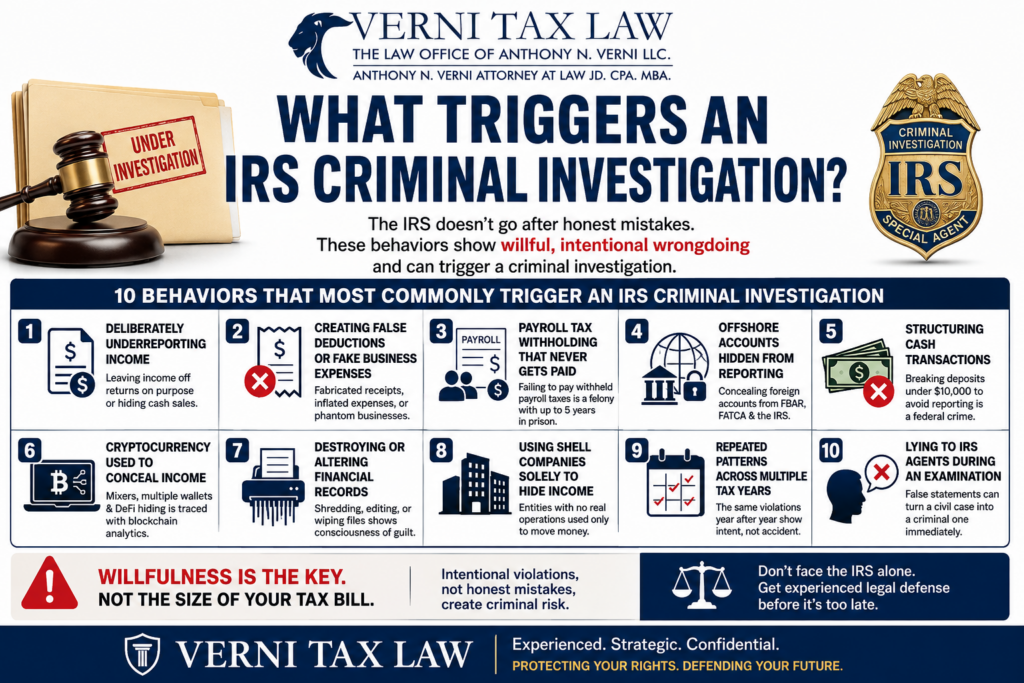
10 Behaviors That Most Commonly Trigger an IRS Criminal Investigation
These are the recurring tax fraud red flags examiners escalate to CI, drawn from IRS enforcement patterns and the Internal Revenue Manual’s fraud-handling guidance.
1. Deliberately Underreporting Income
Underreporting is the act of leaving income off a return on purpose, such as skipping an entire 1099 or running cash sales through a personal account instead of the business ledger. A single omitted client rarely draws attention; a repeated pattern across years does.
2. Creating False Deductions or Fake Business Expenses
Fabricated receipts, inflated charitable donations, invoices from contractors who never worked, and deductions run through a phantom business are among the clearest IRS fraud indicators examiners are trained to spot. IRS-CI treats manufactured paperwork as direct proof of intent, since honest mistakes don’t usually come with matching fake documents.
3. Payroll Tax Withholding That Never Gets Paid
Payroll tax cases draw aggressive criminal attention because the employer is holding money that already belongs to employees and the government. Under IRC § 7202, willfully failing to turn over withheld payroll taxes is a felony carrying up to 5 years in prison, separate from the civil Trust Fund Recovery Penalty. A business owner facing this exposure should get payroll tax fraud defense counsel involved before the next payroll deadline, not after.
4. Offshore Accounts Hidden From Reporting
Concealing a foreign bank, brokerage, or crypto-linked account from FATCA and foreign asset reporting is one of the fastest paths to a criminal referral, especially now that most foreign institutions report U.S. account holders directly to the IRS. Willful FBAR penalties reach the greater of $165,353 or 50% of the account balance per year, and criminal FBAR exposure adds fines up to $250,000 and 5 years in prison on top of that.
5. Structuring Cash Transactions
Breaking a large cash deposit into smaller amounts to dodge the $10,000 reporting threshold is itself a federal crime under 31 U.S.C. § 5324, regardless of where the cash came from. Banks file Suspicious Activity Reports the moment they spot a pattern like this, and that filing alone can open a case.
6. Cryptocurrency Used to Conceal Income
Using mixers, spreading funds across multiple wallets, or hiding NFT and DeFi gains no longer provides the anonymity many traders assume it does. IRS-CI partners with outside firms to run blockchain analytics in IRS cases, tracing wallet activity back to exchange accounts and real identities; the agency seized 2.35 petabytes of digital evidence in FY2025 alone. Anyone facing this exposure needs crypto tax crime defense built around the specific blockchain trail investigators are following.
7. Destroying or Altering Financial Records
Shredding records, editing QuickBooks entries, or wiping files right after an audit notice arrives reads as consciousness of guilt to a jury. Most accounting software keeps autosaved and cloud-backed versions the IRS can subpoena regardless.
8. Using Shell Companies Solely to Hide Income
A shell company with no real operations, employees, or purpose beyond moving money is a classic badge of fraud. Investigators look for entities that exist only on paper and only around tax filing season.
9. Repeated Patterns Across Multiple Tax Years
A single bad return can be an accident. The same omission, the same fake deduction, or the same unreported account appearing across three or more consecutive years tells IRS-CI the conduct was deliberate rather than a one-time slip.
10. Lying to IRS Agents During an Examination
False statements made to a revenue agent during a civil audit, whether about income, ownership of an account, or the existence of records, can convert a civil matter into a criminal one on the spot. Anything said without counsel present becomes evidence the government can use later.
Read more: How Blockchain Analytics Is Changing Criminal Tax Investigations
How Does the IRS Decide to Open a Criminal Investigation?
The IRS opens a criminal case through a two-stage internal review, not a single agent’s judgment call. A special agent first builds a “primary investigation” from the evidence, then at least two layers of CI management have to approve it before it becomes an active “subject criminal investigation.”
Preliminary Fraud Review
A special agent analyzes referrals from audits, banks, whistleblowers, or other agencies to determine whether criminal tax fraud may have occurred. The agent’s front-line supervisor reviews that preliminary file and decides whether it’s worth developing further.
Criminal Referral Process
If the supervisor approves, the special agent in charge signs off, IRS Chief Counsel attorneys get involved, and the agent gathers evidence through subpoenas, interviews, and forensic review. When the evidence supports prosecution, the case moves to the Department of Justice Tax Division for a final charging decision.
Badges of Fraud the IRS Looks For
Courts and the IRS rely on a documented list of “badges of fraud” in the Internal Revenue Manual’s fraud-handling guidance to infer intent when direct proof is unavailable.
The table below groups the badges the IRS documents most often, and a taxpayer showing several of these at once faces a materially higher chance of a criminal referral than someone with just one isolated issue.
| Badge Category | What It Looks Like |
| Income concealment | Omitted income sources, unexplained net worth growth, unreported bank deposits |
| Record manipulation | Two sets of books, false journal entries, altered invoices |
| Deception and obstruction | False statements to examiners, destroyed records, concealed assets |
| Behavioral pattern | Multi-year underreporting, implausible explanations, uncooperative conduct |
Intentional Record Alteration
Falsifying dates, amounts, or signatures on financial documents after the fact is a direct badge of fraud, since it requires deliberate action rather than oversight.
Hidden Assets or Nominee Accounts
Titling property or accounts in a relative’s or associate’s name specifically to keep them off your return is a recognized concealment tactic examiners are trained to trace through bank and title records.
Multiple Sets of Financial Records
Keeping one set of books for the IRS and a second, more accurate set for internal use is one of the strongest indicators of fraud in the Internal Revenue Manual, because it proves the taxpayer knew the true numbers.
Who Reports Suspected Tax Fraud to the IRS?
Most criminal referrals start with someone or something outside the taxpayer’s control flagging the activity first.
IRS Informants and Whistleblowers
Employees, ex-spouses, and business partners can file Form 211 with the IRS Whistleblower Office and collect 15% to 30% of what the government recovers if the tip leads to a case. The program paid out $123.5 million in awards in FY2024 alone, a clear financial incentive for insiders to come forward.
Financial Institutions and Bank Reporting
Banks file Currency Transaction Reports on cash transactions over $10,000 and routinely flag patterns that look engineered to avoid that threshold, feeding data straight into IRS and FinCEN systems.
Suspicious Activity Reports (SARs)
SARs are confidential filings banks submit when transaction activity looks designed to evade reporting rules or hide the source of funds. IRS-CI reviewed BSA-linked filings tied to 87.3% of its prosecution-recommended cases from FY2022 through FY2024, with those cases producing a 97.3% conviction rate.
Other Government Agencies
State tax departments, the Department of Labor, and even divorce or bankruptcy courts routinely pass financial red flags to the IRS when their own proceedings surface unreported income or hidden assets.
Technology Used to Detect Tax Fraud
IRS-CI uses three technology categories that now drive most modern referrals.
Data Matching Systems
The IRS automatically cross-checks W-2s, 1099s, and broker statements against filed returns, flagging any return where reported income doesn’t match what third parties already told the government.
Artificial Intelligence and Analytics
CI’s data analytics teams score returns for anomalies, unusual deduction ratios, and patterns that match known fraud schemes, directing scarce agent time toward the files most likely to hold intentional violations.
Digital Footprints and Electronic Records
Cloud backups, deleted-file recovery, email metadata, and blockchain records now give investigators a documentation trail that survives even when a taxpayer tries to destroy the originals.
Warning Signs You May Be Under Criminal Investigation
- A revenue agent suddenly stops communicating mid-audit with no explanation
- Your case gets referred to a Fraud Technical Advisor
- Two people show credentials identifying themselves as special agents, not revenue agents
- Your bank, accountant, or business partner mentions receiving a subpoena about you
- You receive a grand jury subpoena instead of a standard IRS notice
- Family members or former employees report being interviewed about your finances
What Happens After a Criminal Investigation Begins?
Once IRS-CI opens a subject investigation, the process shifts from asking questions to building a prosecutable case file.
Evidence Collection
Special agents use search warrants, third-party subpoenas, and witness interviews to assemble documentary proof of the elements required for a tax crime charge.
Forensic Accounting
CI’s forensic accountants reconstruct actual income and expenses independent of what the taxpayer reported, often using bank deposit or net worth methods to show the gap between reported and real income.
DOJ Tax Division Review
Before any indictment, the Department of Justice Tax Division reviews the referral for legal sufficiency, a separate checkpoint that filters out weaker cases before they ever reach a courtroom.
How to Reduce Criminal Risk If You Discover a Serious Tax Problem
File current-year returns accurately and stop the behavior in question immediately. Continuing a scheme after you know it’s a problem removes any argument that the earlier conduct was accidental.
Gather Complete Financial Records Before Responding
Pull bank statements, prior returns, and supporting documents before contacting the IRS or a preparer, so any professional advising you is working from the full picture rather than a partial one.
Understand Whether the Issue Involves Negligence or Willfulness
An honest, documentable mistake is treated very differently than a knowing violation, and that distinction should be assessed by counsel before you make any voluntary statement to the IRS.
Consider Voluntary Disclosure Before the IRS Contacts You
The IRS Voluntary Disclosure Practice allows taxpayers to come forward before an investigation starts, which historically reduces criminal exposure compared to being caught first. Timing is everything here; disclosure after the IRS already has your name doesn’t carry the same protection.
Coordinate Legal and Tax Strategy
A criminal tax matter needs an attorney directing the case under privilege, with a CPA or accountant working underneath that privilege rather than reporting independently to the IRS.
What to Do If IRS-CI Contacts You
If two agents show badges and ask to speak with you, say only that you want to consult an attorney before answering any questions, because anything said in that first conversation, even something offered to seem cooperative, can become the government’s strongest piece of evidence.
- Do not hand over documents on the spot, even if asked politely
- Do not explain your side of the story informally in the driveway or office
- Write down agent names, badge numbers, and the exact questions asked immediately afterward
- Call a tax fraud defense attorney before your next conversation with anyone at the IRS, including your regular accountant
How Verni Tax Law Defends Criminal Tax Investigations
Verni Tax Law is led by Anthony N. Verni, an attorney, CPA, and MBA with more than 25 years of experience resolving federal and international tax matters from offices in Princeton, New Jersey, and Fort Lauderdale, Florida.
- Direct, personal review of every case file
- Experience representing clients through IRS voluntary disclosure programs since 2009
- Working knowledge of FBAR, FATCA, and offshore reporting rules that intersect with many criminal tax referrals
- Representation before the U.S. Tax Court and U.S. District Courts when a case moves past the investigative stage
- Confidential, privileged handling of financial records from the first consultation forward
Early Intervention Strategies
Getting an IRS criminal investigation attorney involved during the audit stage, before a formal referral, gives you the chance to correct course, respond to a Fraud Technical Advisor, or pursue voluntary disclosure while those options are still open.
Representation During IRS-CI Investigations
Once special agents are involved, he manages every point of contact with the government, from subpoena responses to interview strategy, so nothing you say or produce works against you later.
Federal Criminal Tax Defense
If a case is referred to DOJ, he coordinates IRS criminal investigation defense at the indictment and trial stage, drawing on both the accounting and legal sides of the case to challenge the government’s numbers directly.
Book a confidential consultation with Verni Tax Law today to get a clear, privileged assessment of where your case actually stands.
Understanding IRS Criminal Investigation Triggers Can Protect You
Triggers for an IRS criminal investigation include structuring cash, hiding offshore accounts, falsifying deductions, and lying to an examiner, which can convert a routine civil matter into a federal case. Technology like blockchain analytics and data matching has made those patterns far easier for the IRS to find.
Anthony N. Verni brings 25 years of combined legal and accounting experience to exactly this intersection, where a tax problem is serious enough to carry criminal risk but still has room for a strategic, privileged response. He personally handles every case from the first call through resolution, whether that means heading off a referral, negotiating a voluntary disclosure, or defending a client already under IRS-CI scrutiny.
If you’re worried about any of the red flags covered here, contact Verni Tax Law for a confidential consultation and get a clear, attorney-led read on your actual exposure.
FAQs
What triggers an IRS criminal investigation?
Willful, intentional violations trigger it, such as hidden income, fake deductions, structured cash deposits, or lying to an examiner; simple errors or unpaid balances generally don’t.
Can an IRS audit turn into a criminal investigation?
Yes. If an auditor spots badges of fraud, the case gets referred to a Fraud Technical Advisor, and the audit can convert into a subject criminal investigation.
What are the most common IRS fraud indicators?
Unreported income, fabricated deductions, hidden bank accounts, destroyed records, and a multi-year pattern of the same violation are the most common indicators.
What are the badges of fraud used by the IRS?
Badges include income concealment, false records, asset hiding, implausible explanations, and obstruction; the Internal Revenue Manual lists them as first indicators, not proof by themselves.
Can suspicious bank transactions trigger an IRS investigation?
Yes. Structuring deposits under $10,000 or a bank-filed Suspicious Activity Report can open a case even before the IRS reviews a single tax return.
How does the IRS Whistleblower Program work?
Whistleblowers file Form 211 and can collect 15% to 30% of amounts the IRS recovers; the program paid $123.5 million in awards in FY2024 alone.
What are the warning signs that IRS-CI is investigating you?
An auditor going silent, a referral to a Fraud Technical Advisor, special agents showing credentials, or subpoenas sent to your bank or associates are the clearest signs.
What happens after an IRS criminal referral is made?
The Department of Justice Tax Division reviews the case for legal sufficiency before deciding whether to indict, a separate checkpoint after IRS-CI’s own recommendation.
Should I hire an attorney if contacted by an IRS Special Agent?
Yes, immediately. Say only that you want counsel present before answering questions; anything said informally can become evidence used against you later.
How can a criminal tax defense attorney help during an IRS investigation?
An attorney can assert privilege over financial review, manage all contact with investigators, pursue voluntary disclosure where still available, and build your defense before charges are filed.