
An IRS criminal investigation examines suspected federal tax crimes and related financial crimes. The IRS Criminal Investigation Division focuses on evidence that may support criminal charges, not simply an unpaid tax bill.
A case may start with an audit referral, tip, financial record, or another agency. Agents then trace money, review records, interview people, and test whether facts show willfulness. This guide explains the process from the first lead through DOJ review.
Key Takeaways
- About 3,000 employees work in CI, including about 2,100 special agents.
- A primary investigation comes before a subject criminal investigation.
- Agents can review bank data, interview witnesses, use warrants, and examine digital evidence.
- Tax evasion under §7201 is a felony with up to 5 years in prison.
- DOJ Tax Division review can occur before federal tax prosecution.
- A criminal inquiry can end without criminal charges.
What Is an IRS Criminal Investigation?
An IRS criminal investigation is a federal inquiry into possible violations of tax law and related financial crimes. The IRS Criminal Investigation Division is the IRS law enforcement branch. IRS-CI focuses on criminal tax evidence.
Difference Between Civil and Criminal IRS Cases
A civil case usually seeks tax, interest, or penalties; an IRS criminal investigation asks whether conduct supports a crime. Civil fraud or criminal tax evasion can involve the same conduct, but the legal standards and outcomes differ.
Mission of the IRS Criminal Investigation Division (IRS-CI)
The IRS Criminal Investigation Division investigates tax and related financial crimes. IRS says CI has about 3,000 employees, including about 2,100 special agents, with jurisdiction involving tax, money laundering, and Bank Secrecy Act matters.
What Triggers an IRS Criminal Investigation?
An IRS-CI case can begin with an IRS referral, public information, or another law enforcement matter. A referral does not prove a crime; agents first assess whether the facts justify further investigation.
Unreported Income and False Returns
Unreported income, false deductions, false statements, and hidden assets can create criminal exposure when evidence supports willfulness. Section 7206 covers willfully signing returns or documents containing material falsehoods.
Offshore Accounts and Foreign Assets
An FBAR is a Report of Foreign Bank and Financial Accounts. Foreign accounts can create federal reporting duties when applicable. Understanding when FBAR violations can create criminal tax exposure requires a close review of willfulness evidence. FBAR cases that are selected for criminal investigation can turn on facts showing possible willfulness and supporting a criminal referral.
Payroll Tax Fraud and Business Schemes
Payroll tax fraud can involve withheld employment taxes that are not paid over, false payroll records, or hidden business income. Section 7202 addresses willful failures involving collected employment taxes. Payroll tax fraud can also involve false payroll records or hidden business income. Business owners should also review small business tax evasion penalties before assuming a tax debt is only civil.
Cryptocurrency and Digital Asset Investigations
IRS enforcement of digital assets includes attention to taxable transactions and financial records. The evolution of U.S. tax enforcement increasingly includes data from newer financial systems, which affects digital asset cases.
Blockchain analytics in criminal tax investigations can help trace transfers by connecting wallets, exchanges, and transfers. The DOJ crypto enforcement strategy also shows a broader federal focus on digital asset crime. That DOJ crypto enforcement strategy includes coordination around digital asset investigations.
Whistleblower Tips and Third-Party Referrals
Whistleblower tips and third-party referrals can provide criminal leads. IRS guidance identifies internal IRS referrals, public information, and other law enforcement sources as possible starting points.
How IRS-CI Builds a Criminal Tax Case
A tax evasion investigation is evidence-driven. A related tax evasion investigation theory may change the defense. IRS-CI develops facts that address the offense. Agents develop facts that add to the record.
Initial Case Screening and Referrals
A primary investigation is the first review of possible criminal conduct. A supervisor decides whether the facts justify opening a subject criminal investigation, followed by management review.
Financial Tracing and Forensic Accounting
Forensic accounting is the use of financial records and accounting methods to identify transactions, income, assets, and tax effects. Agents can review bank records and financial data to build a money trail.
Interviews, Summonses, and Evidence Collection
A summons is a legal demand for information or records. Agents can interview witnesses and obtain records through lawful methods.
Search Warrants and Digital Evidence
Search warrants may be used when legal requirements are met. IRS says CI agents also use forensic technology to recover financial data that may be encrypted, password-protected, or hidden.
The IRS Criminal Investigation Timeline
There is no fixed timeline for an IRS criminal investigation. Complex records, witnesses, transactions, digital evidence, and prosecutorial review can affect the length.
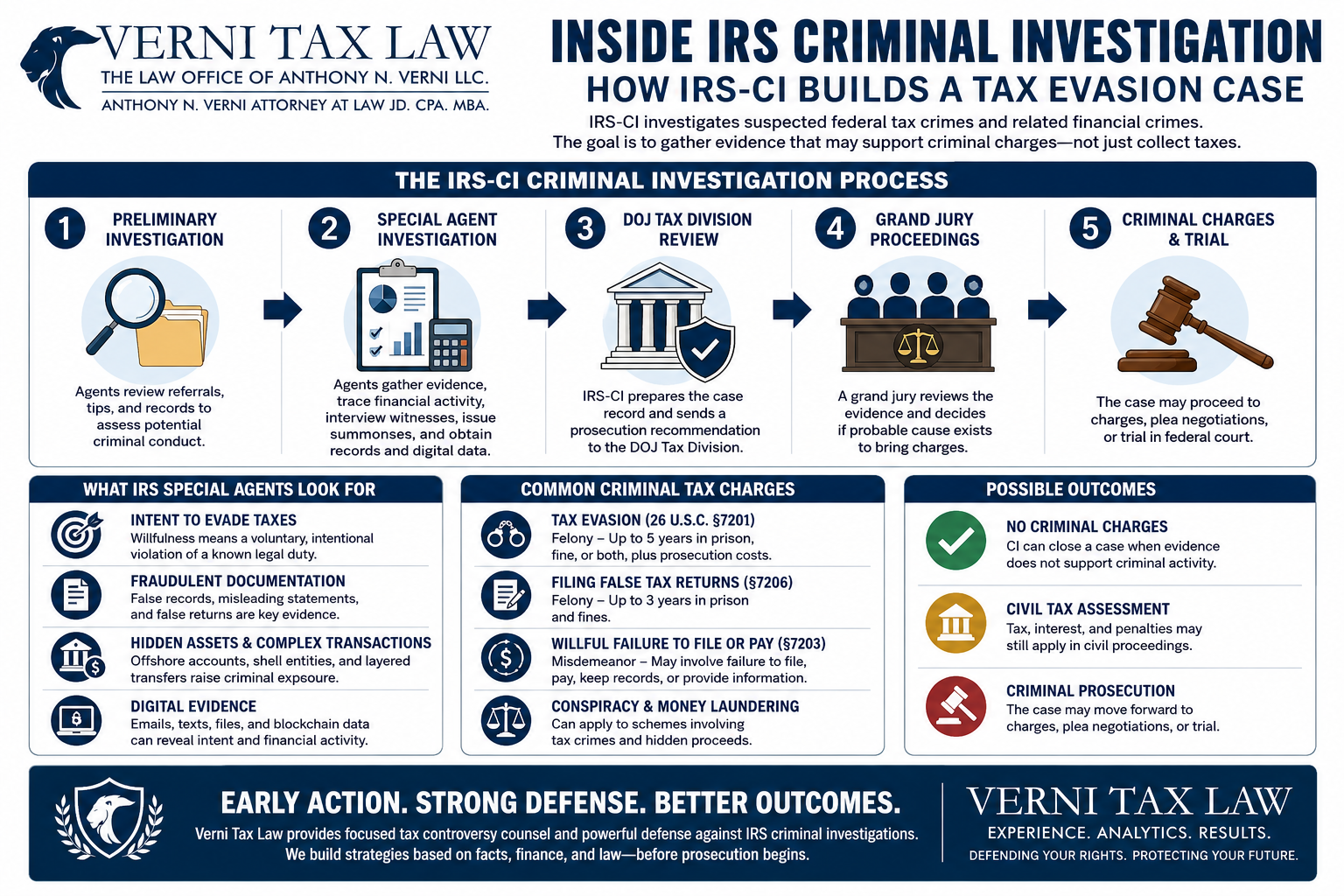
Stage 1: Preliminary Investigation: The preliminary stage tests criminal potential.
Stage 2: Special Agent Investigation: The special agent gathers evidence and tests the offense. IRS-CI then assesses the evidence.
Stage 3: DOJ Tax Division Review: The DOJ is the U.S. Department of Justice. For tax cases, CI can send a prosecution recommendation to the DOJ Tax Division. IRS-CI prepares the case record before referral.
Stage 4: Grand Jury Proceedings: A grand jury considers whether probable cause supports charges.
Stage 5: Criminal Charges and Trial: A case can proceed to charges, plea negotiations, or trial.
What IRS Special Agents Look For
An IRS criminal investigation attorney focuses on facts that may show intent, false records, hidden assets, and conduct tied to a specific tax offense.
Intent to evade taxes: Willfulness is a voluntary, intentional violation of a known legal duty. Tax evasion generally requires a tax due, an affirmative evasive act, and willfulness.
Fraudulent documentation: False records and misleading statements can become important evidence.
Hidden assets and complex transactions: IRS agents expanding audits often depend on new evidence.
Common Criminal Tax Charges
IRS criminal tax charges depend on the conduct and evidence. Common statutes include tax evasion, false returns, willful failures, conspiracy, and money laundering.
Tax Evasion
Tax evasion under 26 U.S.C. §7201 is a felony. This is why you can go to prison for tax evasion because a conviction can bring up to 5 years in prison, a fine, or both, plus prosecution costs.
Filing False Tax Returns
Section 7206 can apply to willful material falsehoods in tax documents. The statute provides felony penalties of up to 3 years in prison and fines.
Failure to File or Pay Taxes
Section 7203 covers certain willful failures and generally creates misdemeanor exposure. It can involve failure to file, pay, keep records, or provide required information.
Conspiracy and Money Laundering
Money laundering law can apply to transactions involving unlawful proceeds, including certain tax offenses.
Possible Outcomes of an IRS Criminal Investigation
An IRS criminal investigation can end with no criminal charges, civil action, or prosecution. The result depends on evidence and decisions during review.
No Criminal Charges: CI can discontinue a case when evidence does not support criminal activity.
Civil Tax Assessment: Common IRS tax fraud misconceptions often treat every audit finding as criminal. Another is assuming small business tax evasion penalties always mean prosecution.
Criminal Prosecution: If prosecutors accept a case, it can proceed toward charges, plea negotiations, or trial.
How a Criminal Tax Defense Attorney Can Help
An IRS criminal investigation attorney can act before charges, protect legal rights, review financial evidence, and address the government's theory.
Responding before charges are filed: Early IRS criminal investigation defense can review records, identify gaps, preserve evidence, and manage communications. An experienced tax fraud attorney can also test the government's tax theory.
Protecting constitutional rights: Counsel can address searches, subpoenas, interviews, and privilege.
Negotiating with federal prosecutors: Counsel can present facts to federal prosecutors and seek an evidence-based resolution.
Early Action Can Prevent Criminal Consequences
Investigators must connect records, transactions, statements, and conduct to the legal elements of the charged offense. Willfulness can become central when the government claims a taxpayer knew a duty and chose to violate it. Early counsel can preserve records, control communications, test financial calculations, and identify gaps in the government's theory. Taxpayers facing IRS scrutiny should treat the first criminal signal as a legal event.
Verni Tax Law is the best choice for taxpayers who need focused tax controversy counsel and strong accounting analysis. Anthony N. Verni is an attorney, CPA, and MBA with more than 20 years practicing before the IRS. He builds an IRS criminal investigation defense from tax and financial evidence, provides an experienced tax fraud attorney and offshore tax evasion attorney perspective, and helps prepare a fact-based response before prosecution. Contact Verni Tax Law to assess the case early and choose a response based on the evidence
FAQs
What is the IRS Criminal Investigation Division (IRS-CI)?
The IRS Criminal Investigation Division is the IRS law enforcement branch that investigates federal tax crimes and related financial crimes.
What usually triggers an IRS criminal investigation?
Common sources include IRS referrals, public tips, third-party information, and other law enforcement investigations involving possible criminal tax violations. IRS criminal tax charges may follow only when evidence supports an offense.
How does the IRS build a criminal tax evasion case?
An IRS-CI case develops through financial records, interviews, digital evidence, searches, and evidence addressing the required criminal elements.
How long does an IRS criminal investigation usually take?
There is no standard deadline; complex records, witnesses, digital evidence, and DOJ review can make a case take months or longer.
What happens when an IRS Special Agent contacts you?
An IRS criminal investigation attorney should review the contact before substantive questioning, especially when agents request an interview or records.
What is the role of the DOJ Tax Division in criminal tax cases?
The DOJ Tax Division reviews prosecution recommendations in many federal tax cases.
Can an IRS criminal investigation become a civil case instead?
Yes. CI can discontinue a case when evidence does not support criminal activity, while civil tax assessment or penalties may remain.
Should I speak to IRS-CI investigators without an attorney?
No. A taxpayer facing possible criminal exposure should obtain legal advice before answering substantive investigative questions; IRS criminal investigation defense should start early.
When should I hire a criminal tax defense attorney?
Hire an IRS criminal investigation attorney when you learn CI may be involved, before interviews, voluntary disclosures, or detailed responses to investigators.
Can forensic accounting help defend against tax fraud allegations?
Yes. Financial analysis can test income, deductions, transfers, records, and tax calculations against the government's theory. That work can strengthen an IRS criminal investigation defense
.