
A willful FBAR violation can expose taxpayers to civil penalties based on the balance of an unreported foreign account. In serious cases, it can also lead to criminal investigation and prosecution.
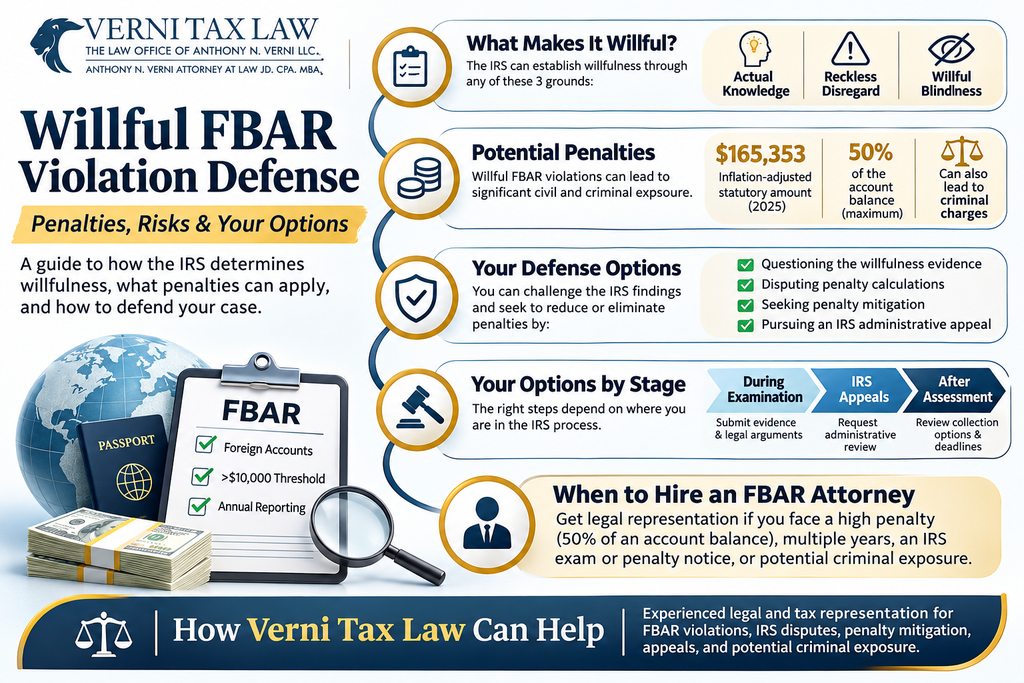
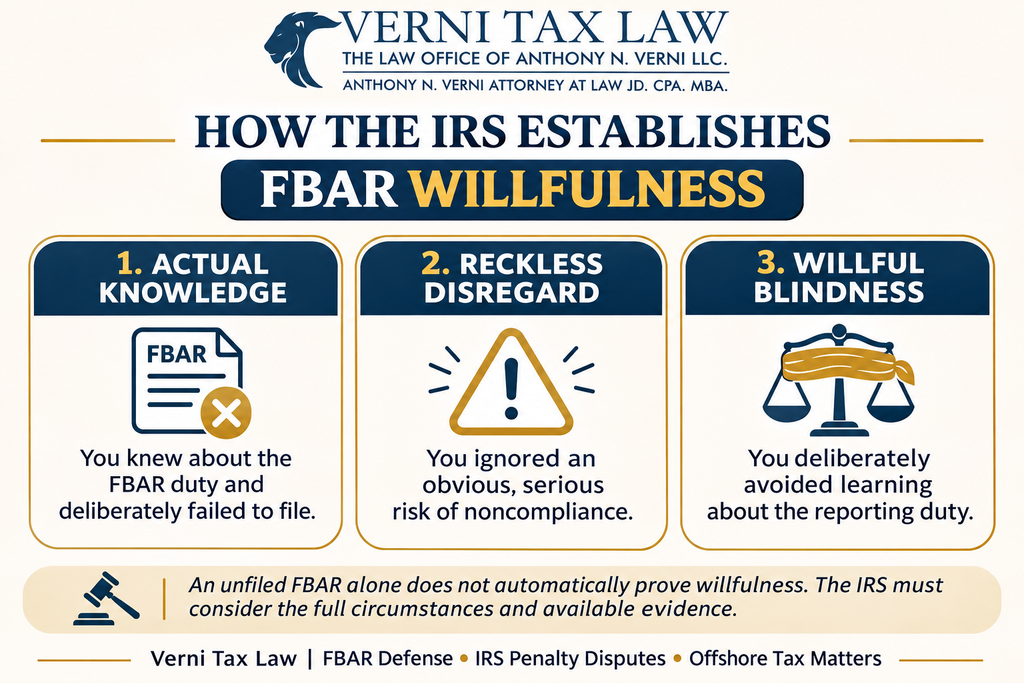
The IRS does not need direct proof of intentional wrongdoing in every case. It can establish civil willfulness through actual knowledge, reckless disregard, or willful blindness.
However, an unfiled FBAR does not automatically mean a willful violation. You have legal options to challenge the IRS’s findings, dispute penalty calculations, and seek penalty mitigation.
Key Takeaways
- $10,000: FinCEN’s aggregate foreign account reporting threshold.
- $165,353: Published inflation-adjusted willful penalty amount effective January 17, 2025.
- 50%: Statutory percentage used in calculating the maximum penalty for an unreported account.
- 6 years: General civil FBAR penalty assessment limitation period.
- 2 years: General period for the government to bring a civil collection action after the applicable statutory starting date.
- 3 grounds: Actual knowledge, reckless disregard, and willful blindness can establish civil willfulness.
What Makes an Unfiled FBAR a Willful Violation Under IRS Rules?
An unfiled FBAR becomes a willful violation when you knowingly, recklessly, or through willful blindness fail to meet the reporting duty.
The IRS Internal Revenue Manual (IRM 4.26.16.5.5.1) recognizes three grounds for civil willfulness. Each requires an examination of your conduct and available evidence.
Actual Knowledge, Reckless Disregard, and Willful Blindness
- Actual knowledge means you knew about the FBAR reporting duty but deliberately failed to comply.
- Reckless disregard means you ignored an obvious and serious risk of failing to meet the reporting requirements. The IRS uses an objective standard to assess this conduct.
- Willful blindness means you consciously avoided learning about a legal duty.
One frequently overlooked issue is Schedule B of Form 1040. The IRS examines whether taxpayers answered the foreign account question correctly.
An incorrect or unanswered question can support a willfulness finding. However, it does not establish willfulness by itself. The IRS must consider the complete circumstances.
How Much Can the IRS Charge for a Willful FBAR Violation?
Under 31 U.S.C. Section 5321(a)(5)(C), the maximum civil penalty generally equals the greater of the inflation-adjusted statutory amount or 50% of the relevant account balance.
For violations subject to the current published adjustment, the $100,000 statutory amount is adjusted to $165,353.
| Consider this example: Foreign account balance on the violation date: $500,000.50% of the account balance: $250,000.Inflation-adjusted statutory amount: $165,353.Applicable statutory maximum: $250,000.This is a maximum calculation, not an automatic IRS assessment. |
The willful FBAR penalty rules require an account-specific calculation. Multiple years can create additional exposure, but the IRS must establish each violation and apply the relevant statutory limits.
The IRS also has discretion when calculating penalties. Its mitigation framework can affect the final amount.
The Supreme Court’s decision in Bittner v. United States (2023) addressed non-willful penalties on a per-report basis. It also recognized the separate account-specific statutory framework for certain willful violations.
What Evidence Does the IRS Use to Prove an FBAR Violation Was Willful?
The IRS uses financial records, tax returns, and communications to determine whether a taxpayer knowingly or recklessly failed to report foreign accounts.
Under IRM 4.26.16.5.5.2, examiners commonly review:
- Previous Schedule B answers on federal income tax returns.
- Foreign bank statements and account-opening documents.
- Emails between taxpayers and tax preparers.
- Previous FBAR filings and corrections.
- Communications with offshore banks and financial advisers.
- Evidence of hidden account ownership or unreported income.
- Records showing deliberate transfers or efforts to conceal assets.
The IRS does not need a written admission of wrongdoing. It can draw reasonable conclusions from the available evidence.
However, the IRS must establish civil willfulness. A missed Schedule B answer, incomplete professional advice, or an omitted account does not automatically prove intentional misconduct.
| For example, the IRS manual describes a situation where a taxpayer omitted a previously closed account but reported its income and cooperated with the examination. Without additional evidence, a willful penalty should not apply. |
How Can You Challenge an IRS Willfulness Determination?
You can challenge an IRS willfulness determination by questioning the evidence, examining your knowledge, and identifying errors in the government’s legal analysis.
An effective FBAR violation defense must address the specific reason the IRS considers the failure willful.
Build the Defense Around Knowledge, Conduct, and Documentation
A strong defense should include these steps:
- Review each tax year separately. Establish what happened during every year under examination.
- Examine your knowledge. Determine whether you understood the FBAR reporting requirements.
- Review Schedule B answers. Examine tax returns and communications with preparers.
- Document reasonable explanations. Identify mistakes, incomplete advice, or misunderstandings supported by records.
- Challenge concealment allegations. Establish whether account transfers or omissions had legitimate explanations.
- Verify the IRS calculation. Check account ownership, reporting duties, violation dates, and penalty amounts.
A useful willfulness penalty defense addresses the exact theory raised by the IRS.
| For example, if the examiner alleges reckless disregard, the response should examine whether you actually faced an obvious reporting risk and could reasonably have identified the requirement.Simply saying that the omission was accidental is not enough. The defense needs supporting documents and a clear explanation. |
Can FBAR Penalties Be Reduced Through IRS Mitigation or Appeals?
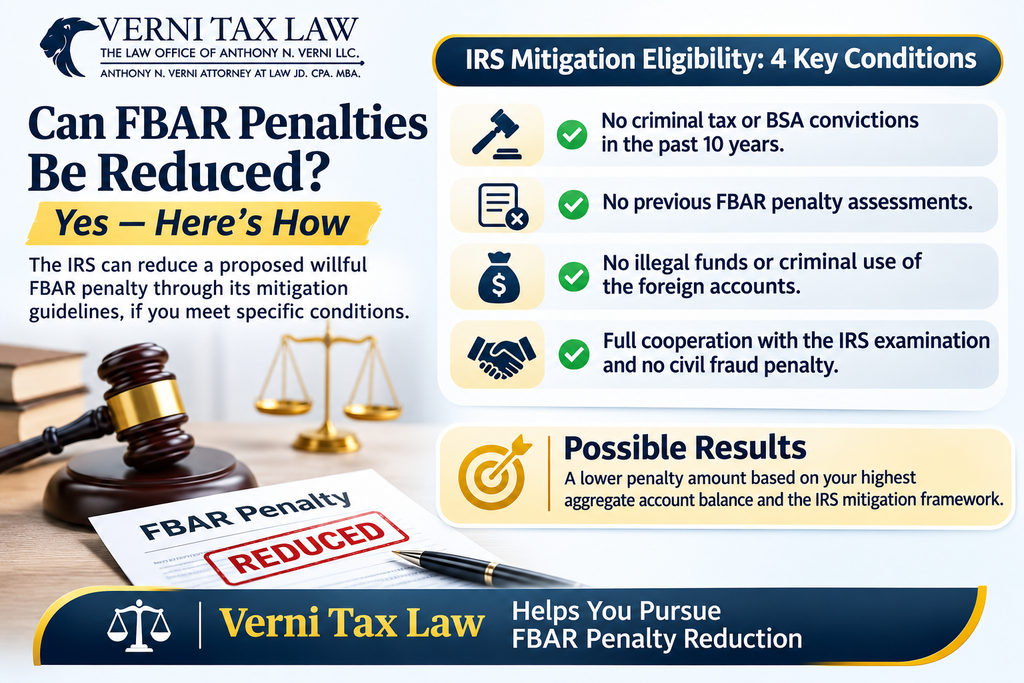
Yes. The IRS can reduce a proposed willful FBAR penalty through its mitigation guidelines and examiner discretion, provided the applicable conditions are satisfied.
The IRS FBAR penalty mitigation guidelines appear in IRM Exhibit 4.26.16-2.
Generally, you must satisfy four conditions:
- No criminal tax or Bank Secrecy Act convictions during the previous 10 years.
- No previous FBAR penalty assessments.
- No illegal funds or criminal use of the foreign accounts.
- Cooperation with the IRS examination and no applicable civil fraud penalty determination.
The IRS also considers the highest aggregate account balance during the examination years.
Its mitigation framework includes different penalty levels based on account balances. For example, the lowest level generally applies when the maximum aggregate balance does not exceed $50,000.
The examiner must document the calculation and consider the facts of the case.
Legal strategies for reducing FBAR penalties include challenging the willfulness finding and disputing the proposed amount separately. A taxpayer can also examine administrative appeal and litigation options.
Mitigation does not mean the IRS agrees that the violation was non-willful. These are separate legal arguments.
What Legal Options Are Available After Receiving an IRS FBAR Penalty Notice?
Your legal options depend on whether the IRS is still examining your case, has proposed a penalty, or has already assessed it.
Before Assessment, After Assessment, and During Litigation
- During an examination: Submit supporting records and legal arguments against the proposed findings. Challenge unsupported assumptions and incorrect calculations.
- During administrative review: Request available IRS Appeals review and challenge the proposed penalty.
- After assessment: Review collection options and applicable deadlines. The IRS generally allows only one administrative appeal in an FBAR penalty case.
Under 31 U.S.C. Section 5321(b)(1), the IRS generally has six years from the FBAR due date to assess a civil penalty.
The government generally has two years from the later of assessment or a qualifying final criminal judgment to bring a civil collection action under Section 5321(b)(2).
If criminal investigation becomes a concern, obtain legal representation before making substantive statements.
The difference between a civil tax audit and a criminal investigation matters. A civil examination seeks to determine tax or reporting liability. A criminal investigation examines possible criminal violations and can lead to prosecution.
Should You Use Voluntary Disclosure or Streamlined Procedures for a Willful FBAR Violation?
No. Streamlined Filing Compliance Procedures are designed for taxpayers whose reporting failures resulted from non-willful conduct.
- The IRS requires taxpayers to certify that their failures resulted from negligence, inadvertence, mistake, or a good-faith misunderstanding of the law.
- For taxpayers facing actual willful conduct, the IRS Criminal Investigation Voluntary Disclosure Practice may provide a separate compliance route.
The IRS Voluntary Disclosure Practice for taxpayers facing criminal exposure is intended for eligible taxpayers who voluntarily disclose willful tax noncompliance.
Important considerations include:
- Existing IRS examinations or investigations.
- Whether the conduct was intentional.
- Potential criminal liability.
- Accuracy of previous tax returns and financial disclosures.
Delinquent FBAR submission procedures also have specific eligibility requirements. They are not a general solution for willful violations.
Assess your offshore voluntary disclosure options before filing corrective reports. An incorrect disclosure strategy can create additional legal exposure.
When Should You Hire a Willful FBAR Violation Defense Attorney?
Hire a willful FBAR violation attorney when the IRS alleges intentional concealment, reckless disregard, or multiple years of unreported foreign accounts.
Legal representation becomes especially important when:
- The proposed penalty uses 50% of an account balance.
- Multiple foreign accounts or tax years are involved.
- You receive an IRS examination or penalty notice.
- A criminal investigation or referral is possible.
An experienced FBAR tax attorney can examine the evidence, challenge the willfulness finding, review mitigation, and protect your legal rights.
How Verni Tax Law’s Willful FBAR Violation Attorney Can Help
Verni Tax Law provides legal representation for taxpayers facing serious FBAR reporting violations, offshore tax issues, and IRS penalty disputes.
Anthony N. Verni is an attorney, Certified Public Accountant (CPA), and MBA with more than 20 years of experience practicing before the IRS. His practice focuses on international tax matters, offshore reporting violations, civil tax disputes, and criminal tax issues.
He can help you with:
- Willfulness analysis: Examine the IRS evidence and challenge unsupported allegations of intentional conduct or reckless disregard.
- Penalty calculations: Review account balances, violation dates, statutory limits, and the IRS’s penalty calculations.
- Penalty mitigation: Evaluate eligibility under IRS mitigation guidelines and challenge excessive proposed penalties.
- IRS examination defense: Prepare legal responses, organize supporting documents, and represent you during examination proceedings.
- Appeals and litigation: Evaluate administrative review and available litigation options.
- Criminal tax exposure: Assess potential criminal risks and advise on appropriate voluntary disclosure options.
His approach combines detailed financial analysis with direct legal representation. He personally handles the important aspects of your tax dispute.
If you face a willful FBAR allegation, schedule a consultation with Anthony N. Verni to understand your legal options and protect your position.
Conclusion
A willful FBAR violation is a serious federal reporting issue, but the IRS must establish the legal basis for its findings and calculate penalties within statutory limits. An account omission does not automatically prove intentional misconduct. you’s knowledge, conduct, financial records, and explanations all matter.
A strong defense examines every violation year separately and challenges unsupported conclusions. Penalty mitigation and administrative appeals provide additional options when the IRS proposes excessive amounts. Early legal advice also helps taxpayers assess potential criminal exposure before making further disclosures. The right legal strategy can directly affect the outcome of an FBAR penalty case.
Verni Tax Law is a strong choice for taxpayers facing willful FBAR allegations. Anthony N. Verni combines legal and accounting credentials with over 20 years of IRS practice experience. He will personally assess your reporting history, challenge the IRS’s willfulness analysis, and review available penalty reduction options. Contact Verni Tax Law to discuss your willful FBAR violation and arrange a consultation with Anthony N. Verni.
FAQs
What is a willful FBAR violation?
A willful FBAR violation occurs when someone knowingly, recklessly, or through willful blindness fails to report qualifying foreign financial accounts.
How does the IRS determine whether an FBAR violation was willful?
The IRS examines Schedule B answers, bank records, tax preparer communications, account transfers, and evidence of intentional or reckless noncompliance.
What is the difference between a willful and non-willful FBAR violation?
A willful violation involves knowing, reckless, or deliberately avoided compliance. A non-willful violation generally results from negligence, mistake, or inadvertence.
How much is the penalty for a willful FBAR violation?
The statutory maximum is generally the greater of the applicable inflation-adjusted amount or 50% of the account balance on the violation date.
Can a willful FBAR violation lead to criminal charges?
Yes. Willful FBAR violations can lead to criminal investigation, prosecution, fines, and imprisonment under applicable federal statutes.
Can the IRS consider recklessness to be willful for FBAR purposes?
Yes. The IRS recognizes reckless disregard when taxpayers ignore an obvious, serious risk of failing to meet reporting requirements.
Can I challenge an IRS finding that my FBAR violation was willful?
Yes. A willfulness penalty defense can challenge the evidence, legal standard, account ownership, and penalty calculation.
What evidence does the IRS use to prove FBAR willfulness?
The IRS examines signed tax returns, Schedule B answers, bank statements, account-opening records, adviser communications, and evidence of concealed assets.
Can I correct a willful FBAR violation before the IRS contacts me?
Yes. Eligible taxpayers can consider voluntary disclosure, but they should obtain legal advice before submitting corrective reports.
Can I use the Streamlined Filing Compliance Procedures if my FBAR violation was willful?
No. Streamlined procedures require non-willful conduct. Eligible taxpayers with willful conduct should assess the Criminal Investigation Voluntary Disclosure Practice.
What should I do if I already received an FBAR penalty notice?
Contact an FBAR tax attorney immediately. Review the assessment date, appeal deadlines, penalty calculations, and supporting evidence.
Can an FBAR attorney help defend against a willfulness penalty?
Yes. A willful FBAR violation attorney can challenge the IRS’s findings, examine mitigation eligibility, and represent you during appeals or litigation.